Scalar's 'additional metadata' features have been disabled on this install. Learn more.
Exploding Tongues: Language, Art, and the Russian Avant-garde
Main Menu
Back to Futurism: Russian Artist Books
Introductory Page by Chris Gilman
BookENDS: A Working Theory of Textuality as Cultural Dominant, 1912-
An Introduction and Conclusion to a Semester's Investigation into the Book Arts as an Avant-garde Practice
Book Case Studies
Collaborative Research by Case Studies
Big Bang: Timeline of Russian Avant-Garde Book Arts and Their Cultural Impacts
A Timeline of Russian Avant-Garde Book Arts and Their Cultural Impacts
CoaRse CaLIBration
ARTS 227 "Introduction to Letterpress Printing" (Pedersen) and CSLC134/RUSN334 "Exploding Tongues" (Gilman)
NthOlogy
A limited edition collaborative book arts project by students of ARTS 227 (Pedersen) and CSLC 134/RUSN 334 (Gilman), Spring, '17
MANIFESTERS (AB & Kelly): A portfolio of process and products
Appendix: A Path Through Russian Avant-Garde Books
Christopher Gilman
1985b99a2acd541caa12a10c3ebf6896565283ab
Dexter Blackwell
92e005ca94195f836c6089cf147faff4c74fa79e
Zoe Foster-La Du
c1c8954189fb3ee4ab6e36bfb90fae86777eab97
Stephen Heim
7069d17c035042745c96bc6c7619096cd7b33da4
Kelly Kirkland
e1805e502570d093d70f00df18f145c99290d0a3
Ian Lehine
b028c384a69e4b92166e7791b002fa3f2cee5818
Timothy Lewis
13880d3d99b4b71ce85be63e69a6d44e38853d68
Jmedina2
9ac3fc10003fb639ac412984b59b01a5b826e161
Taylor Robinson
aa08dd3939f1f1c6162c5518ae531385e51659af
Evan Sarafian
042e10782d9a6d3f0001a4b35abb02f58ad84684
Craig Dietrich
2d66800a3e5a1eaee3a9ca2f91f391c8a6893490
ILiADS (Institute for Liberal Arts Digital Scholarship)
Tango With Cows 2
1 2017-04-23T20:35:53-07:00 Stephen Heim 7069d17c035042745c96bc6c7619096cd7b33da4 12041 6 Print - Vasily Kamensky plain 2017-04-29T14:36:25-07:00 Stephen Heim 7069d17c035042745c96bc6c7619096cd7b33da4This page has annotations:
- 1 2017-04-23T21:27:58-07:00 Stephen Heim 7069d17c035042745c96bc6c7619096cd7b33da4 Text Emanating Lines Stephen Heim 2 plain 2017-04-23T21:45:13-07:00 Stephen Heim 7069d17c035042745c96bc6c7619096cd7b33da4
- 1 2017-04-23T21:45:25-07:00 Stephen Heim 7069d17c035042745c96bc6c7619096cd7b33da4 Separate - Fragmented Stephen Heim 2 plain 2017-04-23T21:58:11-07:00 Stephen Heim 7069d17c035042745c96bc6c7619096cd7b33da4
This page has tags:
- 1 2017-04-29T14:16:19-07:00 Stephen Heim 7069d17c035042745c96bc6c7619096cd7b33da4 Fragmentation Stephen Heim 2 plain 2017-04-29T14:16:55-07:00 Stephen Heim 7069d17c035042745c96bc6c7619096cd7b33da4
- 1 2017-04-29T14:20:46-07:00 Stephen Heim 7069d17c035042745c96bc6c7619096cd7b33da4 Simultaneity Stephen Heim 1 plain 2017-04-29T14:20:46-07:00 Stephen Heim 7069d17c035042745c96bc6c7619096cd7b33da4
- 1 2017-04-29T14:17:42-07:00 Stephen Heim 7069d17c035042745c96bc6c7619096cd7b33da4 Emanation Stephen Heim 1 plain 2017-04-29T14:17:42-07:00 Stephen Heim 7069d17c035042745c96bc6c7619096cd7b33da4
This page is referenced by:
-
1
2017-04-13T10:58:39-07:00
(Hyper)cubism
20
Tracking Higher Dimensionality in the Art Forms of the Russian Avant-garde
plain
2017-04-30T23:00:22-07:00
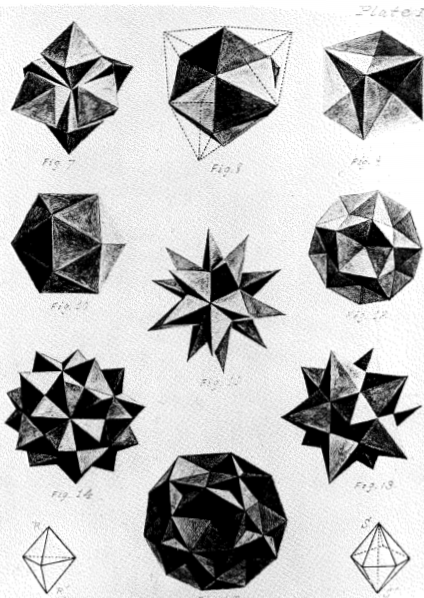
Non-Euclidean geometry is the term given to geometries which oppose Euclid's parallel postulate, that is, in opposition to the postulate: "through a given point can be drawn only one parallel to a given line." In such geometries infinitely many lines through a given point may be parallel to a given line, and similarly the sum of angles of a triangle will be less than 180 degrees. The idea of non-Euclidean geometry was first hypothesized in 1824 by Karl Gauss and more formally in 1829 by Nikolai Lobachevsky, and was further developed throughout the late 19th century and beyond. The geometry of higher dimensions (greater than three) was gradually developed in the following decades, and is far less unified in its formulation than non-Euclidean geometry. Algebraically, the notion of higher dimensional geometry is relatively straightforward: variables are simply added to the typical x, y, and z. Visualizing dimensions beyond the third, however, is much more complex. Often, properties of higher dimensions will be analogous to their more familiar counterparts: rotation about a line in the three dimensions is analogous to rotation about a plane in four dimensions, and a four dimensional hypercube is bounded by cubes just as a cube is bounded by squares. This applies to any conceivable three dimensional shape; four dimensional objects can be formed by boundaries of tetrahedrons, octahedrons, etc. Beyond these analogues, however, n-dimensional geometry was often ascribed philosophical and almost mystical properties. It was perhaps due to these strange properties that it, along with the concept of non-Euclidean geometry, became not only a scholarly but also a cultural and literary phenomenon in Europe during the late 19th century.
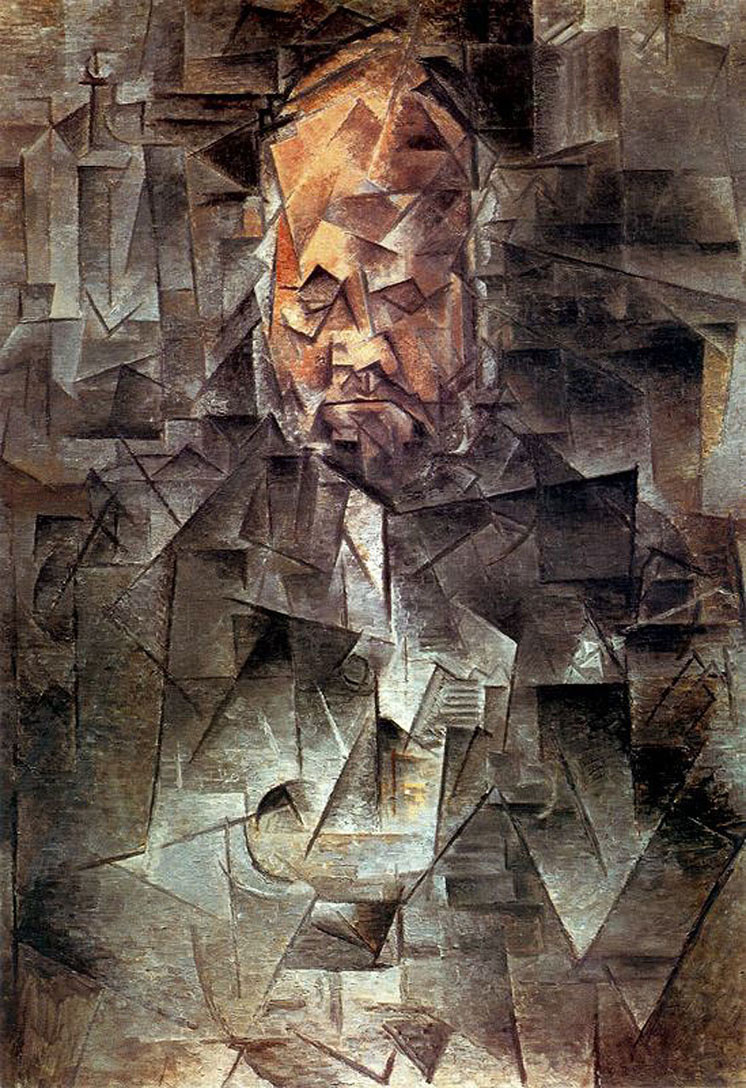
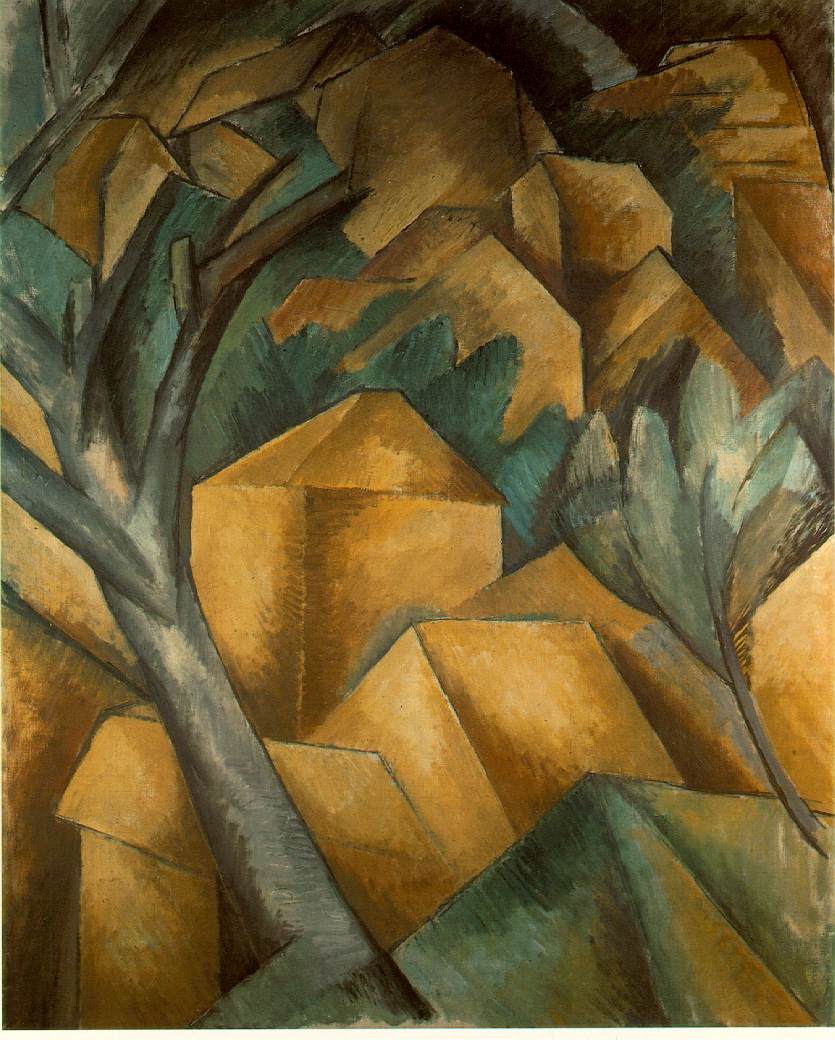
As the topics of n-dimensional and non-Euclidean geometry began to spread through the world - America and Russia in addition to Europe - certain aspects of these ideas were incorporated into artistic movements, including the then-developing Cubist theories. The "freedom" of geometries not constrained by convention or Euclid's three dimensions was particularly appealing to Cubist artists. The works of Pablo Picasso and Georges Braque, among others, exhibit elements of alternate geometries observable in several artistic movements. Farther East, Russian mathematicians and scholars wrote prolifically on the subject of non-Euclidean geometry. It was the idea of a fourth dimension, however, that caught on and spread throughout popular culture and appeared in many art forms of the Russian Avant-garde. The philosophical and mystical - in addition to mathematical - elements of a spatial fourth dimension as described by the writings of Peter Ouspensky were extremely influential to several artists and styles of this movement. Dubbed a "hyperspace philosopher," Ouspensky asserted that the concept of a fourth dimension must be approached psychologically as well as physically or geometrically. He argued that our inability to perceive dimensions above the third is a psychological barrier, that our perception of space is distorted, and that we "see everything as unlike what it really is." Ouspensky maintained that a higher spatial dimensionality is a basic characteristic of the fourth dimension, though his later descriptions suggest temporal properties as well. This spatial quality as well as the relation to human psychology and perception are perhaps the most notable aspects of the fourth dimension represented in Russian Avant-garde pieces. We can track the influence and appearance of the cultural phenomenon that is the fourth dimension as it spreads through the Russian Avant-garde: in Mikhail Larionov and Natalya Goncharova's Rayist paintings; in several of Kazimir Malevich's Futurist paintings and one of his earliest contributions to a Futurist book; in El Lissitzky's Prouns, sketches, and diagrams; and finally in various works of (unrealized) Russian fantasy architecture.
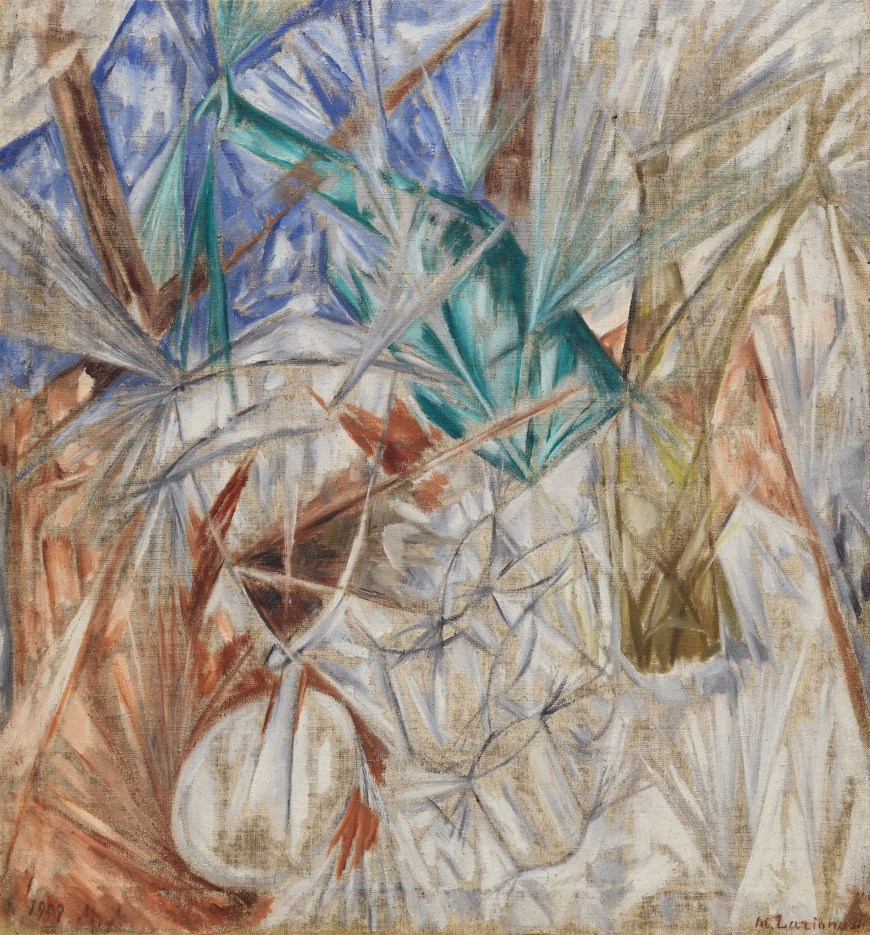
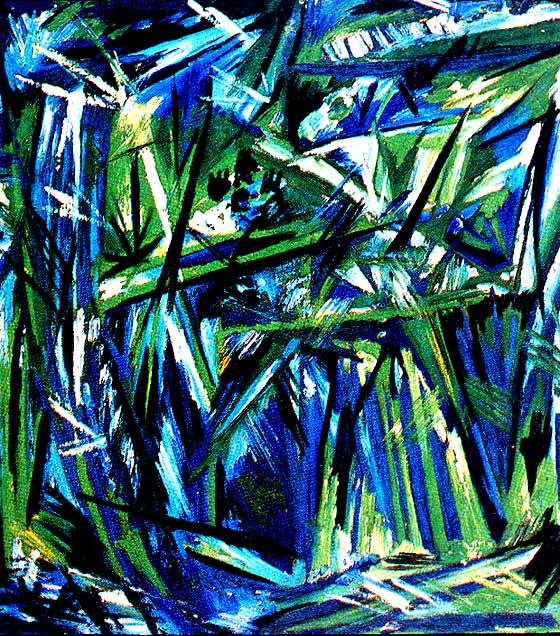
Rayism was a style of the Russian Avant-garde movement developed mainly by Larionov and Goncharova focusing on "intangible forms" and "immaterial objects" in space. These "intangible forms" were expressed in one of two ways: by light rays reflected from three dimensional objects as in Larionov's "Glass," or using general color masses and lines completely separated from concrete objects as in Goncharova's "Green and Blue Forest." The style exhibits notable parallels to the fourth dimension and in particular to the ideas of Charles Hinton - a British mathematician, science fiction author, and precursor to Ouspensky who drew upon Hinton's literature and ideas to develop many of his theories. Hinton described the process of constructing a fourth-dimensional hypercube as connecting a collection of three dimensional cubes with lines in "an unknown direction." The assemblage of these lines, he states, will constitute a solid of higher dimension. Similarly, in both Larionov's and Goncharova's pieces, the collection of rays - either emanating from an object or as a subject of their own - constitute the "intangible forms" and "immaterial objects" upon which the style is based. Rayism is obviously closely related to the geometry of the fourth dimension, and it is but one of many styles in the Russian Avant-garde with such influences.
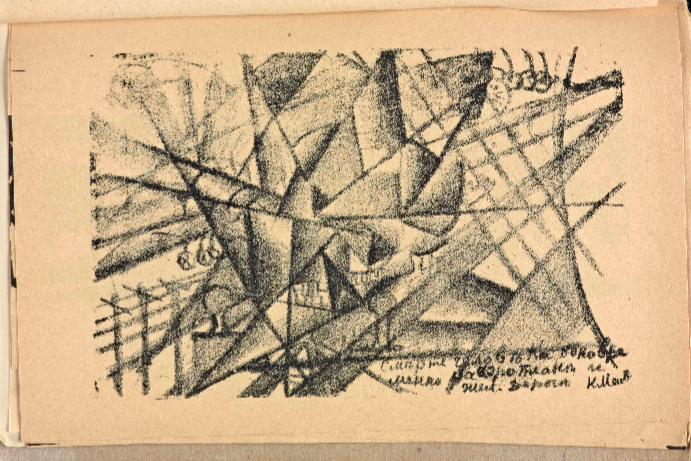
Malevich's relationship with the fourth dimension was interesting and certainly quite varied. While he was quick to abandon the physical (mathematical) elements of the fourth dimension so prominent in his earlier pieces in favor of the simpler, more abstract style of Suprematism, several of its less explicit elements can still be observed in his Suprematist writings and pieces. Malevich's aforementioned contribution to the Futurist book "Vzorval" (Explodity) is titled "Death of a man simultaneously on an airplane and the railway" and is arguably one of the artist's most apparent ventures into the fourth dimension - both physically and philosophically. The piece distinctly contradicts the artistic convention of Alberti's method for perspective; shapes are warped and fragmented with no inference of three-dimensional perspective. The scene is chaotic; bits and pieces are recognizable, but are often themselves somewhat ambiguous. Malevich's work can be thought of as a collection of simultaneous spatial realities, connected by some imperceptible higher domain which provides our viewpoint. The shattered appearance of the piece could represent an attempt of the human consciousness to perceive these three dimensional spaces and the fourth dimensional connection between them, reminiscent of Ouspensky's psychological approach to understanding the fourth dimension. The title lends itself to this interpretation with its literal meaning; there are at least two realities, one in which the man perishes on the plane and one in which he meets his fate on the railway. Additionally, in accordance the image, the title is oddly fragmented and cut short. Odnovremenno (simultaneously) is typically a single word, and zhel. doroge is an abbreviation of zheleznoi doroge (iron railway). The sketch exhibits several aesthetic similarities to Malevich's earlier oil-on-canvas paintings (in a style which he called Cubo-Futurism), which he produced directly following the publication of Ouspensky's "The Fourth Dimension" in 1909. Given Malevich's keen personal interest in the hyperspace philosopher's writings and ideas as well as the prevalence of the fourth dimension as a cultural phenomenon, his experimentation with related artistic principles between 1911 and 1914 - the budding years of the Russian Avant-garde - was to be expected.
Malevich's experimentation with the mathematical and psychological ideas of the fourth dimension took a sharp turn shortly thereafter, however, as he began to more formally develop the style of Suprematism. Perhaps the highly geometrical fragmentation of the space represented by a blank medium was still too rooted in three-dimensional convention, or perhaps Ouspensky's condemnation of the Futurists' attempts at attaining the fourth dimension in 1914 prompted some change of heart. Regardless, the divergence is clear. Malevich's journey into the simplified geometric forms of Suprematism seems to utilize a different expression of the fourth dimension, one linked to motion and color.
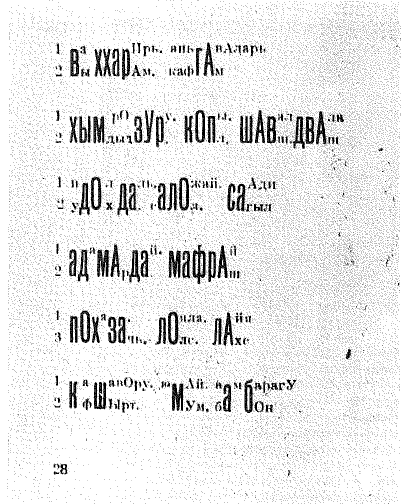
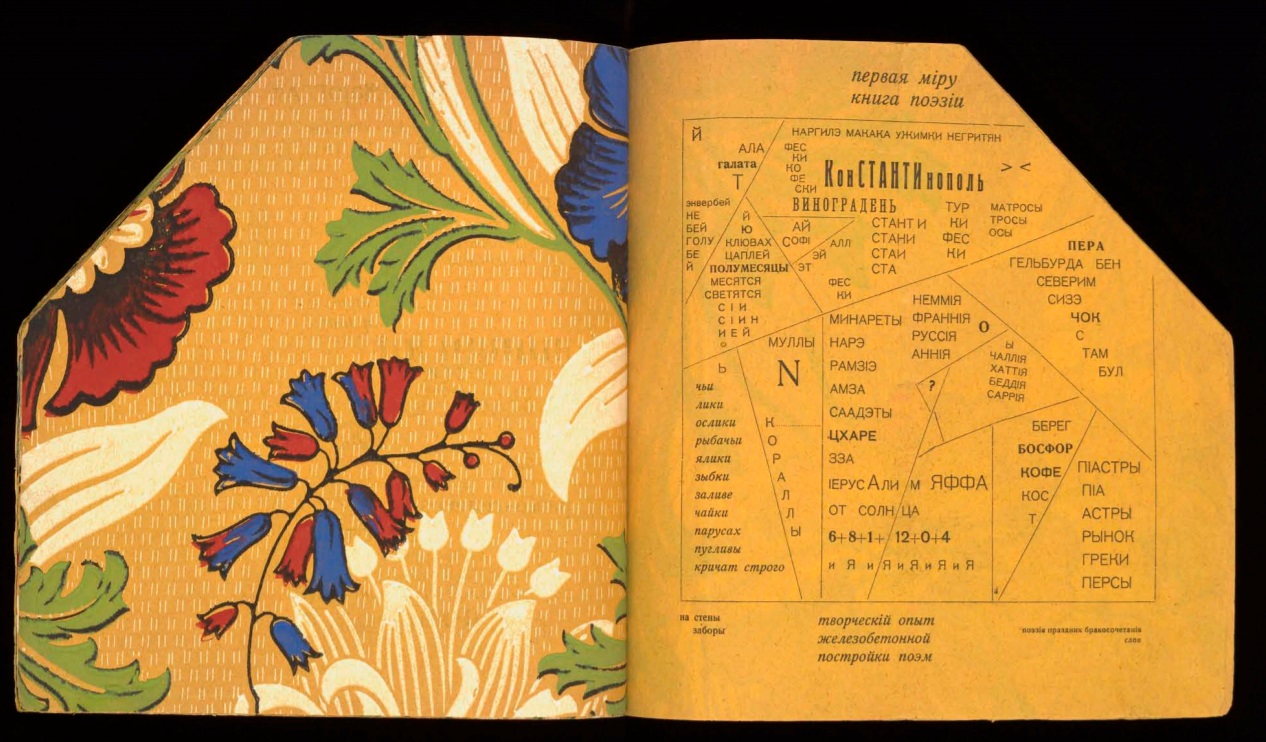
Upon examining these qualities within these early pieces of the Russian Avant-garde and similar ones in later works such as Vasily Kamensky's "Tango With Cows" and Ilia Zdanevich's "As Though Zga", it is clear that certain elements of fourth dimensionality persisted in bookmaking throughout the artistic movement. Tango With Cows exhibits qualities seen in Malevich's Futurist piece as well as qualities seen in Larionov and Goncharova's Rayist pieces. "As Though Zga" exhibits elements of simultaneity and fragmented realities seen in the fourth dimension through its countless possible readings.