All's Well That Starts Well, It Never Ends
Nina Gurianova, in The Aesthetics of Anarchy, makes a clear distinction between early Soviet Avant-garde and post-revolution avant-garde. She claims that the early avant-garde is an autonomous era with little connection to the Constructivism of the post-revolution era. This distinction is important, however, we cannot completely separate the two, even just for the reason that many key actors of both periods overlap. For example, many Constructivists were students of Malevich, and some Suprematists themselves evolved from Suprematism to Constructivism.
Anarchism, Counter-Hegemony, and the Early Russian Avant-garde 1912-1917
If it is true that Victory over the Sun was one of the main inspirations for Malevich's Suprematism, the importance of this opera can not be overstated.
- Victory over the Sun
- “The meaning of the opera has to do with the overthrow of one of the great artistic values-in this particular case, the sun … The Futurists want to free themselves from this ordered quality of the world, from the connections thought to exist in it. They want to transform the world into chaos, to smash the established values to pieces and from those pieces create new values by making new generalizations and discovering new, unexpected, and invisible connections. Take the sun-this is a former value-it therefore constrains them, and they want to overthrow it.”
- Dimensionality
- "Malevich and Kruchenykh’s intention was to manipulate spotlights from the stage projectors in order to make the backdrops look three-dimensional: ‘The ambiguity of the spatial relationship, especially in perception of depth, undoubtedly was increased by the ‘tunnel effect’ created by the receding centers of the backdrops’ … This metaphor of infinity in the opera embodies the quest to destroy the old for the sake of creating anew, which ‘inspired shock in some minds and liberated others’”
- Abstraction
- “The next step in the development of this painterly construction is the transformation of the ‘anatomical structures’ of things into abstract shapes”
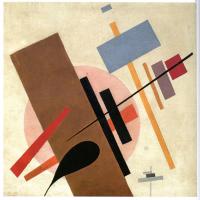
- Suprematism
The connection between circles and zaum can be seen in the fact that zaum is an abstraction of language.
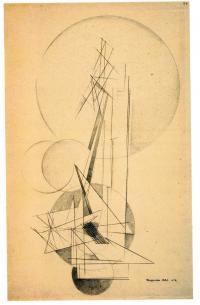
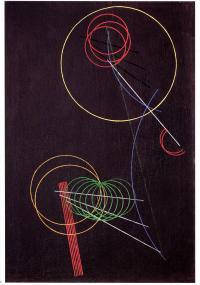
Shklovsky claims that "transrational language is a language of pre-inspiration, the rustling chaos of poetry, pre-book, pre-word chaos out of which everything is born and into which everything disappears.” This notion is reminiscent of the circle as a hole which distorts dimensionality, into which things are able to fall. The chaos of being born and then disappearing is a cycle which can thus be represented by the circle.
- Abstraction in language
- Futurist book a paradox
- “A Futurist book became a true paradox: a material form to capture chaotic flux, immediacy, spontaneity -- all the immaterial, ephemeral elements of life.”
Constructivism and Marxist Hegemony 1918-1925
- “The anarchic nihilism of alogism yielded to a quest for the assertion of the universal.”
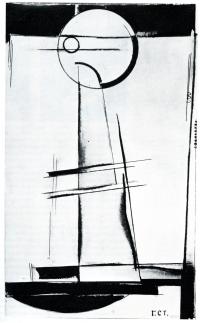
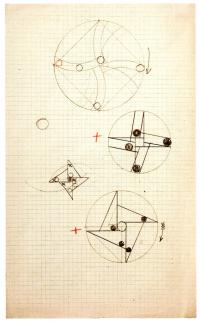
- Mechanical circles
- Rodchenko
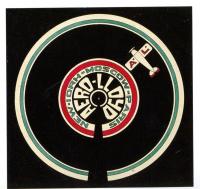
- Circles as propaganda
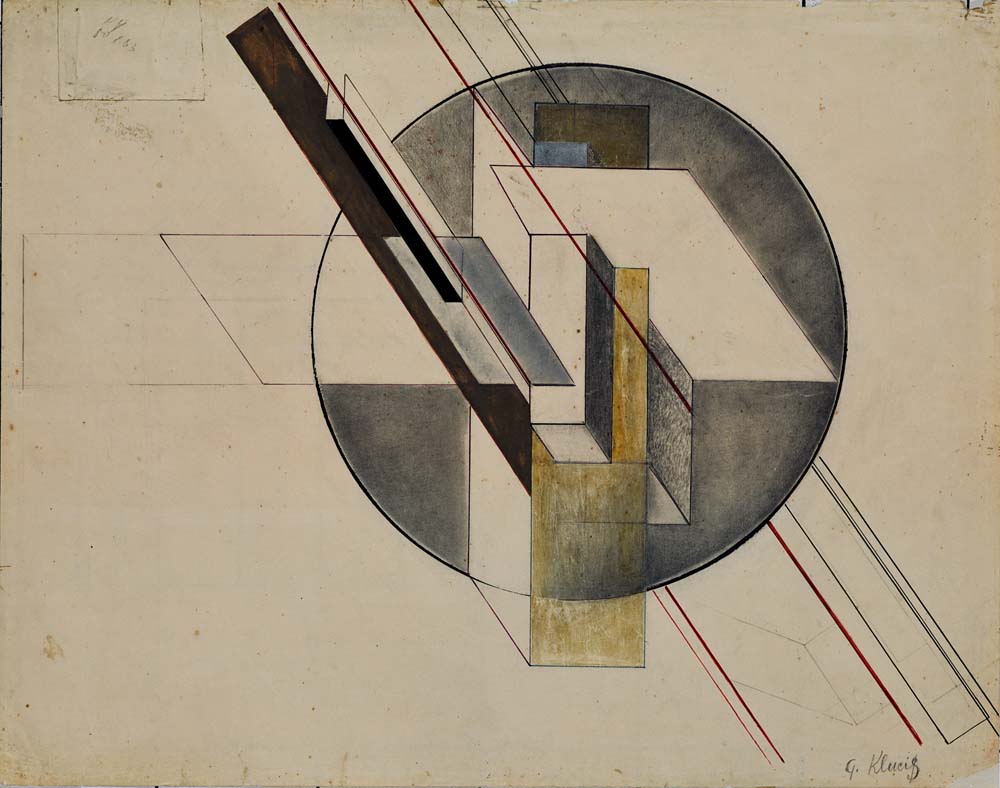
- Klutsis and Lissitzky
Conclusion
A rapidly changing world, a world constantly in chaos and in flux, will never stay the same for long. What was once counter-hegemonic may rapidly transform into a new hegemony. The circle, not just a tool for subverting dimensionality or an example of the mechanical nature of Constructivism, is a symbol of the cyclical nature of the world we live in.
Vesnin
Stenberg
Klutsis
Klutsis
Malevich
Rodchenko
Rodchenko
Rodchenko
Rodchenko
Rodchenko
This page has paths:
- The Big Bang Theory Evan Sarafian