Thanks for your patience during our recent outage at scalar.usc.edu. While Scalar content is loading normally now, saving is still slow, and Scalar's 'additional metadata' features have been disabled, which may interfere with features like timelines and maps that depend on metadata. This also means that saving a page or media item will remove its additional metadata. If this occurs, you can use the 'All versions' link at the bottom of the page to restore the earlier version. We are continuing to troubleshoot, and will provide further updates as needed. Note that this only affects Scalar projects at scalar.usc.edu, and not those hosted elsewhere.
Creative Practice as Research: Discourse on MethodologyMain MenuContentsIntroductionThe Practitioner Model of Creative Cognition: A Potential Model for Creative Practice-Based ResearchModel research methods relevant for creative practice-based research projectsApplication of the Practitioner Model of Creative CognitionCommunity Discourse: Your Practice Research ModelsResources for Conducting and Teaching Practice-Based ResearchAbout the AuthorLyle Skains8ec9a01530aed114a2d78c359a32a6560b8c2714The Disrupted Journal of Media Practice
Practice-Based Research
12016-01-14T11:59:22-08:00Lyle Skains8ec9a01530aed114a2d78c359a32a6560b8c271477036plain2016-01-16T18:36:33-08:00Lyle Skains8ec9a01530aed114a2d78c359a32a6560b8c2714Practice-based research (also called practice-led research, or practice-as-research) is an umbrella method incorporating many different approaches. What these approaches all have in common is that the practice of creating a work of literature or art is intended to inform the research. In other words, the creative practice is how the researcher gathers data.
Practice-based research can be applied to questions about the creative act itself, or the creative artefact. The researcher conducts the creative practice in order to examine how it is done, or how certain methods or approaches affect the creative process. This examination can be done using various techniques, including observation and records of activities while they occur (such as research logs), and reflective analysis. S/he may also apply textual analysis to the final artefact, as this can give greater understanding into the choices made in creating the text, as well as show how the “experiment” affected the creative work.
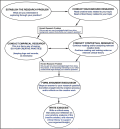
Below is a diagram offering a guide to conducting practice-based research, and some details on the various steps.