This site requires Javascript to be turned on. Please enable Javascript and reload the page.
Thanks for your patience during our recent outage at scalar.usc.edu. While Scalar content is loading normally now, saving is still slow, and Scalar's 'additional metadata' features have been disabled, which may interfere with features like timelines and maps that depend on metadata. This also means that saving a page or media item will remove its additional metadata. If this occurs, you can use the 'All versions' link at the bottom of the page to restore the earlier version. We are continuing to troubleshoot, and will provide further updates as needed. Note that this only affects Scalar projects at scalar.usc.edu, and not those hosted elsewhere.
100 Years of the Women's Vote
Main Menu
Jenn Brandt
ca8b9ff85976cc2eb08bae779aeef1e3713ced6c
The Suffrage Movement
1
2020-06-26T10:41:58-07:00
Jenn Brandt
ca8b9ff85976cc2eb08bae779aeef1e3713ced6c
37593
21
timeline
2020-07-07T15:41:17-07:00
Jenn Brandt
ca8b9ff85976cc2eb08bae779aeef1e3713ced6c
The Women's Suffrage Movement advocated for women to win the right to vote, along with broad-based economic and political equality for social reforms. The fight was not easy. The Declaration of Independence (1776) declared "all men to be equal," but this equality only extended to white male landowners of European ancestry. This excluded poor men who did not own land, as well as women and children. Black and Indigenous people were unjustly denied citizenship altogether. In 1787, the U.S. Constitutional Convention placed voting rights in the hands of individual states. For a short period of time, the state of New Jersey allowed “all free inhabitants” including women, the right to vote, but revoked the right in 1807. It was not until 1838 that Kentucky passed the first suffrage law, which allowed women who were "heads of households" to vote in local tax and school board elections. In 1848 Elizabeth Cady Stanton and Lucretia Mott, among others, organized the first women’s right’s convention. The Seneca Falls Convention, held July 19 – 20 in Seneca Falls, NY, drew a crowd of close to three hundred attendees to publicly discuss the social, civil, and religious conditions and rights of women. The first day’s attendance was limited to women, with men invited to attend on the second day. Mott and Stanton had traveled to London in 1840 to participate in the World’s Anti-Slavery Convention, only to be barred from speaking based on their gender. The two, while both still committed to the abolition movement, began to also organize and advocate for women’s rights upon their return to the United States. At the Seneca Falls Convention Stanton gave her now-famous speech “The Declaration of Sentiments.” Modeled after the “Declaration of Independence,” the document urged the abandonment of unjust laws that discriminated against women, although it should be noted that there was no mention of those women who were enslaved nor Indigenous women, whose rights were continually violated. After discussing and debating the sentiments, Stanton put forth eleven resolutions. The ninth, which was the most controversial, stated, “That it is the duty of the women of this country to secure to themselves their sacred right to the elective franchise.” After much debate, the sentiments and resolutions were signed by 68 women and 32 men, “officially” setting off the suffrage movement.
This page has paths:
1
media/Suffrage Parade Wagon Sign.jpg
2020-06-23T16:41:26-07:00
Jenn Brandt
ca8b9ff85976cc2eb08bae779aeef1e3713ced6c
100 Years of the Women's Vote
Jenn Brandt
10
splash
2020-07-01T21:38:17-07:00
Jenn Brandt
ca8b9ff85976cc2eb08bae779aeef1e3713ced6c
Contents of this path:
1
media/100yrsWomensVote013_small.jpg
2020-06-23T17:15:37-07:00
Exhibit Overview
33
gallery
1006150
2020-07-08T12:50:03-07:00
1
2020-06-26T10:41:58-07:00
The Suffrage Movement
21
timeline
2020-07-07T15:41:17-07:00
1
media/Case1Drawer1.jpg
2020-06-26T16:17:28-07:00
Women's Roles in the 19th Century
32
image_header
2020-07-07T15:51:06-07:00
1
media/WorkingWomen.jpg
2020-06-29T12:59:07-07:00
Labor Rights
6
image_header
2020-06-29T13:47:56-07:00
1
media/Case1Drawer2.jpg
2020-06-26T16:52:12-07:00
Paths to Voting Rights
19
image_header
2020-07-13T10:35:54-07:00
1
media/SuffrageProcession.jpg
2020-06-29T12:26:51-07:00
1913 Woman Suffrage Procession
14
image_header
2020-07-01T10:21:29-07:00
1
2020-06-29T22:29:14-07:00
The 19th Amendment
14
plain
2020-07-01T10:23:33-07:00
1
media/ThePersonalIsPolitcal.jpg
2020-07-01T11:16:48-07:00
The Personal is Political
22
image_header
2020-07-08T13:17:27-07:00
1
media/LasChicanasBWL.jpeg
2020-07-01T13:11:24-07:00
The Need for Intersectionality
24
gallery
2020-07-08T13:18:27-07:00
1
media/WMS 100 Posters.jpg
2020-07-01T14:55:46-07:00
The Fight For Justice Continues
69
image_header
2020-07-08T13:32:50-07:00
1
media/Credits.jpg
2020-07-01T21:06:00-07:00
Thank you for visiting.
24
Zine Created for the "100 Year of the Women's Vote" Exhibit featuring work from students in WMS 320: Feminist Principles (Fall 2019) and WMS 100: Gender, Sex, the Body & Politics (Fall 2019)
gallery
2020-07-08T18:39:59-07:00
Contents of this tag:
1
media/DeclarationOfSentiments_thumb.jpg
2020-06-26T11:06:07-07:00
Jenn Brandt
ca8b9ff85976cc2eb08bae779aeef1e3713ced6c
Declaration of Sentiments
9
The first women’s rights convention, the Seneca Falls Convention, is held in Seneca Falls, New York on July 19 - 20, 1848. Attended by approximately 300 people, the convention was limited to women the first day, with men invited for the second. Elizabeth Cady Stanton delivered her “Declaration of Sentiments,” which was followed by eleven resolutions. The ninth argued “That it is the duty of the women of this country to secure to themselves their sacred right to the elective franchise,” thus setting off the women's suffrage movement.
media/DeclarationOfSentiments.jpg
plain
2020-06-26T16:07:00-07:00
Jenn Brandt
ca8b9ff85976cc2eb08bae779aeef1e3713ced6c
1
media/SuffrageProcession_thumb.jpg
2020-06-26T11:33:34-07:00
Jenn Brandt
ca8b9ff85976cc2eb08bae779aeef1e3713ced6c
Suffrage Procession
5
The Woman Suffrage Procession was the first large, organized march on Washington for political purposes.
media/SuffrageProcession.jpg
plain
2020-07-08T12:53:07-07:00
Jenn Brandt
ca8b9ff85976cc2eb08bae779aeef1e3713ced6c
1
media/19th Amendment_thumb.jpg
2020-06-26T11:34:00-07:00
Jenn Brandt
ca8b9ff85976cc2eb08bae779aeef1e3713ced6c
19th Amendment
5
The 19th Amendment was passed by Congress on June 4, 1919, and ratified on August 18, 1920, stating, “The right of citizens of the United States to vote shall not be denied or abridged by the United States or by any state on account of sex. Congress shall have power to enforce this article by appropriate legislation.”
media/19th Amendment.jpg
plain
2020-06-26T12:04:26-07:00
Jenn Brandt
ca8b9ff85976cc2eb08bae779aeef1e3713ced6c
1
media/WomansJournal_thumb.png
2020-06-26T11:29:08-07:00
Jenn Brandt
ca8b9ff85976cc2eb08bae779aeef1e3713ced6c
The Woman's Journal
5
The Woman’s Journal is founded and edited by Mary Livermore, Lucy Stone, and Henry Blackwell in 1870. This became the official paper of the National American Woman Suffrage Association, refusing to carry ads for liquor or tobacco.
media/WomansJournal.png
plain
2020-06-27T11:31:26-07:00
Jenn Brandt
ca8b9ff85976cc2eb08bae779aeef1e3713ced6c
1
media/SojournerTruth_thumb.jpg
2020-06-26T11:09:31-07:00
Jenn Brandt
ca8b9ff85976cc2eb08bae779aeef1e3713ced6c
Sojourner Truth
4
At the 1851 Women’s Rights Convention in Akron, OH abolishonist and women’s rights advocate Sojourner Truth gives her famous “Ain’t I a Woman?” speech.
media/SojournerTruth.jpg
plain
2020-06-27T11:29:38-07:00
Jenn Brandt
ca8b9ff85976cc2eb08bae779aeef1e3713ced6c
1
media/NationalAmericanWomanSuffrageAssociation_thumb.jpg
2020-06-26T11:31:30-07:00
Jenn Brandt
ca8b9ff85976cc2eb08bae779aeef1e3713ced6c
National American Woman Suffrage Association
3
The National Woman Suffrage Association (NWSA) and the American Woman Suffrage Association (AWSA) merged to form the National American Woman Suffrage Association in 1890.
media/NationalAmericanWomanSuffrageAssociation.jpg
plain
2020-06-26T12:11:05-07:00
Jenn Brandt
ca8b9ff85976cc2eb08bae779aeef1e3713ced6c
1
media/TheRevolution_thumb.jpg
2020-06-26T11:28:37-07:00
Jenn Brandt
ca8b9ff85976cc2eb08bae779aeef1e3713ced6c
The Revolution
3
Elizabeth Cady Stanton and Susan B. Anthony publish the first edition of The Revolution with the motto: “Men, their rights and nothing more; women, their rights and nothing less!”
media/TheRevolution.jpg
plain
2020-06-26T12:15:39-07:00
Jenn Brandt
ca8b9ff85976cc2eb08bae779aeef1e3713ced6c
1
media/SuffrageMap_thumb.gif
2020-06-26T11:33:11-07:00
Jenn Brandt
ca8b9ff85976cc2eb08bae779aeef1e3713ced6c
Suffrage Map
3
Women's Suffrage is achieved in California in 1911.
media/SuffrageMap.gif
plain
2020-06-26T12:17:32-07:00
Jenn Brandt
ca8b9ff85976cc2eb08bae779aeef1e3713ced6c
1
media/VotingRightsAct_thumb.jpg
2020-06-26T11:34:30-07:00
Jenn Brandt
ca8b9ff85976cc2eb08bae779aeef1e3713ced6c
Voting Rights Act of 1965
3
President Lyndon Johnson signs the Voting Rights Act of 1965 into law: “No voting qualification or prerequisite to voting, or standard, practice, or procedure shall be imposed or applied by any State or political subdivision to deny or abridge the right of any citizen of the United States to vote on account of race or color.”
media/VotingRightsAct.jpg
plain
2020-06-26T12:18:41-07:00
Jenn Brandt
ca8b9ff85976cc2eb08bae779aeef1e3713ced6c
1
media/MaryChurchTerrell_thumb.jpg
2020-06-26T11:32:42-07:00
Jenn Brandt
ca8b9ff85976cc2eb08bae779aeef1e3713ced6c
Mary Church Terrell
3
Mary Church Terrell, Ida B. Wells-Barnett, and Frances E.W. Harper were among the founders of the National Association of Colored Women’s Clubs in 1896.
media/MaryChurchTerrell.jpg
plain
2020-06-26T12:09:16-07:00
Jenn Brandt
ca8b9ff85976cc2eb08bae779aeef1e3713ced6c
This page has replies:
1
media/Credits.jpg
2020-07-01T21:06:00-07:00
Jenn Brandt
ca8b9ff85976cc2eb08bae779aeef1e3713ced6c
Thank you for visiting.
Jenn Brandt
24
Zine Created for the "100 Year of the Women's Vote" Exhibit featuring work from students in WMS 320: Feminist Principles (Fall 2019) and WMS 100: Gender, Sex, the Body & Politics (Fall 2019)
gallery
2020-07-08T18:39:59-07:00
This online exhibit was created in collaboration with CSUDH's Women's Studies Program, CSUDH's Donald R. & Beverly J. Gerth Archives and Special Collections, and California Humanities. Online Exhibition Curator : Jenn Brandt, Associate Professor of Women's Studies, CSUDH with assistance from Beth McDonald, Archivist, Gerth Archives and Special CollectionsPhysical Exhibition Curators : Jenn Brandt, Associate Professor of Women's Studies, and Greg Williams, Director, Gerth Archives & Special CollectionsExhibition Designer : Itzel Marin, CSUDH Class of 2020Exhibition Sources at CSUDH Gerth Archives Homepagehttps://libguides.csudh.edu/archives-home Gerth Archives Primary Source Materials Women’s Suffrage Movement Materials Collectionhttps://oac.cdlib.org/findaid/ark:/13030/c84j0mn7/ Vivian Price Collectionshttps://oac.cdlib.org/findaid/ark:/13030/kt838nf3rf/ Anti-Suffrage Movement Collectionhttps://oac.cdlib.org/findaid/ark:/13030/c85q52zk/ LGBTQ Publications Collectionshttps://oac.cdlib.org/findaid/ark:/13030/c8hq45dc/ Women at Work Collectionhttps://oac.cdlib.org/findaid/ark:/13030/c8v98g23/ Tradeswomen Lib Guidehttps://libguides.csudh.edu/tradeswomen-labor As we approach the 2020 U.S. Presidential Election, we want to hear from you on what political concerns are most pressing in your community. Please leave a comment by clicking on the speech bubble at the bottom of the page. Thank you for visiting.
Jenn Brandt
ca8b9ff85976cc2eb08bae779aeef1e3713ced6c
Contents of this reply:
1
media/Suffrage Parade Wagon Sign.jpg
2020-06-23T16:41:26-07:00
100 Years of the Women's Vote
10
splash
2020-07-01T21:38:17-07:00
1
media/Credits.jpg
2020-07-01T21:06:00-07:00
Thank you for visiting.
24
Zine Created for the "100 Year of the Women's Vote" Exhibit featuring work from students in WMS 320: Feminist Principles (Fall 2019) and WMS 100: Gender, Sex, the Body & Politics (Fall 2019)
gallery
2020-07-08T18:39:59-07:00
This online exhibit was created in collaboration with CSUDH's Women's Studies Program, CSUDH's Donald R. & Beverly J. Gerth Archives and Special Collections, and California Humanities. Online Exhibition Curator : Jenn Brandt, Associate Professor of Women's Studies, CSUDH with assistance from Beth McDonald, Archivist, Gerth Archives and Special CollectionsPhysical Exhibition Curators : Jenn Brandt, Associate Professor of Women's Studies, and Greg Williams, Director, Gerth Archives & Special CollectionsExhibition Designer : Itzel Marin, CSUDH Class of 2020Exhibition Sources at CSUDH Gerth Archives Homepagehttps://libguides.csudh.edu/archives-home Gerth Archives Primary Source Materials Women’s Suffrage Movement Materials Collectionhttps://oac.cdlib.org/findaid/ark:/13030/c84j0mn7/ Vivian Price Collectionshttps://oac.cdlib.org/findaid/ark:/13030/kt838nf3rf/ Anti-Suffrage Movement Collectionhttps://oac.cdlib.org/findaid/ark:/13030/c85q52zk/ LGBTQ Publications Collectionshttps://oac.cdlib.org/findaid/ark:/13030/c8hq45dc/ Women at Work Collectionhttps://oac.cdlib.org/findaid/ark:/13030/c8v98g23/ Tradeswomen Lib Guidehttps://libguides.csudh.edu/tradeswomen-labor As we approach the 2020 U.S. Presidential Election, we want to hear from you on what political concerns are most pressing in your community. Please leave a comment by clicking on the speech bubble at the bottom of the page. Thank you for visiting.
1
media/Case1Drawer2.jpg
2020-06-26T16:52:12-07:00
Paths to Voting Rights
19
image_header
2020-07-13T10:35:54-07:00
Conflict over the Fifteen Amendment, which granted voting rights to all men regardless of their race, caused a rift in the suffragist movement, with its effects still felt today. Suffragists such as Lucy Stone and Julia Ward Howe were happy that at least one disenfranchised group would now have the right to vote, hoping it would pave the way for women's suffrage. These suffragists, who went on to form the American Woman Suffrage Association, believed in a state-by-state approach to gaining the women's vote. Others, such as Elizabeth Cady Stanton and Susan B. Anthony, were against the Fourteenth and Fifteenth Amendment because they did not explicitly include women. They formed the National Woman Suffrage Association and pushed for a constitutional amendment that would grant all women the right to vote. These groups would combine to form the National American Woman Suffrage Association in 1890, favoring a state-by-state initiative for women’s suffrage until there was enough momentum and support for a constitutional amendment. Eventually the National Woman’s Party, led by Alice Paul and Lucy Burns, leaders of the Woman Suffrage Procession of 1913, would splinter from the NAWSA, arguing for more radical approaches such as political marches and organizing the “Silent Sentinels” to demonstrate outside the White House for a constitutional amendment.
1
media/100yrsWomensVote013_small.jpg
2020-06-23T17:15:37-07:00
Exhibit Overview
33
gallery
1006150
2020-07-08T12:50:03-07:00
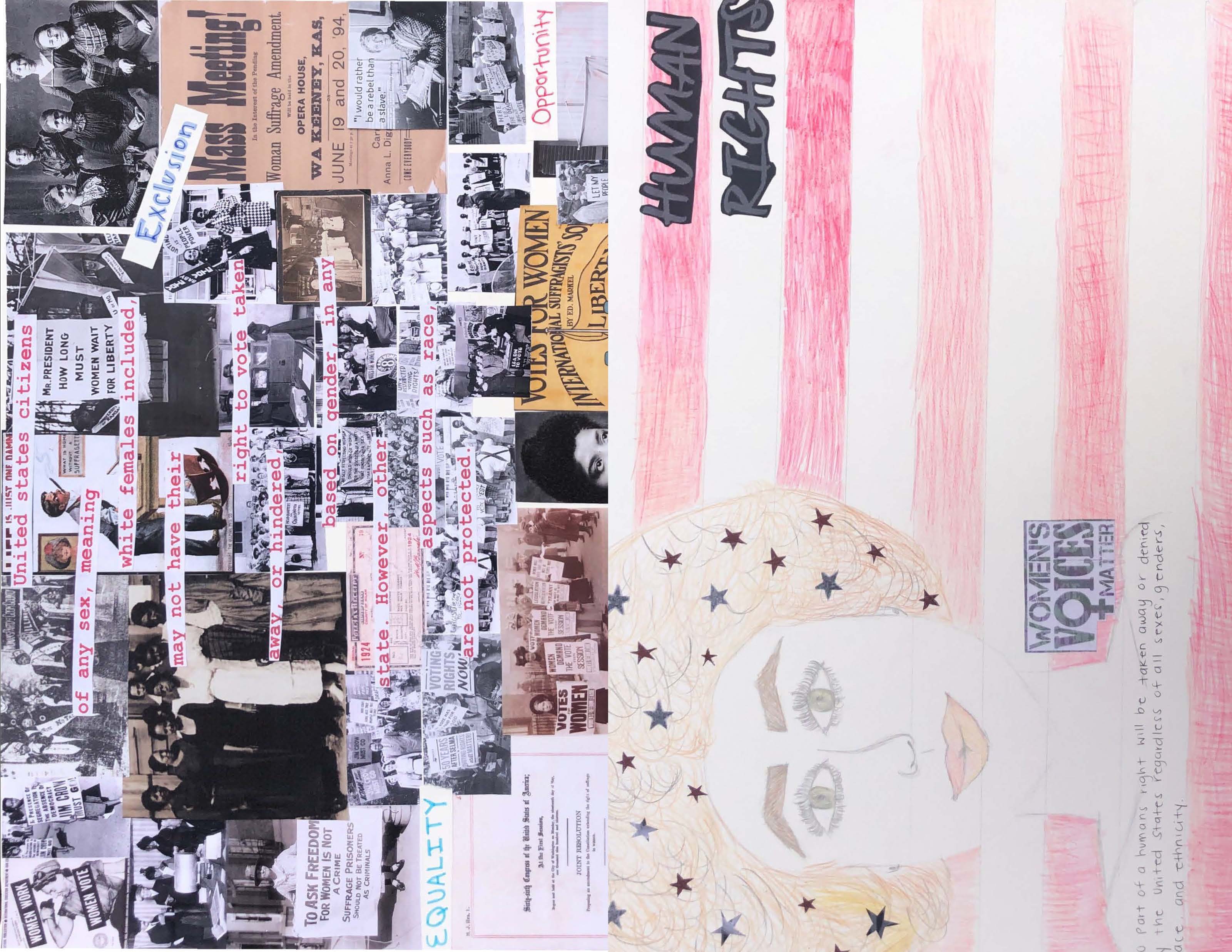
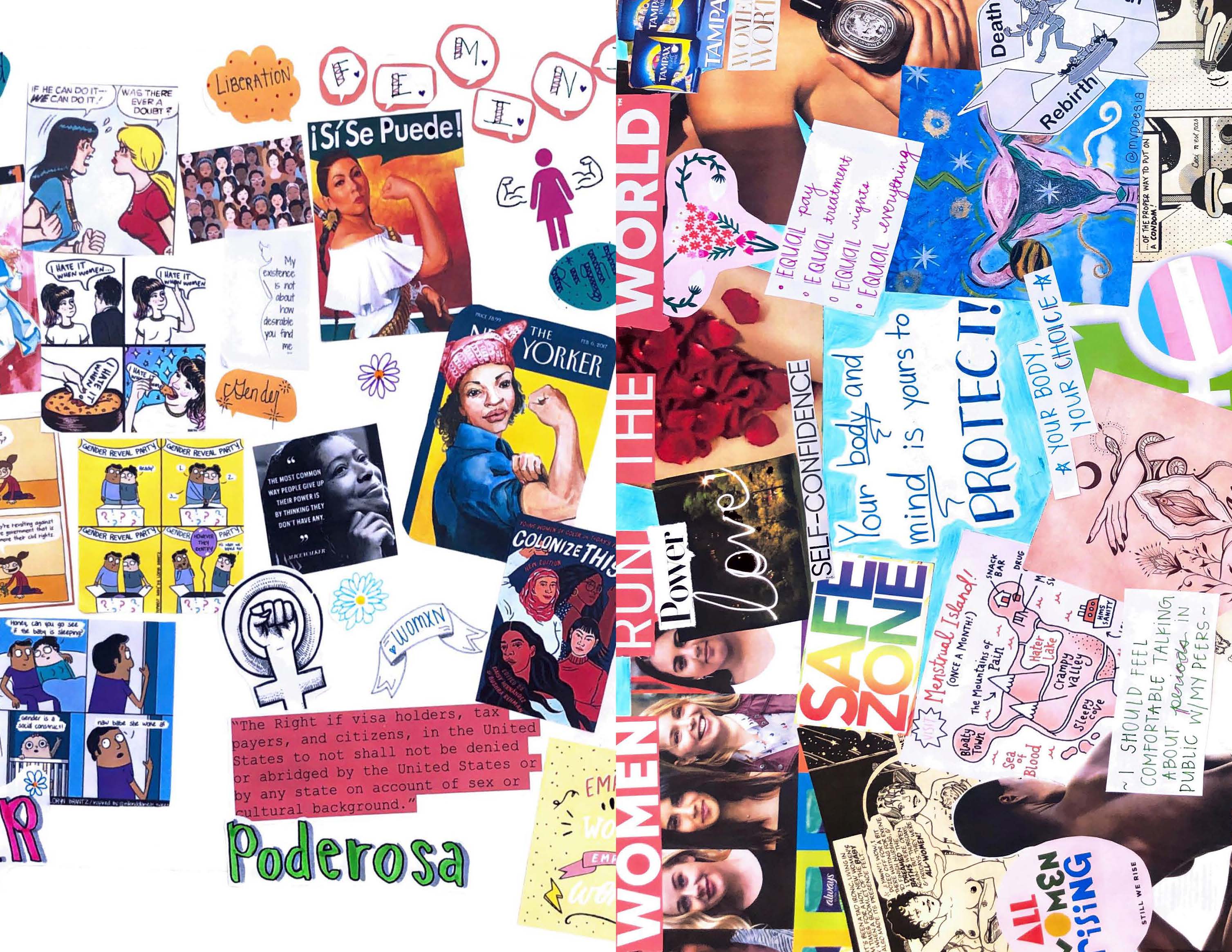
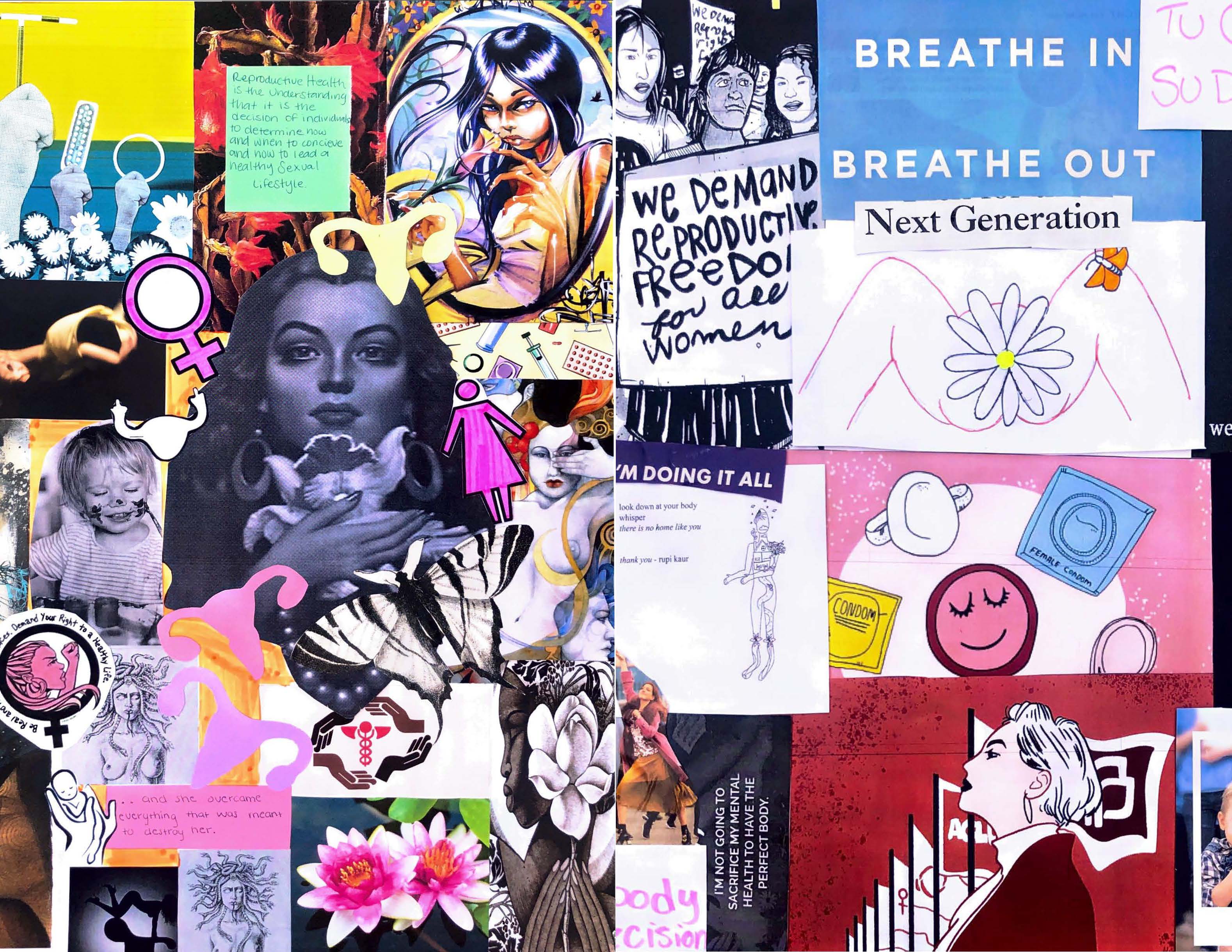
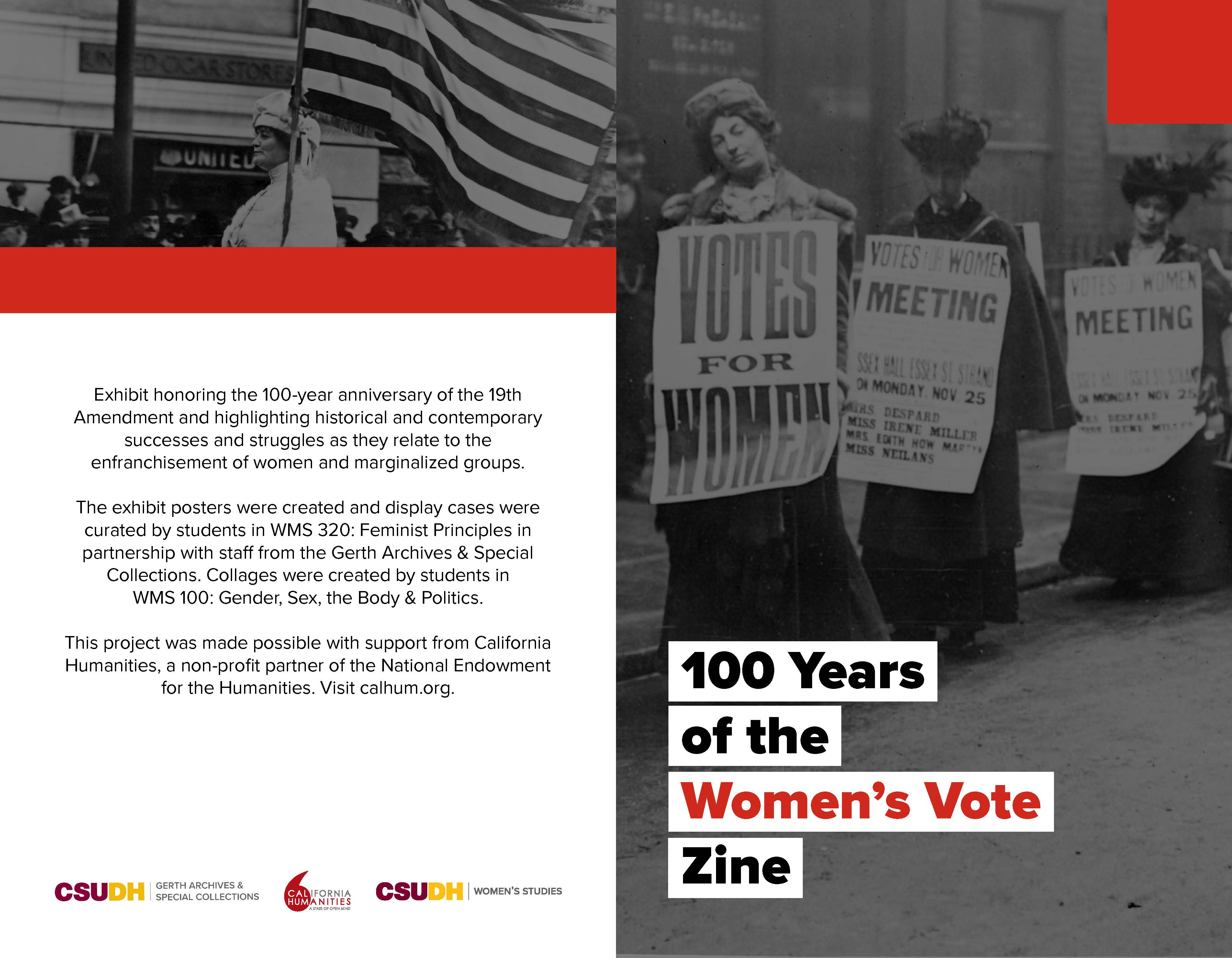
This exhibit honors the 100-year anniversary of the 19th Amendment, highlighting historical and contemporary successes and struggles as they relate to the enfranchisement of women and marginalized groups. In the fall of 2019, students in WMS 320: Feminist Principles spent the semester studying women's movements on a local, national, and global level. Working with staff from the CSUDH Donald R. & Beverly J. Gerth Archives & Special Collections, students collected information, materials, and images to create posters and display cases related to the Suffrage Movement and women's political participation over the past 100 years. Students also researched and interviewed local organizations and individuals in order to highlight contemporary women and women’s issues that are relevant to our current political moment and the continued fight for women’s rights. The final project culminated in the posters, display cases, and zine that are featured in this online exhibit. Students in WMS 100: Gender, Sex, the Body & Politics also contributed to the creation of the posters on contemporary women's issues, as well as art images for the exhibit's zine. This project was made possible with support from California Humanities, a non-profit partner of the National Endowment for the Humanities. Visit calhum.org .
1
media/WorkingWomen.jpg
2020-06-29T12:59:07-07:00
Labor Rights
6
image_header
2020-06-29T13:47:56-07:00
Many poor, working class, and immigrant women found employment in factories at the turn of the century. In addition to not being paid equally to their male counterpoints, they faced other injustices such as 12- and 16- hour shifts, little to no breaks, and were often locked in the factories until their work days were over. On March 25, 1911, the Triangle Shirtwaist Company factory caught on fire, killing 145 workers trapped inside the burning building. Women either jumped to their death or were burned alive; within 18 minutes, most of the workers were dead. The majority of victims were young Jewish and Italian immigrant women whose death could have been prevented. Only one of the building’s four elevators worked, with the working elevator unreachable; one of the stairway doors was locked, the other opened inward making it nearly inaccessible; and the fire escape was too narrow to accommodate the number of workers. The tragedy helped unite organized labor movements and shed light on the harsh working conditions women and other factory workers faced.
1
media/SuffrageProcession.jpg
2020-06-29T12:26:51-07:00
1913 Woman Suffrage Procession
14
image_header
2020-07-01T10:21:29-07:00
In the second decade of the 20th century, suffragists began staging large and dramatic parades to draw attention to their cause. One of the largest demonstrations was a march held in Washington, DC, on March 3, 1913. The date of the march was strategically selected to occur the day before Woodrow Wilson's first presidential inauguration. More than 5,000 suffragists from around the country paraded down Pennsylvania Avenue from the U.S. Capitol to the Treasury Building. The Woman Suffrage Procession was the first large, organized march on Washington for political purposes and was organized by Alice Paul and Lucy Burns, leaders of the National American Woman Suffrage Association (NAWSA). The Procession set a precedent for future protest marches, but was not without controversy. According to the NAWSA, all women and men were welcome to march. Facing pressure, however, Paul attempted to exclude black women from participating because she feared white women would not march alongside them. Ultimately Paul allowed women of color to join the procession at the rear. Some women of color -- such as anti-lynching activist Ida B. Wells-Barnett and lawyer Marie Louise Bottineau Baldwin, a member of the Turtle Mountain Band of Chippewa Indians -- blocked the attempt to racially segregate the parade by walking alongside white women. Both supporters and anti-suffrage groups came out to watch the parade. During the Procession, local police failed to keep the crowds off the street, who began to block the marchers and hinder their progress. Although the Procession drew a number of supporters, the marchers were also subjected to heckling from spectators. As tensions mounted, riots broke out, with over 200 people eventually treated for injuries. Citizens and on-lookers tried to break up the riots, and eventually the cavalry was called in. Due to their failure to properly secure the parade route and control the crowds, local police later faced a congressional inquiry as a result of their mismanagement of the event. As a result of the 1913 Woman Suffrage Procession, smaller, regional parades took place around the country. In 1917, Paul and other women from the National Women's Party began to regularly stand in protest in front of the White House. Known as the "Silent Sentinels," they stood outside the White House six days a week, silently protesting. The first group to ever protest in front of the White House, nearly 2,000 women participated over a two-year period. Hundreds of women were arrested, with some even beaten, jailed, and subject to other injustices by U.S. authorities.
1
2020-06-29T22:29:14-07:00
The 19th Amendment
14
plain
2020-07-01T10:23:33-07:00
The American Woman Suffrage Association and the National Woman Suffrage Association combined to form the National American Woman Suffrage Association (NAWSA) in 1890, favoring a state-by-state initiative for women's suffrage until there was enough momentum and support for a constitutional amendment. Eventually the National Woman's Party, led by Alice Paul and Lucy Burns, leaders of the Woman Suffrage Procession of 1913, would splinter from the NAWSA, arguing for more radical approaches such as political marches and organizing the "Silent Sentinels" to demonstrate outside the White House for a constitutional amendment. The "Night of Terror" The "Silent Sentinels" began to silently picket outside of the White House on January 10, 1917. Holding signs such as "Mr. President How Long Must Women Wait for Liberty," various women were arrested for their protests. On November 15, 1917, the warden at the Occoquan Workhouse in Virginia ordered his guards to "teach a lesson" to the suffragists imprisoned because of their persistence in picketing outside of the White House. Lucy Burns was beaten by police and chained to her cell bars overnight, while Dora Lewis's skull was damaged when she was shoved into a dark cell. Alice Paul went on a hunger strike over the women's treatment, causing prison guards to force-feed her through her nostrils and threaten to have her institutionalized as mentally unfit. Eventually word of these abuses, referred to as the "Night of Terror," reached the general public, swaying public opinion in the suffragists' favor. The 19th Amendment When the United States entered World War I, there was concern in the movement about the momentum they had been gaining. Their support and efforts during the war, however, advanced the suffragists' arguments, and proved that women were just as patriotic and deserving of the full rights of citizenship as men. While President Woodrow Wilson was initially against the women's vote, he was ultimately moved to support the cause. Finally, the 19th Amendment was passed by Congress on June 4, 1919, and ratified on August 18, 1920, stating: “The right of citizens of the United States to vote shall not be denied or abridged by the United States or by any state on account of sex." Although she did not live to see it pass, the 19th Amendment is often referred to as the "Susan B. Anthony Amendment" in her honor.
1
media/LasChicanasBWL.jpeg
2020-07-01T13:11:24-07:00
The Need for Intersectionality
24
gallery
2020-07-08T13:18:27-07:00
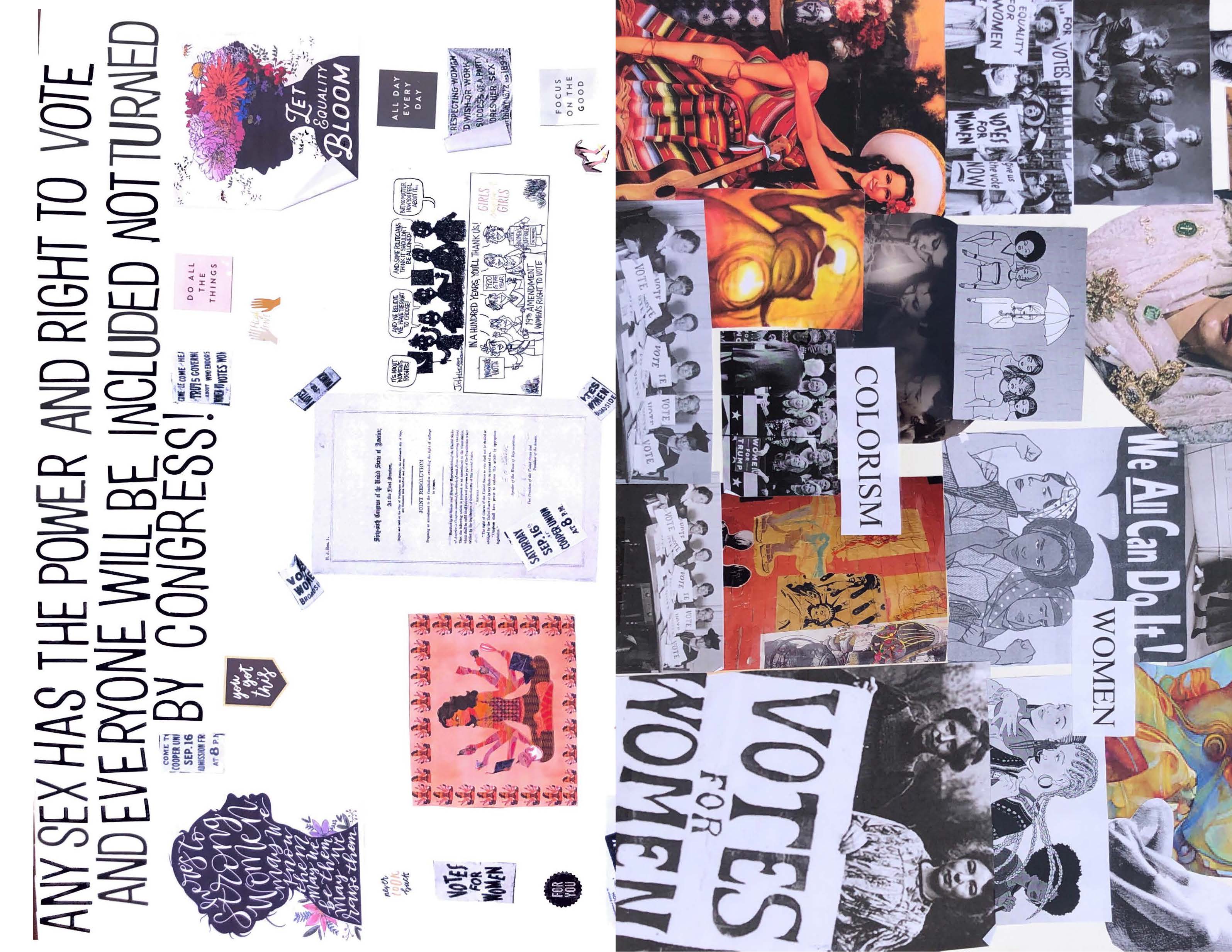
Racial tensions in the second wave of feminism echoed many of the divides in the early movement for women’s suffrage. Although many early suffragists were staunch abolitionists, the split over the 14th and 15th Amendments spilled into early organizing for the women’s vote. Similarly, many women of color involved in the Civil Rights Movement and the Chicano/a Movement were doubly alienated, as they experienced sexism within the Civil Rights Movement and Chicano Movement, and racism from within the women’s movement. Queer women, and in particular queer women of color, also felt excluded from the mainstream of larger movements for equality. Towards a Theory of Intersectionality A number of women, such as Angela Davis, Audre Lorde, Cherrie Moraga, and Gloria Anzaldúa began to write about the intersections of race, class, and gender in women’s lives. In 1974, Barbara Smith, Beverly Smith, and Demita Frazier, among others, formed the Combahee River Collective, a radical, Marxist feminist group devoted to addressing the needs of black lesbians. The group, which released the Combahee River Collective Statement in 1977, saw themselves as a necessary political intervention to the feminist movement. They analyzed the roots of black women’s oppression under capitalism, and argued for reorganizing society based on the collective needs of those who are most oppressed. The Combahee River Collective argued that oppression can be a source of political radicalization and encouraged black women to become political in personal and collective ways. The Combahee River Collective asserted that “Black women could not quantify their oppression only in terms of sexism or racism, or of homophobia experienced by Black lesbians,” but that they were “not ever a single category, but it was the merging or enmeshment of those identities that compounded how Black women experienced oppression.” This theory of interlocking oppression was further developed by Black feminist scholars such as bell hooks and Patricia Hill Collins, and refined into the theory of intersectionality by Kimberlé Crenshaw. The importance and legacy of this work is vital and evidenced today.
1
media/WMS 100 Posters.jpg
2020-07-01T14:55:46-07:00
The Fight For Justice Continues
69
image_header
2020-07-08T13:32:50-07:00
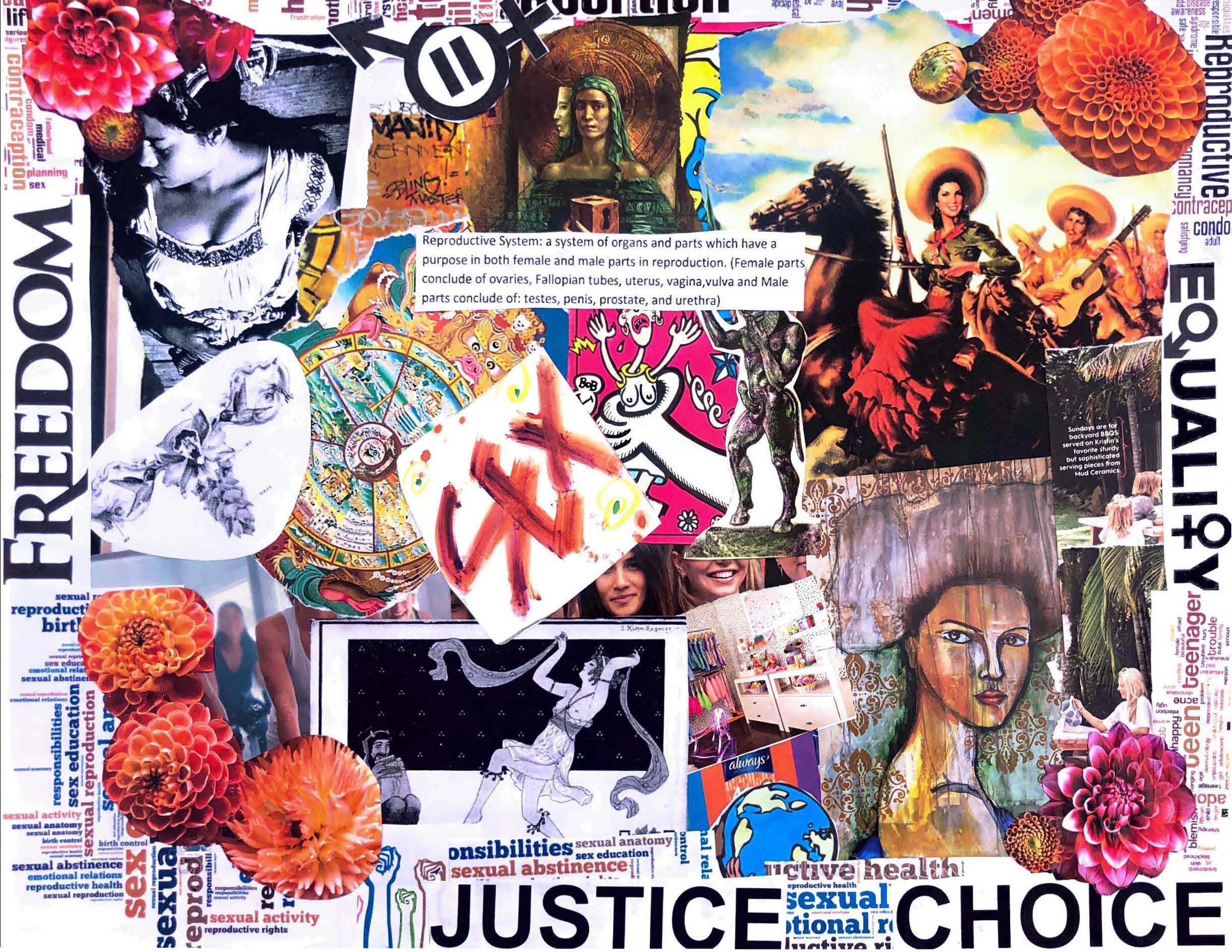
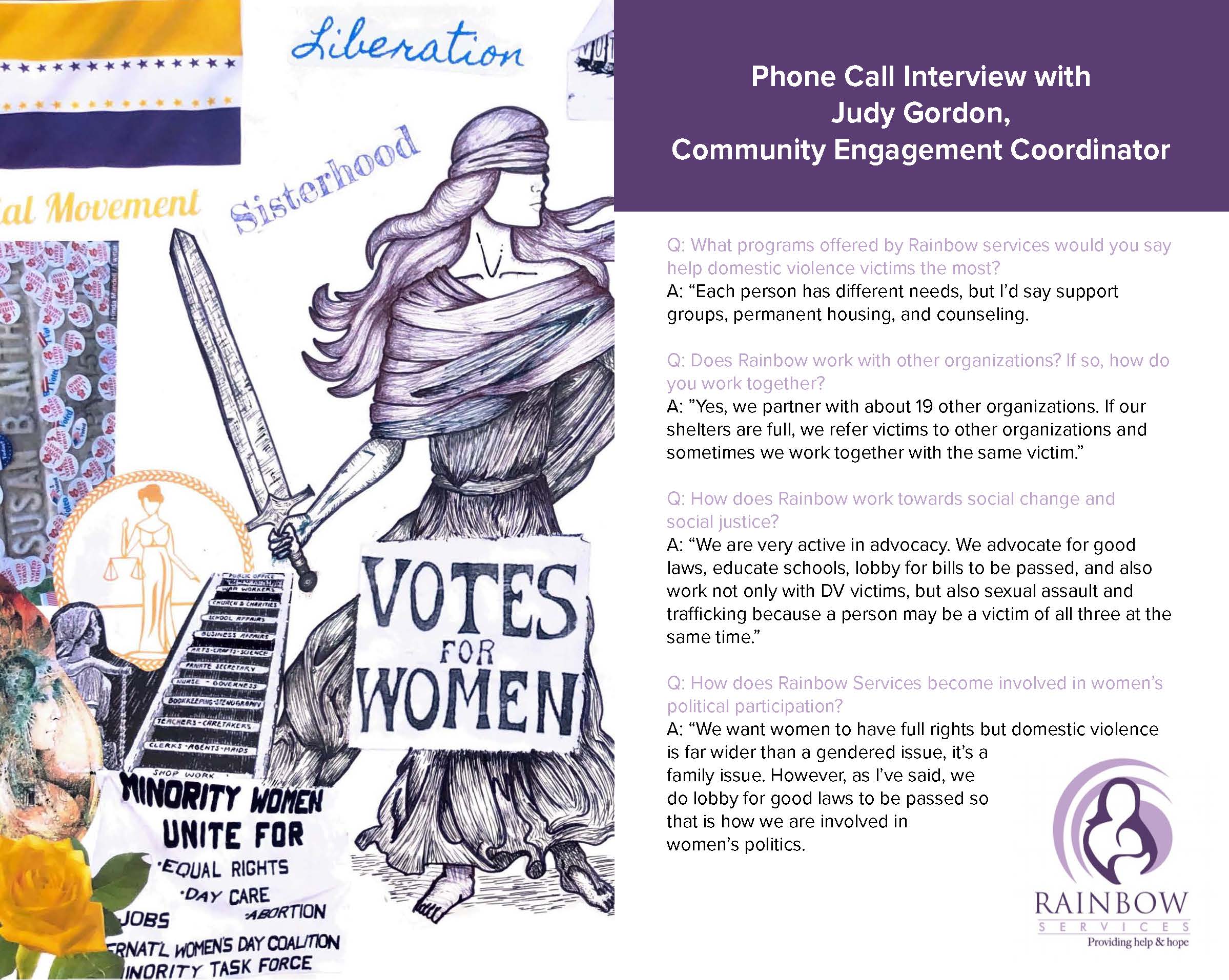
Consciousness raising continues to be a form of feminist activism used by women to bring awareness to social issues and personal struggles. Although there have been great strides in equality over the years, women, particularly women of color and queer women of color, are still undermined in many areas such as the workplace, home, and sometimes even amongst each other. It is crucial to encourage discussion of these topics between women to come to an understanding of why they happen, and to persuade more people to advocate for change. "The Battered Women's Movement" Domestic violence continues to be the single leading cause of injury to women in the United States today. Alabama and Massachusetts were the first states to criminalize physical violence against women by their husbands; by the time the 19th Amendment passed, all states had similar laws on the books. The consciousness raising of the 1960s and 1970s brought to light, however, the prevalence of violence that continued to take place behind closed doors. Often considered an “open secret,” domestic violence was (and in many ways still is) considered a family matter that should be dealt with privately. Under the mantra of “the personal is political,” feminists in the 1970s began to organize around this issue and the legal system’s lack of appropriate response. Known at the time as the “Battered Women’s Movement,” activists argued that violence against women is a symptom of larger systemic sexism and began to work on reform, including the creation of domestic violence shelters, hotlines, and changes in laws that allow married victims of domestic violence to file criminal charges against a spouse. In 1994 the Violence Against Women Act (VAWA) was passed, becoming the first federal legislation acknowledging domestic violence and sexual assault as crimes, as well as providing federal resources to train law and court officials and provide services to survivors of domestic and sexual assault. Since it was introduced in 1994, VAWA has been renewed by Congress in 2000, 2005, and 2012. These reauthorizations have expanded services to protect those facing violence in same-sex relationships, and transgender, gender non-conforming, and gender nonbinary individuals are all protected under VAWA’s non-discrimination conditions. The most recent reauthorization of VAWA was stalled due to the U.S. government shutdown in 2018. A short-term extension expired on February 15, 2019, and in April 4, 2019 reauthorization was passed in the House of Representatives. As of July 2020, the Violence Against Women Act still is awaiting a vote for reauthorization by the Senate. To be more LGBTQIA+ inclusive, as well as to acknowledge that violence takes place in relationships outside of marriage, domestic violence is now often referred to as “intimate partner violence.” Some activists worry, though, that this title lacks the political force and visceral reality of the “Battered Women’s Movement.”The Gay Rights Movement The Gay Rights movement is a political and social movement that advocates for the full acceptance of LGBTQ+ people in society. The movement began in the 1940s with a growth in the urban subculture of gay men and lesbians. At this time, there was a great deal of government surveillance and police harassment, investigation, and persecution of LGBTQ+ people. By the end of the 1960s, the Gay Rights movement grew and began its rise of activism. At this time, the movement's goals were to decriminalize homosexual acts, receive equal social treatment, and obtain equal rights under the law. In 1969, the Stonewall Riots served as a catalyst to launch the movement into a new era of resistance and revolution. In the 1970s, the movement primarily emphasized coming out and equal public participation. Members of the community expected and demanded acceptance for who they were, as well as ending job, religious, and military discrimination. Due to gay men's lack of understanding of sexism, lesbians fought for political agendas that recognized their needs. As a result, they formed their own autonomous lesbian-feminist groups that focused on developing ideologies of lesbianism that challenged mainstream feminism, lesbian invisibility, and heterosexuality. The 21st century has seen many gains in the fight for gay rights. In 2011 President Obama repealed the military’s “Don’t Ask, Don’t Tell” policy, allowing gay individuals to openly serve in the U.S. military. In 2015 gay marriage became legal in all 50 states when the Supreme Court declared that states could not legally ban same-sex marriage. Most recently, on June 15, 2020, the Supreme Court ruled that the Civil Rights Act of 1964, which prohibits sex discrimination in the workplace, extends to sexual orientation and gender identity, providing gay and transgender employees protection from workplace discrimination. Even with these gains, there have still been setbacks, particularly in the trans community. In March 2018, transgender individuals were banned from the military, reversing the 2016 decision that allowed them to serve. More urgently, conservative estimates state that one in four transgender individuals has experienced assault, with the rates even higher for trans women and trans people of color. Reproductive Justice Consciousness raising advocates for an awareness of issues affecting women’s personal and public lives. Related to this awareness was a growing need in the 1960s for women to have a greater understanding of their bodies and control over their health, including their reproductive health. The FDA approved the first oral contraceptive birth control pill in 1960, but it wasn’t until 1965 that married women in all 50 states had access to it, and not until the court case of Eisenstadt v. Baird in 1972 were unmarried people granted the right to possess oral contraceptives on the same basis as their married counterparts. Autonomy over one’s body – “my body, my choice” – was a key mandate of second wave feminism. Feminists and advocates for women’s health began to raise awareness in the 1960s of the number of women that died each year as a result of complications from unsafe abortion. Advocates for reproductive justice not only pushed to make abortion safe and legal in the United States, but also to increase access to comprehensive sex education and access to contraception. Roe v. Wade made abortion legal in all 50 states in 1973. Restrictions and limits on reproductive freedoms, however, were placed on women almost immediately afterward. The Hyde Amendment was passed in 1976, barring the use of federal funds for abortions, effectively ending access to abortion for low-income women who obtain healthcare through Medicaid. In the 21st century, there has been an increasing number of targeted regulations of abortion providers, also known as “TRAP Laws,” which place unnecessary regulations and restrictions on clinics and individuals providing abortion care. Abortion rights continue to be threatened today. Despite this, abortion remains a medically safe and common procedure, with 1 in 4 women in the U.S. having an abortion by the age of 40. These women come from all racial, religious, and socio-economic backgrounds, with over 50% already having at least one child. Feminists and women’s health advocates work hard to destigmatize abortion and clear up inaccuracies and misconceptions that often cloud the debate over women’s health. Advocates for reproductive justice know that the most effective way to lower abortion rates is through comprehensive sex education in schools, making contraceptives widely and easily available, and giving women access to safe and affordable health care.
1
2020-06-26T10:41:58-07:00
The Suffrage Movement
21
timeline
2020-07-07T15:41:17-07:00
The Women's Suffrage Movement advocated for women to win the right to vote, along with broad-based economic and political equality for social reforms. The fight was not easy. The Declaration of Independence (1776) declared "all men to be equal," but this equality only extended to white male landowners of European ancestry. This excluded poor men who did not own land, as well as women and children. Black and Indigenous people were unjustly denied citizenship altogether. In 1787, the U.S. Constitutional Convention placed voting rights in the hands of individual states. For a short period of time, the state of New Jersey allowed “all free inhabitants” including women, the right to vote, but revoked the right in 1807. It was not until 1838 that Kentucky passed the first suffrage law, which allowed women who were "heads of households" to vote in local tax and school board elections. In 1848 Elizabeth Cady Stanton and Lucretia Mott, among others, organized the first women’s right’s convention. The Seneca Falls Convention, held July 19 – 20 in Seneca Falls, NY, drew a crowd of close to three hundred attendees to publicly discuss the social, civil, and religious conditions and rights of women. The first day’s attendance was limited to women, with men invited to attend on the second day. Mott and Stanton had traveled to London in 1840 to participate in the World’s Anti-Slavery Convention, only to be barred from speaking based on their gender. The two, while both still committed to the abolition movement, began to also organize and advocate for women’s rights upon their return to the United States. At the Seneca Falls Convention Stanton gave her now-famous speech “The Declaration of Sentiments.” Modeled after the “Declaration of Independence,” the document urged the abandonment of unjust laws that discriminated against women, although it should be noted that there was no mention of those women who were enslaved nor Indigenous women, whose rights were continually violated. After discussing and debating the sentiments, Stanton put forth eleven resolutions. The ninth, which was the most controversial, stated, “That it is the duty of the women of this country to secure to themselves their sacred right to the elective franchise.” After much debate, the sentiments and resolutions were signed by 68 women and 32 men, “officially” setting off the suffrage movement.
1
media/Case1Drawer1.jpg
2020-06-26T16:17:28-07:00
Women's Roles in the 19th Century
32
image_header
2020-07-07T15:51:06-07:00
During the 19th century, most states adopted the British common law system of "coverature," where women were legally "covered" by their husbands, their rights subsumed with his. This led to the concept of "chattel marriages," which left most women as the "property" of their husbands, unable to maintain ownership of wages, wealth, or even themselves. During this time, women could not sign a contract, serve on a jury, or participate freely and equally in public life. Instead, a "cult of domesticity" was in place, where the ideal of "true womanhood" segregated women to the private sphere of the home as models of purity and domesticity as wives and mothers. This image of ideal womanhood was supported by newspapers, periodicals, and other forms of popular press, as well as by religious, education, and other social systems. These stereotypes were a strong basis for the anti-suffrage movement, which argued, among other things, that a women's place was in the home, that women were too emotional and/or fragile for political participation, and that politics would corrupt women. These images from Catalina Island, CA (1910) show that, while not discussed in today's terms, there were many women who were more comfortable outside the gender norms of the time and adopted more non-binary dress and gender roles.
1
media/ThePersonalIsPolitcal.jpg
2020-07-01T11:16:48-07:00
The Personal is Political
22
image_header
2020-07-08T13:17:27-07:00
The passing of the 19th Amendment was just the beginning of the women's movement for equality in the United States. The 1960s ushered in a great time of social change, with both the Civil Rights Movement and the Women’s Liberation Movement, also referred to as the Second Wave of Feminism. During this time, women began to meet in groups known as “consciousness raising” (CR) groups to discuss the inequality and injustices they experienced in their lives. In addition to valuing the voices of women and validating their lived experiences, consciousness raising aimed to mobilize women around systemic injustice. “The Personal is Political” became a rallying cry for the movement, as women began to realize that the inequalities they experienced in their personal lives were representative of larger social and political inequities. The Equal Rights Amendment To mark the 75th anniversary of the Seneca Falls Convention, Alice Paul proposed that the U.S. Constitution adopt an amendment that would ensure “Men and women shall have equal rights throughout the United States and every place subject to its jurisdiction.” The amendment, then referred to as the “Lucretia Mott Amendment,” was introduced to Congress in 1923. Despite support from both Republicans and Democrats, the amendment stalled, in part due to concerns from the labor movement. In 1943, Paul re-wrote the amendment, which was becoming known as the “Alice Paul Amendment,” to state, “Equality of rights under the law shall not be denied or abridged by the United States or by any state on account of sex.” The ERA finally passed the U.S. Senate and the House of Representatives, and was sent to the individual U.S. states for ratification in 1972. This set off a movement of anti-ERA sentiment in the U.S., led by both male and female social and religious conservatives. The fight for the ERA continues to this day, with the state of Virginia becoming the 38th state to ratify the ERA on January 27, 2020. With this vote, the ERA has now reached the minimum number of states Congress required for ratification when the amendment was first approved in 1972. The deadline for state ratifications has passed, however, and five states (Idaho, Kentucky, Nebraska, Tennessee, and South Dakota) have rescinded their prior approval. Therefore, the status of the ERA continues to be a pressing political concern today.
This page references:
1
media/Pro-Suffrage Poster_thumb.jpg
2020-06-27T12:03:40-07:00
Pro-Suffrage Poster
1
media/Pro-Suffrage Poster.jpg
plain
2020-06-27T12:03:40-07:00