Thanks for your patience during our recent outage at scalar.usc.edu. While Scalar content is loading normally now, saving is still slow, and Scalar's 'additional metadata' features have been disabled, which may interfere with features like timelines and maps that depend on metadata. This also means that saving a page or media item will remove its additional metadata. If this occurs, you can use the 'All versions' link at the bottom of the page to restore the earlier version. We are continuing to troubleshoot, and will provide further updates as needed. Note that this only affects Scalar projects at scalar.usc.edu, and not those hosted elsewhere.
Unpinning History: Japanese Posters in the Age of Commercialism, Imperialism, and ModernismMain MenuIntroductionJapan in the Age of Commercialism, Imperialism, and ModernismThe Rise of Tourism and the Era of Ocean LinersThe Rise of Tourism and the Development of Railway NetworksProvocation of Citizenship: Posters for the Ministry of CommunicationsExhibition CultureBijin: Posters with a Beautiful WomanArrival of Modern Commercial DesignBibliographyCollection NoteReuse and Remix this Exhibition
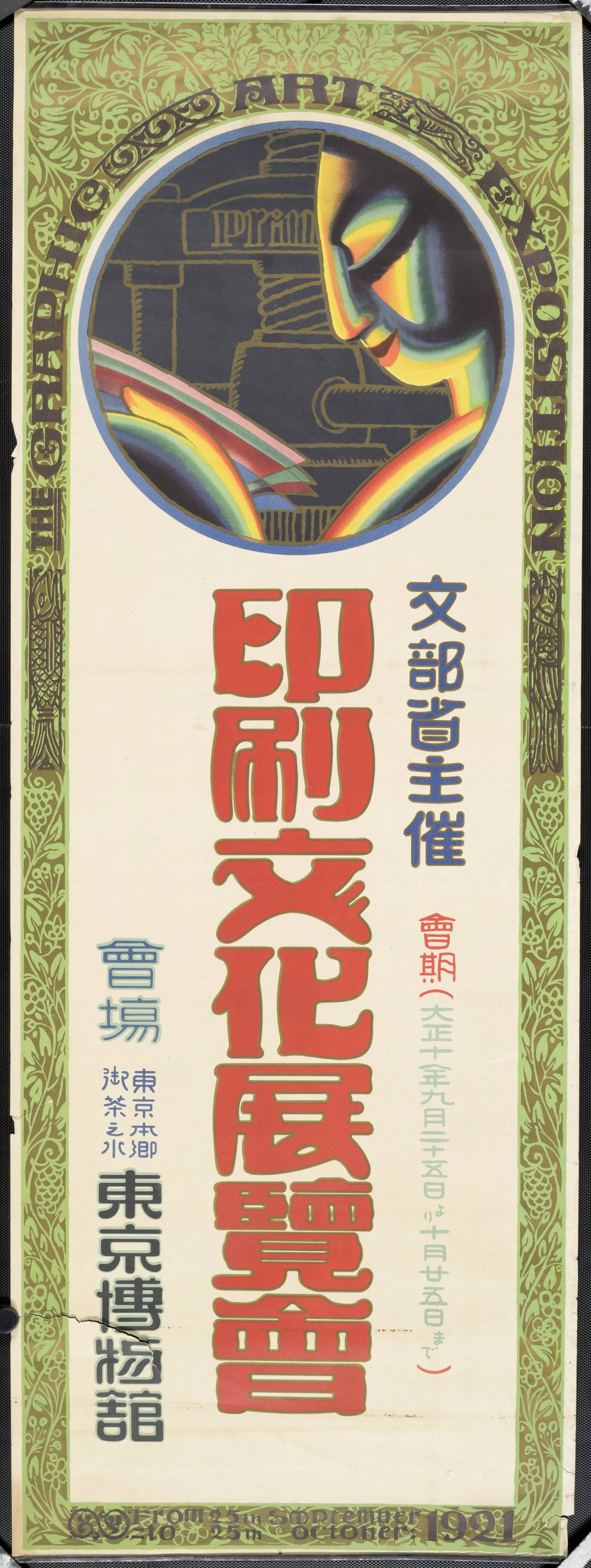
Monbushō shusai, Insatsu bunka tenrankai: Graphic Art Exposition, Organized by the Ministry of Education, Tōkyō Hakubutsukan, September 25 to October 25, 1921
12020-04-29T14:40:52-07:00Anne-Marie Maxwell326ac6eff123bb3f77fb517c66299be8b435b479371409plain2020-05-07T15:52:35-07:00Rebecca Corbetta90733ad69f461205618486aa72143b4a46f0ff9This poster attests to the unique graphic design of the Taishō-period, combining German Expressionism, Art Nouveau, and modern design. The most noticeable element is a fairly simple profile of a young woman reading or viewing printed matter in front of a printing machine. The poster was made for the Insatsu Bunka Tenrankai/Graphic Art Exposition, which was held between September 25th and October 25th, 1921.
Sugiyama Sueo was not just the designer of the poster but one of the central figures in curating the exhibition that was dedicated to prints, printing technologies, and graphic arts. Organized by the Ministry of Education, the exhibition shows how the ministry was interested in implementing new technology into the Japanese education system at the time. The exhibition covered a wide range from historical printed matter to new printing technologies. It also promoted the notion of graphic design and the role of designers. Furthermore, the printing companies, including Toppan Printing Co.—the printer of this poster—were also advertised through the exhibition, which attracted more than 300 thousand visitors. (Qira Kong)
Contents of this tag:
1media/Heiwa Kinen Tokyo Hakurankai Tokyo Ueno Koen Taishoojuichinen sangatsu tōka yori The Tokyo Peace Exhibition Ueno Park Tokyo March 10July 31 1922 Goddess.jpgmedia/Heiwa Kinen Tokyo Hakurankai Tokyo Ueno Koen Taishoojuichinen sangatsu tōka yori The Tokyo Peace Exhibition Ueno Park Tokyo March 10July 31 1922 Goddess.jpg2020-04-10T14:46:24-07:00Anne-Marie Maxwell326ac6eff123bb3f77fb517c66299be8b435b479Exhibition Culture29image_header2020-11-17T14:39:50-08:00Tyson Gaskill93cb401bee8f73160b4c4378060de7643c42eee9