Thanks for your patience during our recent outage at scalar.usc.edu. While Scalar content is loading normally now, saving is still slow, and Scalar's 'additional metadata' features have been disabled, which may interfere with features like timelines and maps that depend on metadata. This also means that saving a page or media item will remove its additional metadata. If this occurs, you can use the 'All versions' link at the bottom of the page to restore the earlier version. We are continuing to troubleshoot, and will provide further updates as needed. Note that this only affects Scalar projects at scalar.usc.edu, and not those hosted elsewhere.
Unpinning History: Japanese Posters in the Age of Commercialism, Imperialism, and ModernismMain MenuIntroductionJapan in the Age of Commercialism, Imperialism, and ModernismThe Rise of Tourism and the Era of Ocean LinersThe Rise of Tourism and the Development of Railway NetworksProvocation of Citizenship: Posters for the Ministry of CommunicationsExhibition CultureBijin: Posters with a Beautiful WomanArrival of Modern Commercial DesignBibliographyCollection NoteReuse and Remix this Exhibition
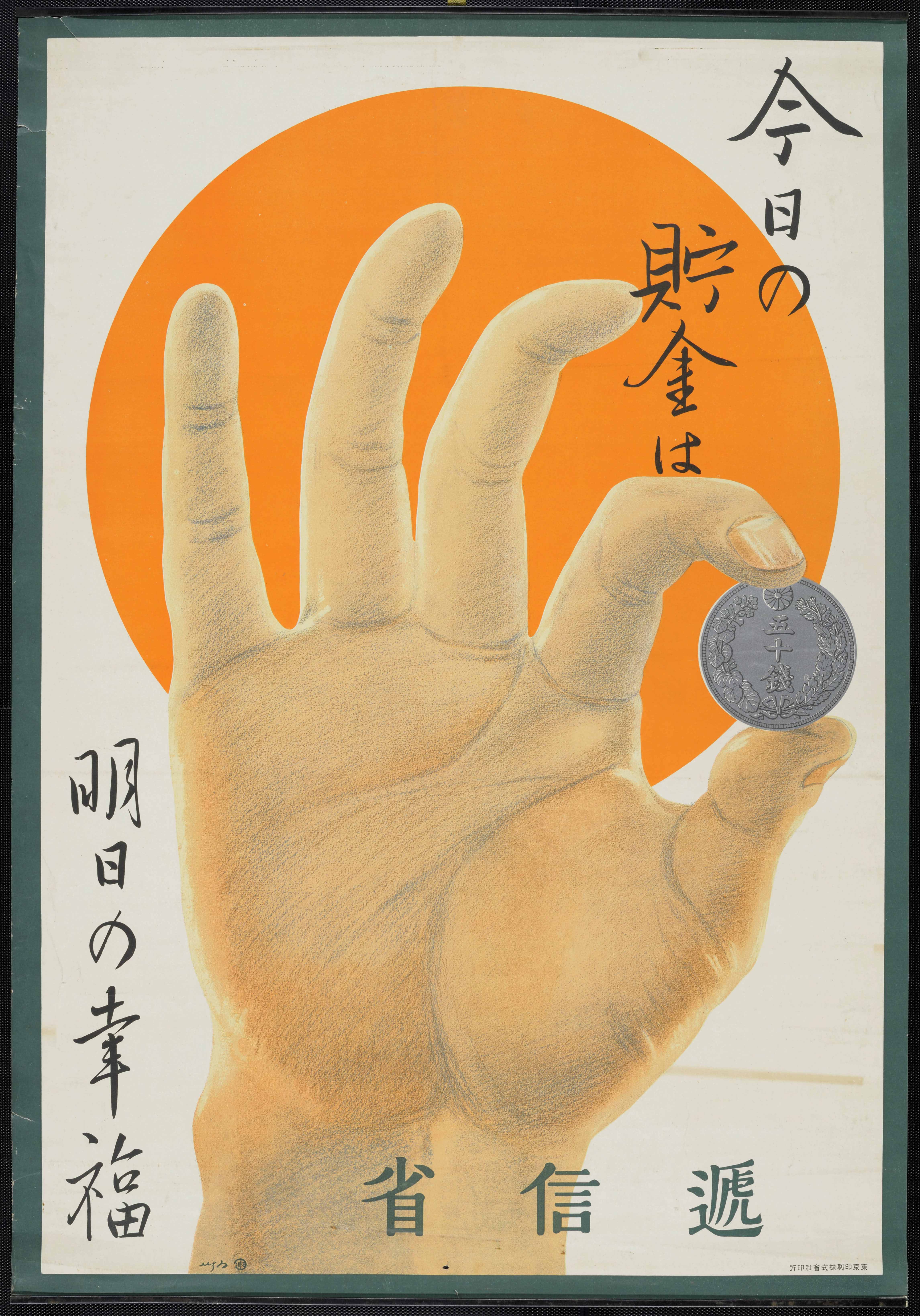
Kyō no chokin wa ashita no kōfuku, Teishin-shō [Today’s saving is tomorrow’s happiness, Ministry of Communications]
12020-04-29T14:48:58-07:00Anne-Marie Maxwell326ac6eff123bb3f77fb517c66299be8b435b479371408plain2020-11-17T15:26:05-08:00Tyson Gaskill93cb401bee8f73160b4c4378060de7643c42eee9In this poster for the Postal Savings Bank, Sugiura Hisui employs a minimalist and modernist approach to poster design. The only elements present here include a hand, a coin, an abstract background, and a slogan. The Japanese text reads “Saving for Tomorrow’s Happiness.” The message in this work applies to every person: the young, the middle-aged, and the old. Trained in both yōga (Western- and nihonga (Japanese) painting styles, Hisui builds upon the tradition of Japanese iconography while applying early 20th-century Western design elements. By the late Edo period (1600–1868), the rising sun came to symbolize fortune, prosperity, and tradition. (Corey Gordon)