Thanks for your patience during our recent outage at scalar.usc.edu. While Scalar content is loading normally now, saving is still slow, and Scalar's 'additional metadata' features have been disabled, which may interfere with features like timelines and maps that depend on metadata. This also means that saving a page or media item will remove its additional metadata. If this occurs, you can use the 'All versions' link at the bottom of the page to restore the earlier version. We are continuing to troubleshoot, and will provide further updates as needed. Note that this only affects Scalar projects at scalar.usc.edu, and not those hosted elsewhere.
12018-12-03T03:56:24-08:00Josie Cotton85e536e9436ca7acf1cc79640b3de84b2753ceeb3147431plain2019-03-22T19:03:15-07:00Josie Cotton85e536e9436ca7acf1cc79640b3de84b2753ceebOn September 1, 1939, the German armed forces thundered into Poland, making their way east, marking the beginning of the Second World War in Europe. But after the initial upheaval of the Nazi invasion of Poland, there was relatively little activity on the western front for the next several months. It was as if the world was holding its breath, waiting. In the spring of 1940, the waiting ended abruptly, as the Nazis invaded the Netherlands, Belgium, and France. It was not until July that the dangers of the war came home to Britain in perhaps the most celebrated air battle in British history: The Battle of Britain. Hitler intended to invade Britain, but in order for the invasion to take place, he first needed control of the skies over the English Channel. As the Luftwaffe, the German air force, dropped bombs over southern England, targeting Royal Air Force (RAF) airfields, the RAF fought to stop them. Over the Channel and southern England, the British Spitfires and German Messerschmitts collided in showers of sparks and volleys of gunfire, each trying to gain the upper hand.
Once it became clear that Germany could not defeat the RAF and achieve air superiority, Hitler tried another tactic. On September 7, 1940, the Luftwaffe launched its first nighttime attack on London. The wail of the air raid sounded across the city, warning Londoners of the danger and driving them to take shelter. Planes darkened the skies above London and bombs exploded in the streets. The Blitz, the German bombing of London and other major British cities between September 1940 and May 1941, had begun. Though the Germans soon abandoned plans for an invasion of Britain due to an RAF victory in the Battle of Britain and the approaching winter, they did aim to disrupt manufacturing, transportation, and administration systems in London, while also striving to break civilian morale and to encourage the British government to seek peace terms. In London alone, the bombing killed tens of thousands of civilians and destroyed more than two million homes.
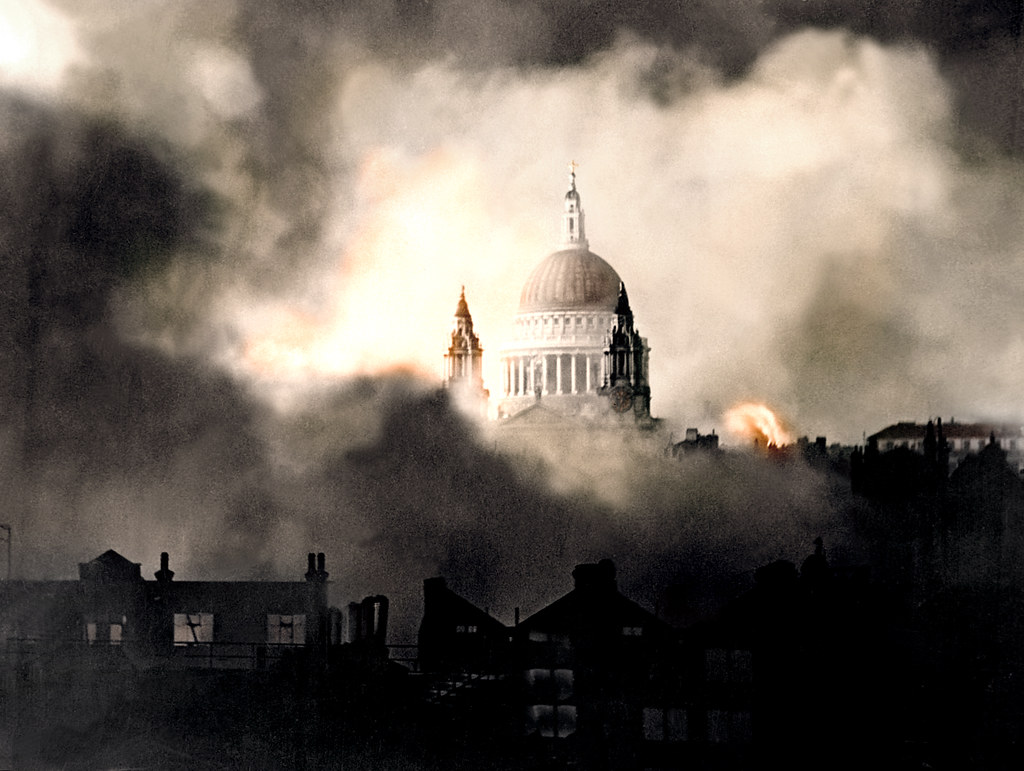
12018-12-03T03:59:31-08:00St. Paul's Cathedral4Herbert Mason's iconic photograph of the London Blitzmedia/5655161807_1631ef1e57_o.jpgplain2019-03-20T18:05:29-07:00