Tim McLaughlin's Traversal of
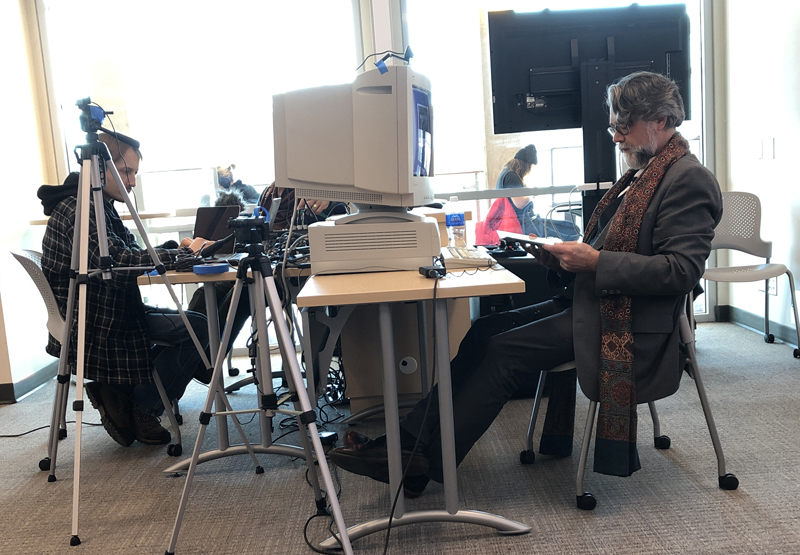
Notes Beyond Absolute Zero took place on Friday, March 1, 2019, from 2:00-3:00 p.m. at the University of Victoria Library's Digital Scholarship Commons as part of
Endangered Data Week. The event was organized by John Durno, Head of Library Services and the Director of the
Obsolete Computing and Media Lab (OCAM). McLaughlin performed the work in front of both an online and onsite audience using the Macintosh floppy disk––Version 2.1––on the G3 Macintosh collected by Durno. Grigar conducted the Traversal and moderated the Q & A that followed the performance. Assist with the technical production was the CMDC Program's Greg Philbrook who handled the video capture and Dr. John Barber, who captured the sound for later creation into a podcast. Durno's own team handled the live streaming and other major logistics.
Traversal of Tim McLaughlin's Notes Toward Absolute Zero, IntroductionThis video captures John Durno’s introduction of author Tim McLaughlin’s work,
Notes Toward Absolute Zero, and Dene Grigar’s research with preserving electronic literature in the Electronic Literature Lab at Washington State University Vancouver.
Traversal of Tim McLaughlin's Notes Toward Absolute Zero, Part 1This video clip starts off by introducing
Notes Toward Absolute Zero. While discussing about cover, he points out that the graphics had to be bitmaps; thus, he explains why the display has a gritty look. During the reading, McLaughlin also points out that readers “can follow default pathways and then make excursions”.
Traversal of Tim McLaughlin's Notes Toward Absolute Zero, Part 2In this video clip, McLaughlin continues to read through
Notes Toward Absolute Zero and involves the audience’s participation when choosing between choices. One of the lines he reads from his work is “travel is a conversation between places.”
Traversal of Tim McLaughlin's Notes Toward Absolute Zero, Part 3This video clip displays McLaughlin continuing to read through
Notes Toward Absolute Zero and letting the audience choose the next lexias for him to read. One of the lines that he reads is “and you realize that you’ve been here before.”
Traversal of Tim McLaughlin's Notes Toward Absolute Zero, Part 4This video clip captures McLaughlin continuing to read
Notes Toward Absolute Zero. A line that he reads from the lexia
"Hiding
," is “[p]erhaps the world is a cinematograph and there is no right way of seeing. Perhaps this is simply how things are.”
Traversal of Tim McLaughlin's Notes Toward Absolute Zero, Q&A, Part 1This video clip marks the beginning of the Q&A session with Dene Grigar introducing
Notes Toward Absolute Zero author and presenter, Tim McLaughlin. An online audience member asks for tips for writing hypertext narratives. McLaughlin says to take advantage of hypertext because the interface is “like a film animation in a text” and that “whatever is in front of you is in front of you.” McLaughlin also mentions that there was a “big technological euphoria [where] computers will solve almost all of our problems” during the time he wrote the work, and he was working against that sentiment.
Traversal of Tim McLaughlin's Notes Toward Absolute Zero, Q&A, Part 2In this clip, the Q&A session with Tim McLaughlin continues. He talks about the problem with electronic literature becoming endangered and that Grigar is “doing a heroic act trying to preserve all these [electronic] works.” Grigar mentions Amaranth Borsuk's work with mixing Augmented Reality environments with print books. An online audience member asks McLaughlin to expand on his thought process with drafting the work. McLaughlin says that “a lot of the initial passages [were] brought back [from the hypertext he used to work on]” while he was also doing research on evaluating hypertext in Ireland. He then talks about how the work is a transparent media and can’t be worked as a navigation because “we’re all familiar with how the book works [and] we all know how to turn the page to the next.”
Traversal of Tim McLaughlin's Notes Toward Absolute Zero, Q&A, Part 3This video clip presents more of Tim McLaughlin’s Q&A session. A member from the live audience asks McLaughlin to explain the technological situation in 1993. He answers by saying that “access to computer technology was extremely limited and not at all easy to get.” He brings up the idea that the Traversal is like a social event. He also describes how hypertext is a more of private act than reading a traditional book. Grigar mentions how back in the late 1980s, it would take days for people to communicate to one another through the Internet and how a Traversal is similar to present social media.
Traversal of Tim McLaughlin's Notes Toward Absolute Zero, Q&A, Part 4This video clip presents the final portion of Tim McLaughlin’s Q&A session. He notes that hypertext has taken over the Internet and people who want “to produce works that [they] could have 100% control of, the World Wide Web was the way to go.” Grigar explains how she started collecting Apple computers. A member from the online audience asks McLaughlin how structure equals meaning in
Notes Toward Absolute Zero. He explains how he wanted the work to function like a short story or a poetry where one can “consume [a] chunk of text and . . . do the work of understanding it . . . and un-packing it. It’s almost modular."