Scalar's 'additional metadata' features have been disabled on this install. Learn more.
Rebooting Electronic Literature, Volume 2: Documenting Pre-Web Born Digital Media
Main Menu
Introduction to Rebooting Electronic Literature
Documentation of pre-web works of electronic literature from the library of the Electronic Literature Lab
Kathryn Cramer's "In Small & Large Pieces"
Documentation of Kathryn Cramer's In Small & Large Pieces
Deena Larsen's "Samplers"
Documentation of Deena Larsen's hypertext essay "Samplers"
Richard Holeton's "Figurski at Findhorn on Acid"
Biography of Richard Holeton
Tim McLaughlin's "Notes Toward Absolute Zero"
Documentation of Tim McLaughlin's "Notes Toward Absolute Zero"
Stephanie Strickland's "True North"
Documentation of Stephanie Strickland's hypertext "True North"
Authors' and Contributors' Bios
The bios of those who authored and produced Rebooting Electronic Literature
Dene Grigar
ae403ae38ea2a2cccdec0313e11579da14c92f28
Nouspace Publications | Washington State University Vancouver
cramer-Artifacts.jpg
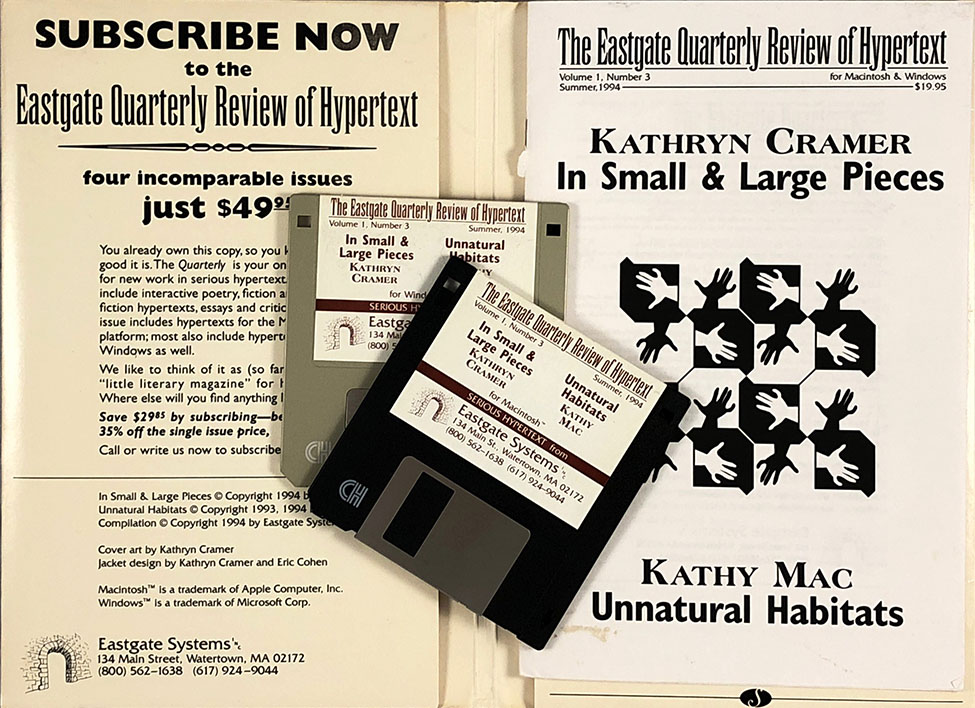
1 2019-04-16T16:45:30-07:00 Holly Slocum 87a15d5be5d5713ba3f952eaf71119eff38132d4 32032 3 A photo of the In Small & Large pieces and Unnatural Habitats folio interior, the Windows floppy disk, the Macintosh floppy disk, and booklet cover plain 2019-09-04T11:14:56-07:00 Kathleen Zoller d12f5a19398157747ffcda98170a372b72a1ea00This page is referenced by:
-
1
2018-11-01T17:57:57-07:00
Photos of Kathryn Cramer's "In Small & Large Pieces"
79
Photos of the packaging of Kathyrn Cramer's "In Small & Large Pieces"
plain
2021-05-31T10:47:24-07:00
Kathryn Cramer’s In Small & Large Pieces was published by Eastgate Systems in the summer of 1994. This section is intended to supplement the reader with the material aspects of the work by providing images and detailed descriptions of the folio, booklet, and floppy disks.
Both In Small & Large Pieces and Kathy Mac’s Unnatural Habitats share a 9 x 6 inch folio. The folio is in fairly good condition, as it is still clearly readable despite the softening of the edges and slight cracks in the heavy card stock. Both the Macintosh and Windows floppy disks are contained inside. The booklet contains a large tear in the back, but the rest of the booklet is in good condition.
Folio, Front
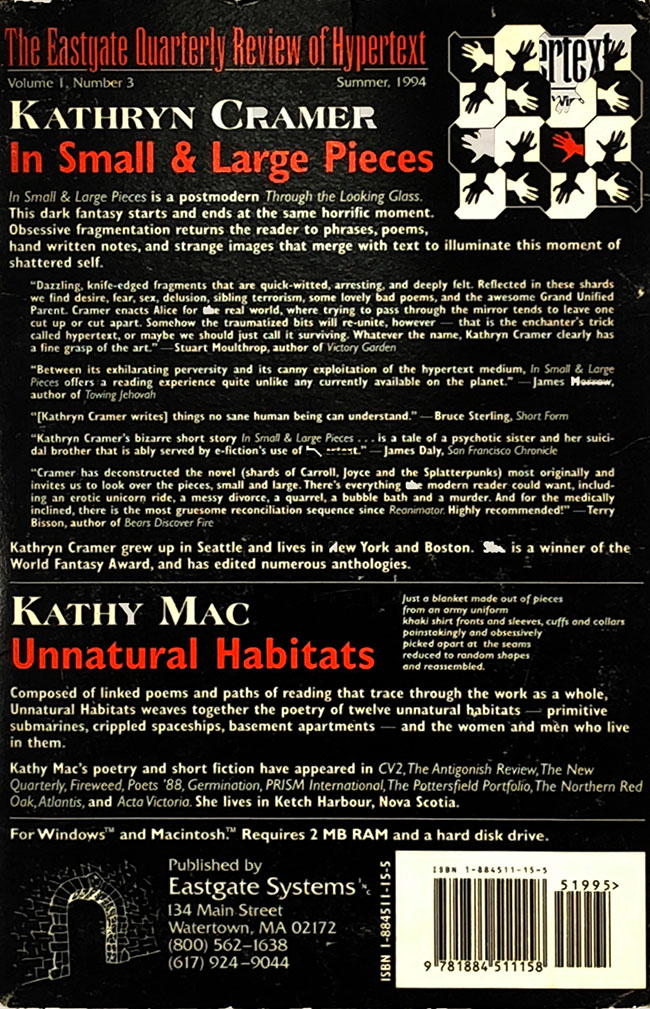
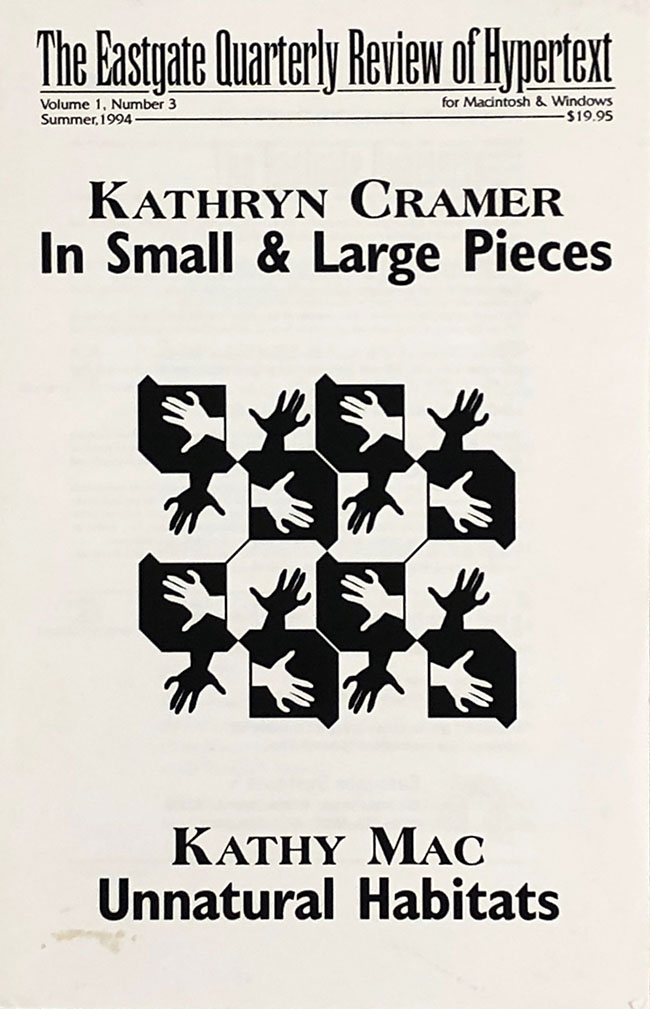
The folio cover displays the titles for In Small & Large Pieces and Unnatural Habitats in red at the top and bottom respectively. Above each of these titles are the authors’ names in white. The black folio with bold, red and white lettering sets an ominous tone for Cramer’s dark fantasy, which is aided by visuals of splayed hands desperately reaching for each other. It should be noted that one of the sixteen hands is red, possibly signifying how the user must choose which links (or “hands”) to grasp. Each of these hands are contained within alternating black and white cells, which are irregular square-like polygons with two edges pointed up and down on opposite corners, one normal corner at a right angle, and one chopped off corner. The hands are always the opposite of their cell color (excluding the red hand, which is placed on a black cell.) The total size of this graphic measures approximately 4 inches on each side, with each cell approximately 1 inch in length and width. The words “Eastgate Quarterly Review of Hypertext” stretches along the top of the front cover in red with a thin white underline. Smaller white text underneath and aligned to the left reads “Volume 1, Number 3,” while text on the right reads “for Macintosh & Windows.” Additionally, text beneath each of these are present with a thin white line stretching across the folio between them: “Summer, 1994” on the left and “$19.95” on the right. The very bottom of the cover provides a review from The Wall Street Journal: “‘Eastgate [is] the pre-eminent hyperfiction publisher.’ —The Wall Street Journal.” A thin white line separates this review from the rest of the content above it. A sticker placed near the bottom left reads “Property of Katherine Hayles.”
Folio, Back
The back of the folio uses the same color scheme as the cover, using white and red text over a solid black background. The two titles with author’s names are displayed near the top (In Small & Large Pieces) and the bottom (Unnatural Habitats) of the folio with summaries underneath. The summaries for each are as follows:
Kathryn Cramer [Written in white]
In Small and Large Pieces [Written in red]
Paragraph 1 [The following paragraphs are printed in white]
In Small & Large Pieces is a postmodern Through the Looking Glass. This dark fantasy starts and ends at the same horrific moment. Obsessive fragmentation returns the reader to phrases, poems, hand written notes, and strange images that merge with text to illuminate this moment of shattered self.
Paragraph 2 [Paragraphs 2 through 6 are reviews written in smaller text than paragraphs 1 and 7]
“Dazzling, knife-edged fragments that are quick-witted, arresting, and deeply felt. Reflected in these shards we find desire, fear, sex, delusion, sibling terrorism, some lovely bad poems, and the awesome Grand Unified Parent. Cramer enacts Alice for the real world, where trying to pass through the mirror tends to leave one cut up or cut apart. Somehow, the traumatized bits will re-unite, however — that is the enchanter’s trick called hypertext, or maybe we should just call it surviving. Whatever the name, Kathryn Cramer clearly has a fine grasp of the art.” — Stuart Moulthrop, author of Victory Garden
Paragraph 3
“Between exhilarating perversity and its canny exploitation of the hypertext medium, In Small & Large Pieces offers a reading experience quite unlike any currently available on the planet.” — James Morrow, author of Towing Jehovah
Paragraph 4
“[Kathryn Cramer writes] things no sane human being can understand.” — Bruce Sterling, Short Form
Paragraph 5
“Kathryn Cramer’s bizarre short story In Small and Large Pieces… is a tale of a psychotic sister and her suicidal brother that is ably served by e-fiction’s use of hypertext.” — James Daly, San Francisco Chronicle
Paragraph 6
“Cramer has deconstructed the novel (shards of Caroll, Joyce and the Splatterpunks) most originally and invites us to look over pieces, small and large. There’s everything the modern reader could want, including an erotic unicorn ride, a messy divorce, a quarrel, a bubble bath ad a murder. And for the medically inclined, there is the most gruesome reconciliation sequence since Reanimator. Highly recommended!” — Terry Bisson, author of Bears Discover Fire
Paragraph 7
Kathryn Cramer grew up in Seattle and lives in New York and Boston. She is a winner of the World Fantasy Award, and has edited numerous anthologies.
Kathy Mac [Written in white]
Unnatural Habitats [Written in red]
Paragraph 1 [Aligned on the right side of the title and author’s name]
Just a blanket made out of pieces
From an army uniform
Khaki shirt fronts and sleeves, cuffs and collars
Painstakingly and obsessively
Picked apart at the seams
Reduced to random shapes
And reassembled.
Paragraph 2
Composed of linked poems and paths of reading that trace through the work as a whole, Unnatural Habitats weaves together the poetry of twelve unnatural habitats -- primitive submarines, crippled spaceships, basement apartments -- and the women and men who live in them.
Paragraph 3
Kathy Mac’s poetry and short fiction have appeared in CV2, The Antigonish Review, The New Quarterly, Fireweed, Poets ‘88, Germination, PRISM International, The Pottersfield Portfolio, The Northern Red Oak, Atlantis, and Acta Victoria. She lives in Ketch Harbour, Nova Scotia.
The top of the back of the folio reads “The Eastgate Quarterly Review of Hypertext” in red with a thin white underline, occupying three quarters of the uppermost portion on the left side. The fourth quarter contains a smaller version of the image of hands that is displayed on the front cover (1 inch and 11 centimeters on each side.) Small text in white beneath the Eastgate title read “Volume 1, Number 3” on the left and “Summer, 1994” on the right. The bottom portion of the back folio reads “For Windows™ and Macintosh.™ Requires 2 MB RAM and a hard disk drive. Underneath this on the left side is Eastgate’s logo, which is a brick wall with an ornate passageway in white outlines. To the right of the logo reads the following:
Published by
Eastgate Systems INC [Each letter in INC are arranged like a staircase, with I in the top left, N underneath it in the center, and C in the bottom right.]
134 Main Street
Watertown, MA 02172
(800) 562-1638
(617) 924-9044
To the right of the logo and corporation information is the ISBN number, printed in a white box and displayed as bar code. The ISBN number is recorded on the left side of the box as “ISBN 1-884511-15-5.” The main sections of the back folio are separated with thin white lines, with a white line above and below the Unnatural Habitats summary.
Folio, Spine
The spine contains white text with a black background. The far left of the spine reads “The Eastgate Quarterly Review of Hypertext”, though the first word is difficult to read due to the softening and splitting of the folio’s upper-left corner. The center-left says “Kathryn Cramer” and the center-right says “Kathy Mac.” The far right reads “Eastgate Systems, Inc.”, but the bottom left corner of the folio is softened.
Folio, Inside, Opened
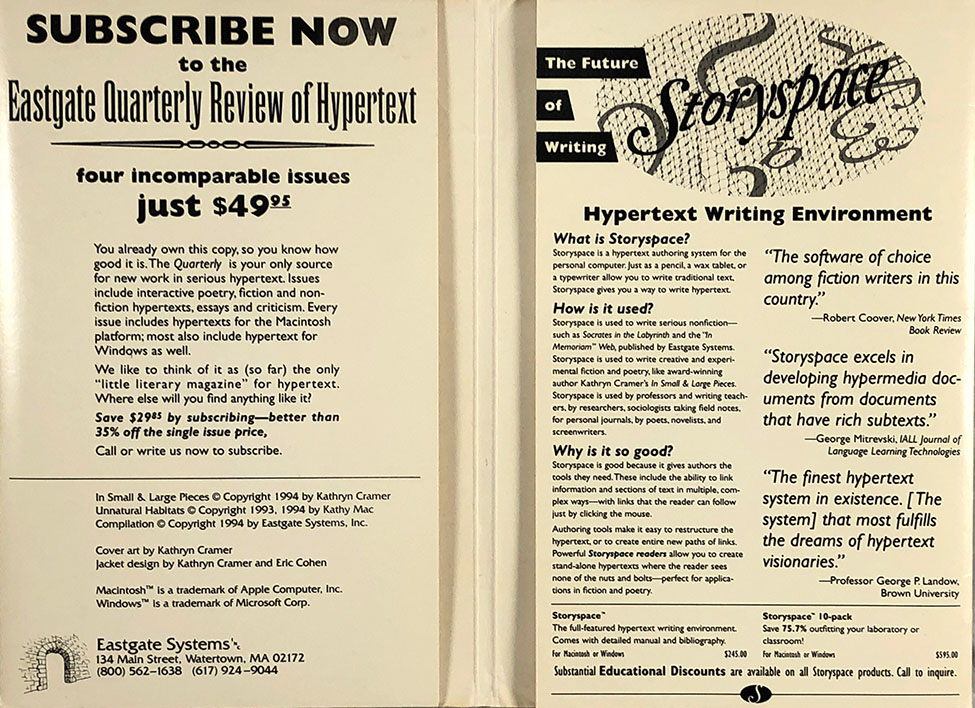
The Folio’s interior contains black text with a creamy white background. A pocket on the left-hand side is used to contain floppy disks, while the right pocket contains the booklet. The left-hand side provides the copyright information for In Small and Large Pieces and Unnatural Habitats, and an advertisement for the Eastgate Quarterly Review. The right side displays an advertisement for the Storyspace hypertext authoring system.
Floppy Disk #1, Macintosh, Front
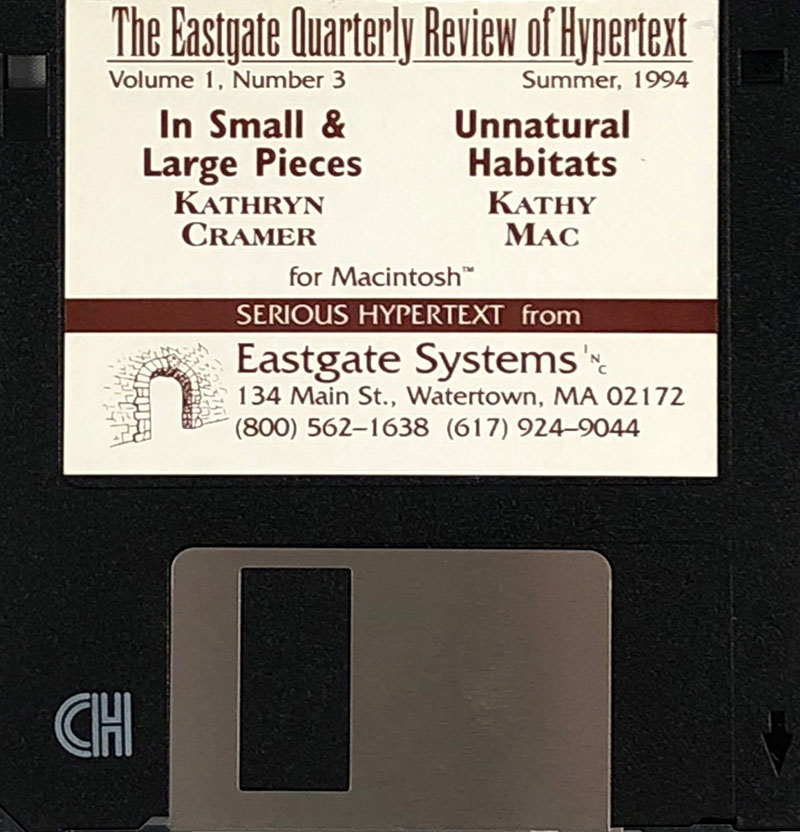
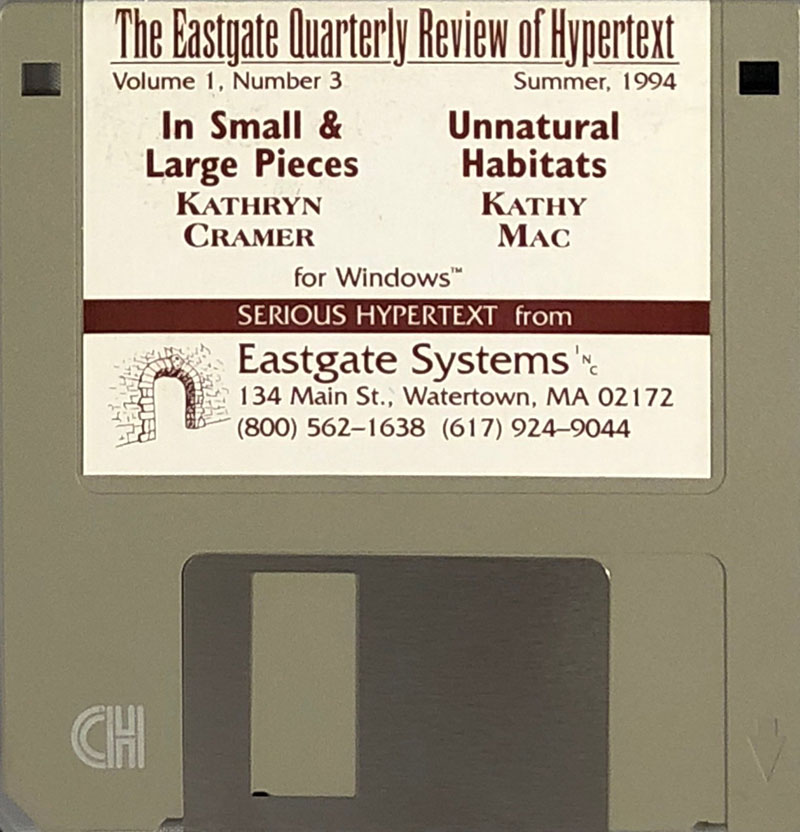
The Macintosh 3 ½” floppy disk has a black casing and contains both In Small & Large Pieces and Unnatural Habitats. A white label lays over the front of the disk and partially wraps around the back. On the label in burgundy text is written “The Eastgate Quarterly Review of Hypertext” with a burgundy underline. Beneath this underline on the left and right sides read “Volume 1, Number 3” and “Summer, 1994” respectively. Near the center of the label are the titles and authors’ names side-by-side, with “for Macintosh” placed underneath and center. A thick red band separates the bottom portion of the label with “SERIOUS HYPERTEXT from” written on top. Eastgate’s logo lies on the left-hand side after the band, outlined in burgundy, with the corporation information on the right.
Floppy Disk #1, Macintosh, Back
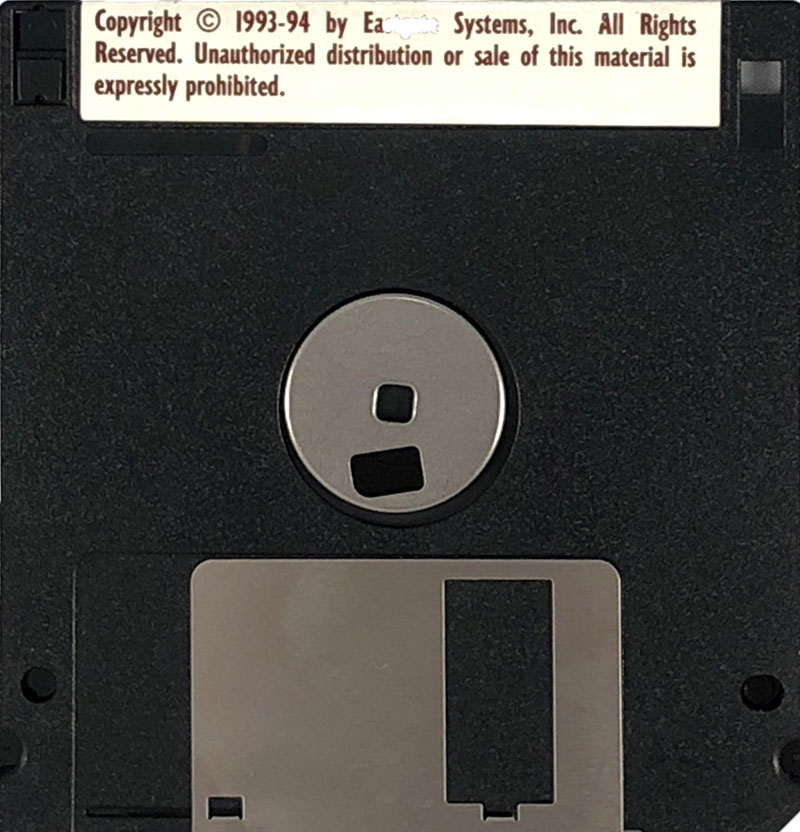
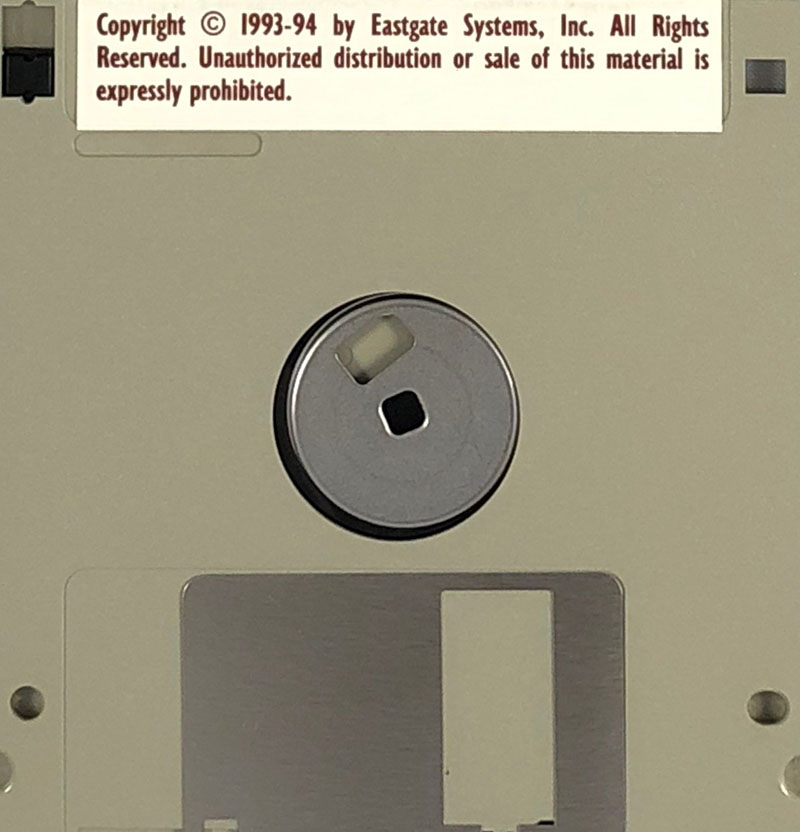
The label on the back of the Macintosh floppy disk reads in burgundy “Copyright © 1993-94 by Eastgate Systems, Inc. All Rights Reserved. Unauthorized distribution or sale of this material is expressly prohibited.
Floppy Disk #2, Windows, Front
The Windows 3 ½” floppy disk has a white casing, and the label is the same as the first floppy except that “for Macintosh” has been replaced with “for Windows.” As before, a white label lays over the front of the disk and partially wraps around the back. On the label in burgundy text is written “The Eastgate Quarterly Review of Hypertext” with a burgundy underline. Beneath this underline on the left and right sides read “Volume 1, Number 3” and “Summer, 1994” respectively. Near the center of the label are the titles and authors’ names side-by-side. A thick red band separates the bottom portion of the label with “SERIOUS HYPERTEXT from” written on top. Eastgate’s logo lies on the left-hand side after the band, outlined in burgundy, with the corporation information on the right.
Floppy Disk #2, Windows, Back
As with the Macintosh floppy, the label on the back of the Windows floppy disk reads in burgundy “Copyright © 1993-94 by Eastgate Systems, Inc. All Rights Reserved. Unauthorized distribution or sale of this material is expressly prohibited.”
Booklet, Front Cover
The front cover of the booklet has the same design as the front of the folio, though it is black and white and smaller in size due to the booklet being 5 ½” by 8 ½”. The booklet is printed on paper stock, which is slightly shredded in places.
Booklet, License Agreement, Warranty and Disclaimer, and Copyright & Page 1
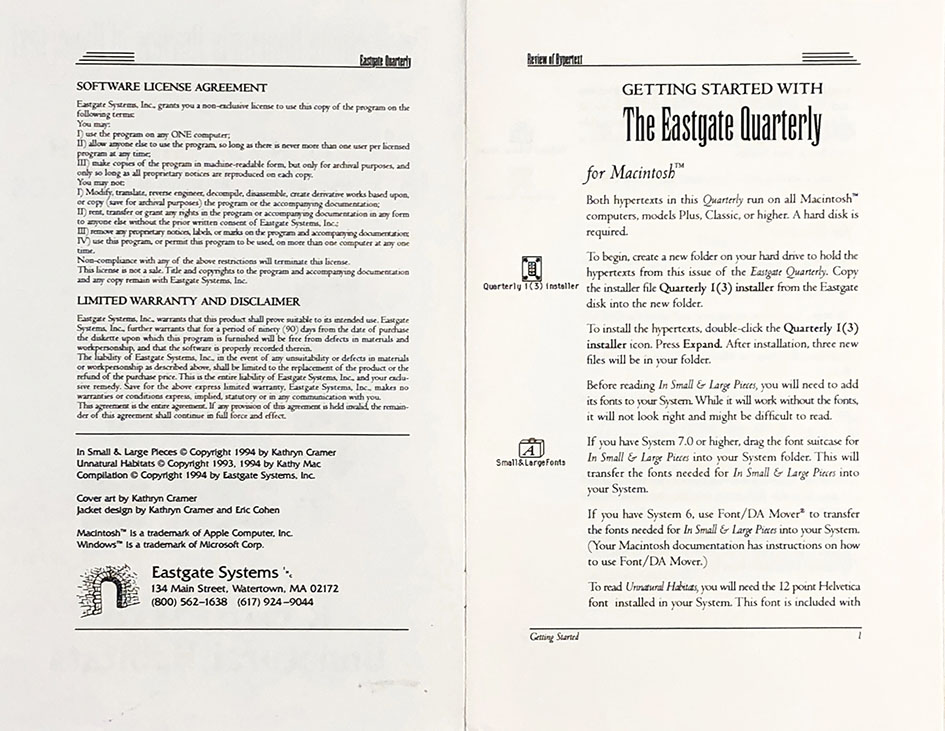
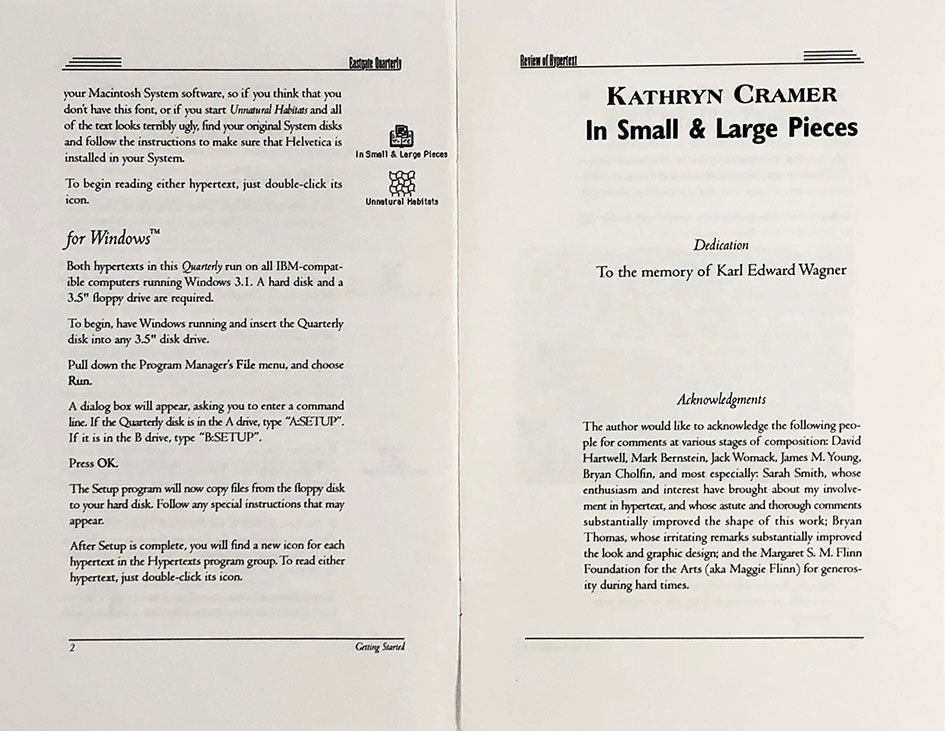
Within the booklet on the left side, the software license agreement, limited warranty and disclaimer, and copyright information can be found. Quarterly installation instructions for the Macintosh are placed on page one.
Booklet, Pages 2 & 3
Page 2 provides installation instructions for Quarterly in Windows. Page 3 contains the dedication and acknowledgements for Kathryn Cramer’s In Small & Large Pieces.
Booklet, Pages 4 & 5
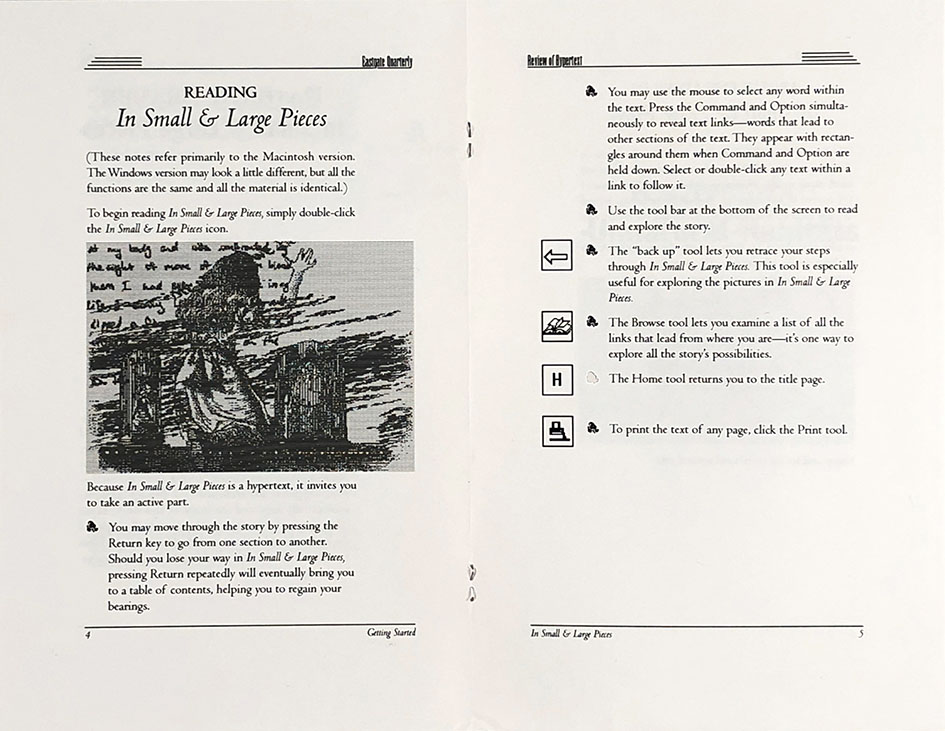
Pages four and five cover the reading instructions for In Small & Large Pieces, teaching users keyboard shortcuts (such as using the RETURN key to progress through sections, or hitting both the Command and Option keys simultaneously to reveal hyperlinked texts.) It is explained that though the instructions are meant for the Macintosh, the Windows version will follow the same principals. Page 5 also includes pictures of the icons for various tools, such as the “back up” and “browse” tools, while Page 4 provides an image of the In Small and Large Pieces icon.
Booklet, Pages 6 & 7
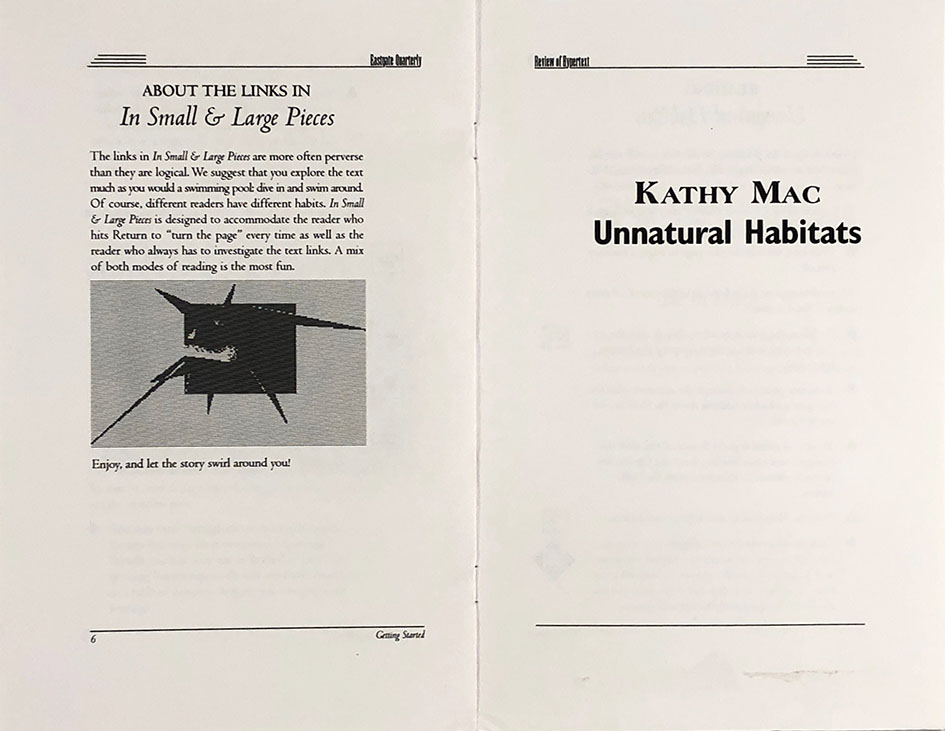
Page 6 describes the links within In Small & Large Pieces, recommending that the reader “explore the text as you would a swimming pool: dive in and swim around.” It also reiterates the use of the RETURN key and links as different ways of navigating the text. Page 7 reads “Kathy Mac” with “Unnatural Habitats” underneath, introducing the reader to the second work.
Booklet, Back
The back of the booklet is blank, with a large tear along the bottom where a strip of tape holds it together. -
1
2021-08-11T13:10:50-07:00
A Critical Essay about Kathryn Cramer's "In Small & Large Pieces," by Astrid Ensslin
15
Essay by Astrid Ensslin about Kathryn Cramer's "In Small & Large Pieces"
plain
2022-04-26T12:49:28-07:00
"Who Shattered the Looking Glass?"
by Astrid Ensslin
Kathryn Cramer’s short poetic hypertext fiction, “In Small & Large Pieces” (“ISLP”), published in the Eastgate Quarterly Review of Hypertext (1:3), revisits Lewis Carroll’s Through the Looking Glass from a postmodern, gothic angle. The titular broken looking glass becomes a metaphor of “obsessive fragmentation” (blurb) throughout the text, and of how readers move between different types of texts, such as poems, hand-written notes, and captioned images “illuminates this moment of shattered self” (ibid). In my ethnographic work on the lore of pre-web hypertext fiction (Ensslin 2020; 2021), I interviewed Kathryn about her work and how it links to autobiographical elements of her life as a young poet, artist and hypertext author-editor.
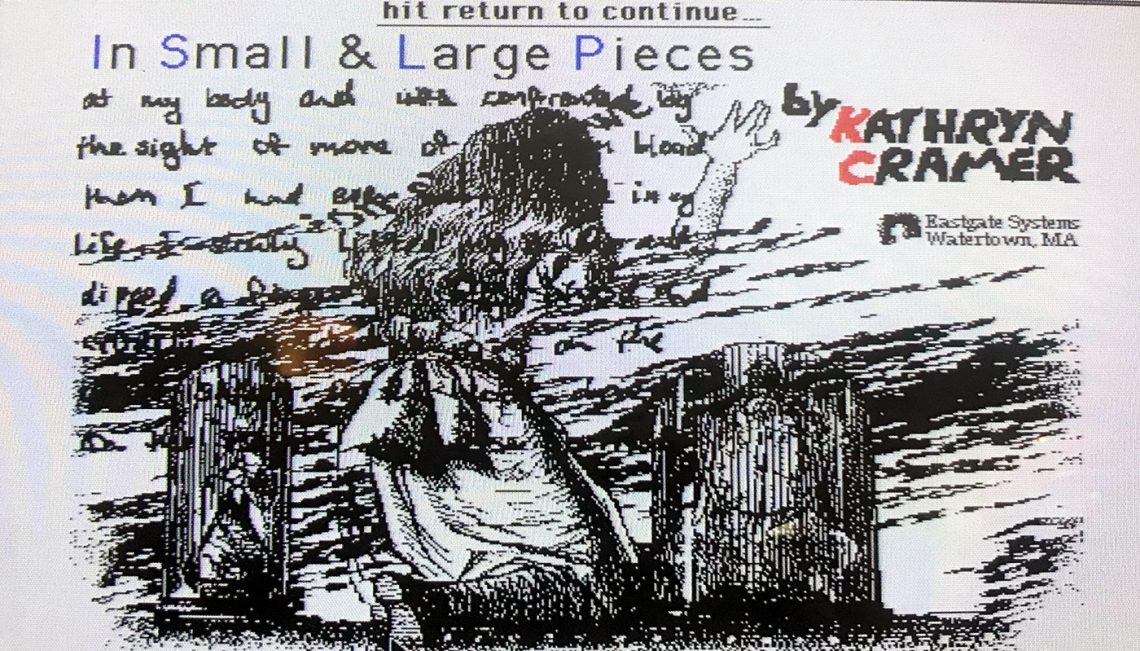
"ISLP" consists of two main, interlacing parts: a narrative section that breaks into six chapters and can be read consecutively, by pressing the return key, and a poetry collection titled “The Mona Lisa Has Been Raped: Collected Poems.” The chapters in the narrative part are titled “Chapter 1: The Effect of Living Backwards,” “Chapter 2: Injury & Breakage,” “Chapter 3: Anna, Phantomwise,” “Chapter 4: The Unified Parent,” Chapter 5: Scrambled Eggs,” and “Chapter 6: The Mirror Shattered.” As suggested by the title page (fig. 3.6), readers are encouraged to “hit return to continue,” which will take them to the prefatory material and then on to the six chapters sequentially. The humorously named “poetry basement,” then, alludes to the basement in the story, where mysterious, “awful” events happen. This architectural concept is reconfirmed by the location of the link to the section, in the lower half of the lexia, and somewhat set apart from the rest of the text in font size and style (fig. 1).
Fig. 1: Contents page of "ISLP," courtesy of Grigar et al. (2019)
The poetry collection comprises 13 short, lyrical poems, individual verses of which are interspersed into the narrative part. Cramer wrote the poems in her late teens and revisited them 15 years later, in the larger framework of her PhD project while studying German literature at Columbia University:
I wrote … a lot of poetry as a teenager. And I would write and write … and then I decided it was not very good. And I would burn it, and I would start over. [The poems in ISLP] are the ones that survived the experience… So I decided that since the character was … the age I had been, I could use as characterization the poems I actually wrote in that age range. (Cramer, interview)
Cramer emphasizes the importance of reading the work with a sense of humorous distance arising from this authorial age gap. Furthermore, she highlights the importance of associative, “synapse like” linkage in her hypertext.
"ISLP’s" title page (fig. 2) shows a girl in Victorian clothing kneeling in front of a mirror. The way the mirror is designed and repeated in a similar, tombstone-like shape to the left of the figure suggests a graveyard setting. This gothic feel is reinforced by the wafts of mist running across the sky in the background, the praying gesture of the girl, and some barely legible snippets of palimpsestic, handwritten text, reading “by the sight of more blood”. The gothic mood revealed by this imagery reflects Cramer’s background as an editor of horror fiction at the time she wrote "ISLP."
Fig. 2: Title page of "ISLP," courtesy of ELL
Immediately following the title page is an epigraph, taken from E.M. Forster’s Aspects of the Novel (1927). It programmatically introduces the work’s major structuring principle, which is the disruption of “sequence in chronology” and repeats in large fonts in the lexia, “That was the effect of living backwards.” This reversion might reflect the materiality of reading via the return key, which paradoxically leads onwards in the narrative whilst suggesting a reverse trajectory. As mentioned by Forster, reversing the order of events in a narrative cannot be done “without abolishing the sequence between the sentences,” which again “is not effective unless the order of the words in the sentences is also abolished.” Clicking on “the order of words” takes the reader to a lexia that displays a paragraph of text in exact reverse order. The Forster quote is illustrated by a linked poem displaying the alphabet in reverse order. The next click leads to a purely graphic lexia showing a human eye and nose on the left, a butterfly at the center, and an open door on the right (fig. 3). Each element in the image is linked to a different onward lexia, some of which are graphic, others are textual - either handwritten or printed. Opening each lexia in turn results in the cognitive construction of a fragmentary frame of reference for the reader, with individual lexias suggesting themes like a potentially pedophile sexual relationship, an escape from home, drug consumption, images of stitching and quilting, as well as injury and blood.
Fig. 3: "ISLP’s" Butterfly lexia, [Control pressed for links]
The default path proceeds from the butterfly imagery straight to the chapter overview of the narrative part. The unfolding story, told by a consistent heterodiegetic narrative, reads immersively and coherently. It introduces the protagonist Anna Miller, her twin sister Annabelle, her brother Martin, their parents, Norma and Martin, and Karl, “a man her father worked with” and presumably had a pedophilic love relationship with Anna. The first and sixth chapter jointly frame an embedded memory of parental neglect, drug abuse, suicidality, and a potentially drug-induced fantasy of Anna’s. The frame narrative centers on a broken mirror, smashed in what turns out to be one of many fights between Anna and her brother Martin.
The idea of breaking and sewing together is programmatic throughout ISLP, and in centering broken and mended body parts, Cramer foreshadows Shelley Jackson’s canonical hypertext novel, Patchwork Girl, Or A Modern Monster, which appeared in 1995. The Frankensteinian motif materializes in a series of grotesquely rendered family crises, which cause the parents’ bodies to break apart whenever they are facing a crisis, and which lead to Martin severing one of Annabelle’s toes with a pair of pruning shears. In all instances, Anna becomes the mending force, taking care of sewing body parts back together and developing semantic-surgical strategies that end up re-uniting her ruptured parents into a “parental unit” of complementary identity that ends up “skuttl[ing] spider-like into the kitchen and made itself cups of tea” [You will.] This grotesque surrealism is backed up with actual quotes from Through the Looking Glass, which Anna reads to her sister after the unified parent has closed the door behind themself.
"ISLP" was inspired by events that happened in Cramer’s own family when she was a teenager:
my brother and I used to really fight physically a lot. And so ... climbing out the bathroom window and then coming around to attack from behind when my brother's trying to get [in bed], that happened, …there was an actual net mirror broken. And ... I'm pretty sure I'm the person who threw the encyclopedia. … The title actually comes from a different broken mirror, … which was in a basement. And I think probably what happened in this case is like the hook it was on came loose, and it fell down on its own. … And I remember being very struck about the inversion of, "it should be large and small pieces". And so the title comes from that and … [a] clear memory of being both the person who had thrown the book and also jumping up to avoid. (Interview)
Cramer was already an established science fiction and horror writer when she began to work and write for Eastgate in 1993. In fact, she had another, novel-length hypertext work under contract with Eastgate, with the working title, Subpoena Vacation. The work was an attempt “to ramp up the production values. And that just kind of never happened, because the kind of fluidity in terms of composition that I had in In Small & Large Pieces was not really possible with higher production values at that point” (ibid). Thus, "ISLP" became the new standard for scoping works for the EQRH. It confirmed the relative success of Mary-Kim Arnold’s “Lust” and J. Yellowlees Douglas’ “I Have Said Nothing” and providing a reading experience that seemed feasible and value-for-money, for its brevity, its intertextualization of genre fiction, and its pastiche texturing technique.
Like other EQRH writers, Cramer used a more varied color palette (red, blue, and grey) than was common at the time: “the screens I was working with initially didn't even have gray pixels. They were black pixels, or they were white pixels…. And we just got to the point where … we could have colour” (Interview). Cramer also laments the neglect with which the fonts of her writing tend to be perceived, especially when reading from Windows machines and emulators: “the type design was very specific and definite. Like if a Macintosh has that in there, it's like my canonical type design,” and a lot of it gets lost when read on a PC.
Similarly, Cramer composed the cover art of the Eastgate Quarterly 1:3 showing a black-and-white grid pattern on a black background, with contrasting white-and-black hands and one red, presumably bloody hand, to reflect the content of Cramer’s work. The writing on the cover is kept in the same, tricolor scheme, thus replicating the novelty of expanding the standard black-and-white user interface. Cramer’s fascination with patterns and patching comes from a life-long interest in collage and cut-up, which also manifests in her recent work, “Am I Free to Go,” (tor.com), which features “a lot of artistic similarities to In Small & Large Pieces” (interview, sic). Viewed across time, Cramer’s work thus shows distinctive continuities that the collective lore approach followed by the Rebooting project (see also Ensslin et al. 2021) has brought to light.
References
Ensslin, Astrid (2020), “'Completing the circle'? The curious counter-canonical case of the Eastgate Quarterly Review of Hypertext (1994-1995)”, in Attention à la marche! Mind the Gap! Thinking Electronic Literature in a Digital Culture, ed. Bertrand Gervais & Sophie Marcotte, Les Presses the l'Écureuil, pp. 511-524.
Ensslin, Astrid (2022) Pre-Web Digital Publishing and the Lore of Electronic Literature, Cambridge: C.U.P.
Ensslin, Astrid, Kathryn Cramer, Dene Grigar and Mariusz Pisarski, “‘On the Effect(s) of Living Backwards”: A Platform-critical, Collaborative Analysis of Kathryn Cramer’s "In Small & Large Pieces,'” peer-reviewed video essay, Proceedings of ELO 2021 “Platform (Post?)Pandemic,” Aarhus University, 26th May, https://vimeo.com/55542683.
Grigar, Dene, Nicholas Schiller, Holly Slocum, Mariah Gwin, Andrew Nevue, Kathleen Zoller, and Moneca Roath (2019) Rebooting Electronic Literature: Documenting Pre-Web Born Digital Media, Volume 2. https://scalar.usc.edu/works/rebooting-electronic-literature-volume-2/index.