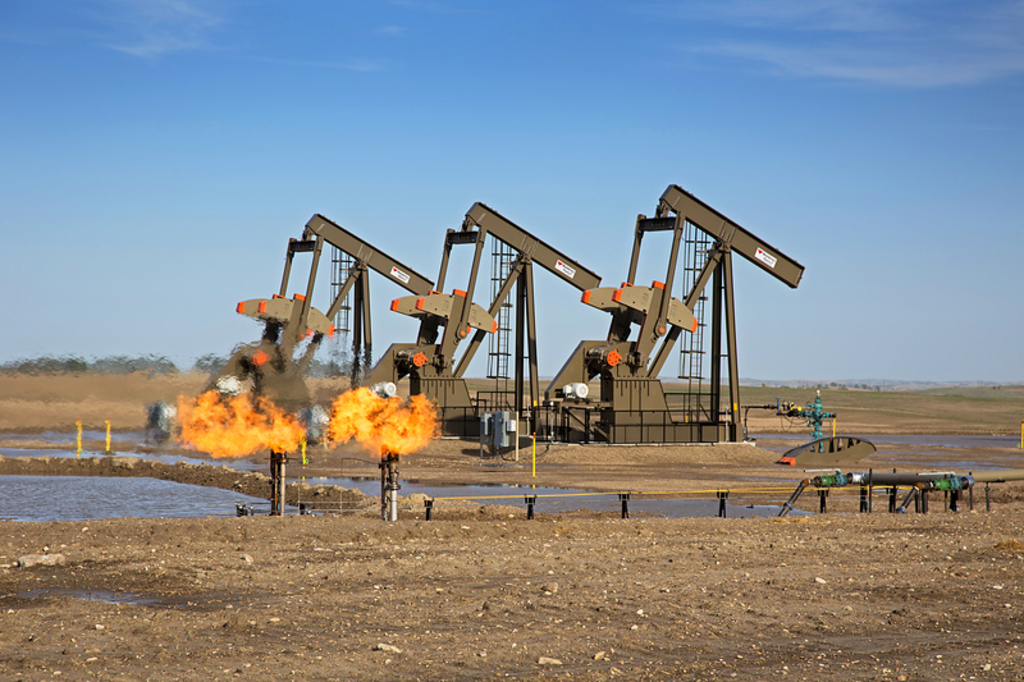
Gas flares and pumps at an oil field
1 2017-12-01T22:02:29-08:00 Bailey Klause b72dc980b1bb6bd5821b729872d3576ef3d45bff 27049 2 plain 2017-12-11T10:22:46-08:00 c0239313 Gas flares in front of jack pumps ( nodding donkeys ) on an oil field. Gas flares are used to burn off small amounts of natural gas in the crude oil. This method is used where the volume of gas is not sufficient to justify extraction for commercial use. Jack pumps are used for oil extraction where the natural pressure in the oil well is too low to force oil out at an economic rate. Such pumps are now becoming less frequently used as new recovery techniques are developed. Photographed at Watford City, North Dakota, USA, on the Bakken shale formation. ENERGY, FOSSIL FUEL, FUELS, INDUSTRY, JACK PUMP, PUMP, NODDING DONKEY, OIL, OIL EXTRACTION, OIL PUMP, OIL WELL, JACKPUMP, GAS, FLARE, FLARE STACK, BURN OFF, BURN-OFF, FLAME, FIRE, HEAT, HEAT HAZE, 21ST CENTURY, AMERICA, AMERICAN, CLIMATE, CLIMATE CHANGE, ENERGY, ENVIRONMENT, ENVIRONMENTAL, ENVIRONMENTAL SCIENCE, EXPLORATION, FOSSIL FUEL, FUEL, GAS, GEOLOGICAL, GEOLOGY, GLOBAL WARMING, GREENHOUSE GAS, INDUSTRIAL, INDUSTRY, MACHINE, NATURAL GAS, NOBODY, NO ONE, NO-ONE, NORTH AMERICA, NORTH AMERICAN, OIL INDUSTRY, PETROCHEMICAL INDUSTRY, POLLUTION, STRUCTURE, TECHNOLOGICAL, TECHNOLOGY, UNITED STATES, US, USA, WELL, OIL, PETROCHEMICAL, HYDROCARBON, CARBON, CO2, BAKKEN, SHALE, OIL BOOM, PETROLEUM, OIL WELL, NORTH DAKOTA, WATFORD CITY, BAKKEN, SHALE FORMATION Bailey Klause b72dc980b1bb6bd5821b729872d3576ef3d45bffThis page is referenced by:
-
1
2017-12-01T17:49:14-08:00
Energy Inefficiency
7
By Bailey Klause
image_header
2017-12-11T10:23:42-08:00
Image: ExxonMobile Baton Rouge. By Adbar (Own work) [CC BY-SA 3.0 (https://creativecommons.org/licenses/by-sa/3.0)], via Wikimedia Commons
The process of refining crude oil requires tremendous amounts of energy. As laid out in the U.S. Energy Information Administration table “Fuel Consumed at Refineries”, one of the biggest sources of energy for refineries is natural gas. In 2016, U.S. refineries used 882,611 million cubic feet of natural gas alone (“U.S. Fuel Consumed at Refineries”). They also used 47,388 million kilowatt hours of purchased electricity, 123,533 million pounds of purchased steam, and smaller quantities of various other energy sources like distillate fuel oil, residual fuel oil, still gas, petroleum coke, and coal (“U.S. Fuel Consumed at Refineries”). When you burn a gallon of gas, you burn not only that gallon but the many other resources that were put into its production and transportation. The inefficiency of using energy to produce energy is something that needs to be considered in the future
- U.S. Energy Information Administration. “U.S. Fuel Consumed at Refineries.” U.S. Energy Information Administration. U.S. Department of Energy, 21 June 2017. Web. 17 Nov. 2017.
- U.S. Energy Information Administration. “U.S. Fuel Consumed at Refineries.” U.S. Energy Information Administration. U.S. Department of Energy, 21 June 2017. Web. 17 Nov. 2017.