Scalar's 'additional metadata' features have been disabled on this install. Learn more.
Performing Archive
Main Menu
Visualizing the “Vanishing Race”: the photogravures of Edward S. Curtis
Front Page for Visualizing the "Vanishing Race" path
Curtis' Image and Life: The Network of The North American Indian, Inc.
An experiment with data visualization approach to understand and contextualize Curtis' images and his life
Media, Technology and Mediations
Curtis's Technology, Relationships to Media and Style
Contextualizing Curtis, The North American Indian, and Race
the collection of essays from the contributors
Consulting with Tribes as Part of Archive Development
Introduction to Consulting with Tribes by Ulia Gosart
Contributing Archives
Information on how to participate in Performing Archive
Browsing the Media
A path of paths that allow users to cut through the collection in a variety of ways.
Acknowledgements and Project Information
Project Network
Jacqueline Wernimont
bce78f60db1628727fc0b905ad2512506798cac8
David J. Kim
18723eee6e5a79c8d8823c02b7b02cb2319ee0f1
Stephan Schonberg
23744229577bdc62e9a8c09d3492541be754e1ef
Amy Borsuk
c533a79d33d48cbf428e1160c2edc0b38c50db19
Beatrice Schuster
a02047525b31e94c1336b01e99d7f4f758870500
Heather Blackmore
d0a2bf9f2053b3c0505d20108092251fc75010bf
Ulia Gosart (Popova)
67c984897e6357dbeeac6a13141c0defe5ef3403
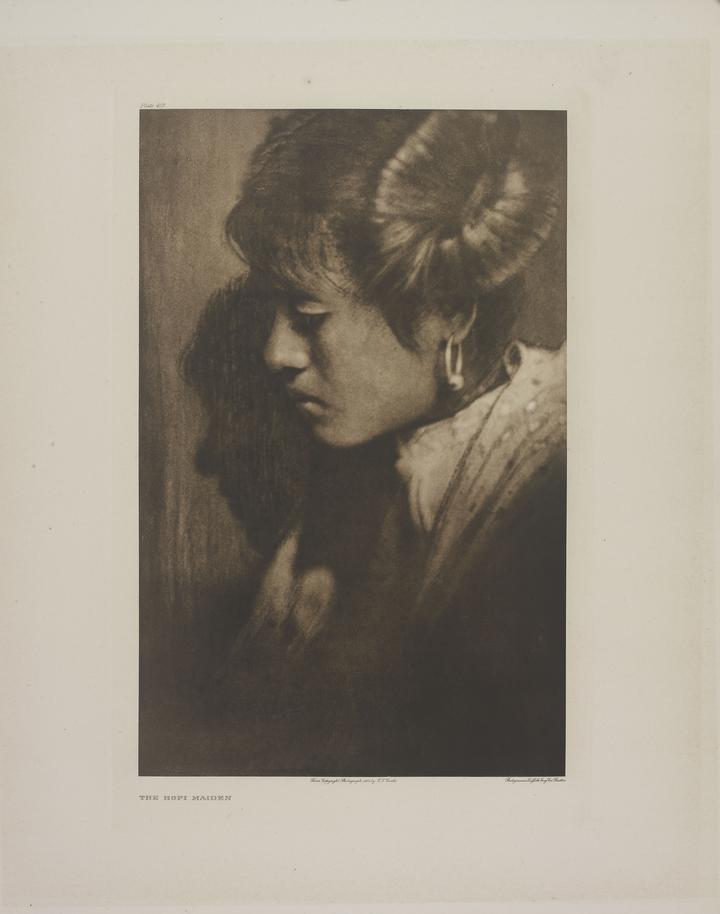
The Hopi Maiden
1 2018-03-16T21:13:11-07:00 Erik Loyer f862727c4b34febd6a0341bffd27f168a35aa637 29482 1 “The Hopi Maiden”, c. 1906, volume 12, Portfolio plate 412, photogravure, 46 x 31 cm., Special Collection, Honnold Library, Claremont. plain 2018-03-16T21:13:11-07:00 Erik Loyer f862727c4b34febd6a0341bffd27f168a35aa637This page is referenced by:
-
1
2018-03-16T21:12:51-07:00
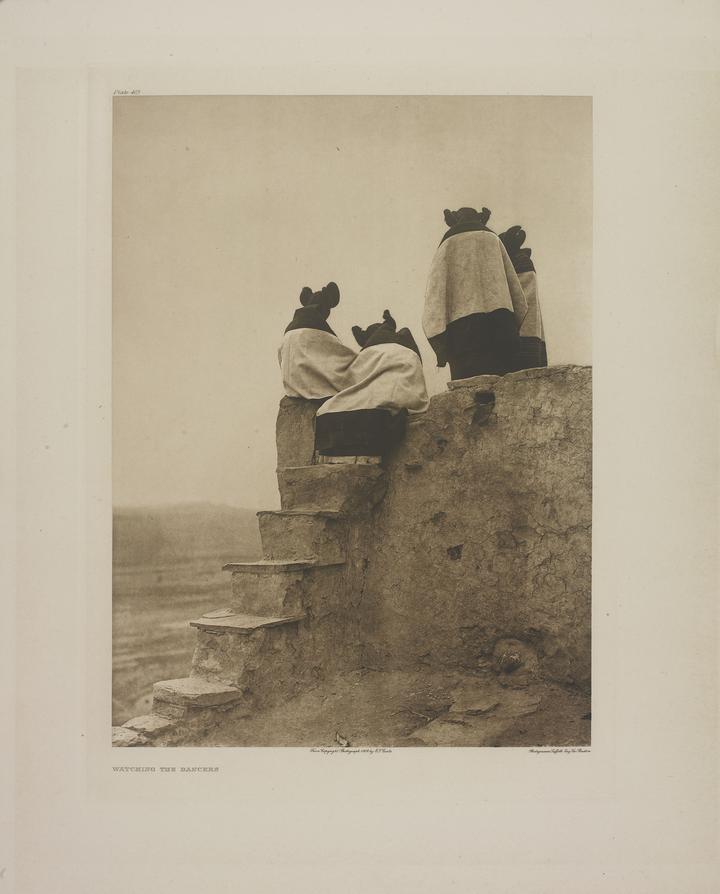
The Hopi Maiden and Watching the Dancers
1
part of Visualizing the "Vanishing Race"
plain
2018-03-16T21:12:51-07:00
Ken Gonzales-Day, Scripps CollegeCurtis visited the Hopi on multiple occasions and went as early as 1900, went back in 1902, 1904, 1906, 1911, 1912, and 1919, so dating which images where shot when can pose something of a challenge, but he does note that the traditional squash blossom hairdo was discontinued by the second decade of the twentieth century. In these early images, “Watching the Dancers” and “The Hopi Maiden,” Curtis captured young unwed women at a time when they still wore their hair in the traditional style. So one can understand that such images confirmed his, and other’s views, that traditional ways of life where passing, and for Curtis, it confirmed the popular view, which his images helped to cement in the popular imagination --that Native Americans were a “vanishing race.” His biographer, Tomas Egan writes:
When he started in 1896, Indians were at their low ebb, with a total population that had dwindled to less than 250,000. Many scholars thought they would disappear within a generation’s time. Curtis set out to document lifestyle, creation myths and language. He recorded more than 10,000 songs on a primitive wax cylinder, and wrote down vocabularies and pronunciation guides for 75 languages.
Curtis suggests a novel eugenic solution to solving the shrinking of the Indian population. He suggests that inter-racial mixing should be encouraged. It was not a very popular idea at the time and often came with no small amount of social stigma. Curtis explains:Brought suddenly in contact with the diseases of civilization, the blood of the Indian was particularly susceptible, and the change in food, and in mode of life generally, lessened his vigor and made it more difficult to combat disease of any sort. In the mixed-blood element must be seen the greatest hope. The proportion of the pure bloods is steadily decreasing, and with each blending the handicap is lighted. The first generation of the amalgamation is on the whole discouraging, but succeeding ones will doubtless show a relatively rapid gain. Even in the West the stigma attached to the possession of Indian blood will gradually disappear…The popular press regularly used Curtis’ images to support the notion of the vanishing race, but the following article goes one step further and suggests that Curtis’ images may be all that will remain of Native peoples. In “Stalking the Indian with Camera and Phonograph: Mr. Edward S. Curtis Perpetuates Aborigine’s Physiognomy, Ceremonies and Environment with the Lens …” Gustave Kobbe writes:We have put his visage on our copper cent –and much good it has done him. His is a race vanishing into the voiceless shadow whence it came, and but for the efforts of one man leaving its presence in the human family an insoluble problem. Stern, silent, inadaptive, he has preferred destruction to assimilation. For four centuries he has fought a losing battle. Shall he thwart and shame us to the end by vanishing unexplained?Perhaps ironically, by the time Curtis published Volume nineteen, he actually records that the Commissioner of Indian Affairs has calculated that the Native American population in the United States had already grown to 349, 595 thousand – and that number excluded Alaska altogether.