Scalar's 'additional metadata' features have been disabled on this install. Learn more.
Performing Archive
Main Menu
Visualizing the “Vanishing Race”: the photogravures of Edward S. Curtis
Front Page for Visualizing the "Vanishing Race" path
Curtis' Image and Life: The Network of The North American Indian, Inc.
An experiment with data visualization approach to understand and contextualize Curtis' images and his life
Media, Technology and Mediations
Curtis's Technology, Relationships to Media and Style
Contextualizing Curtis, The North American Indian, and Race
the collection of essays from the contributors
Consulting with Tribes as Part of Archive Development
Introduction to Consulting with Tribes by Ulia Gosart
Contributing Archives
Information on how to participate in Performing Archive
Browsing the Media
A path of paths that allow users to cut through the collection in a variety of ways.
Acknowledgements and Project Information
Project Network
Jacqueline Wernimont
bce78f60db1628727fc0b905ad2512506798cac8
David J. Kim
18723eee6e5a79c8d8823c02b7b02cb2319ee0f1
Stephan Schonberg
23744229577bdc62e9a8c09d3492541be754e1ef
Amy Borsuk
c533a79d33d48cbf428e1160c2edc0b38c50db19
Beatrice Schuster
a02047525b31e94c1336b01e99d7f4f758870500
Heather Blackmore
d0a2bf9f2053b3c0505d20108092251fc75010bf
Ulia Gosart (Popova)
67c984897e6357dbeeac6a13141c0defe5ef3403
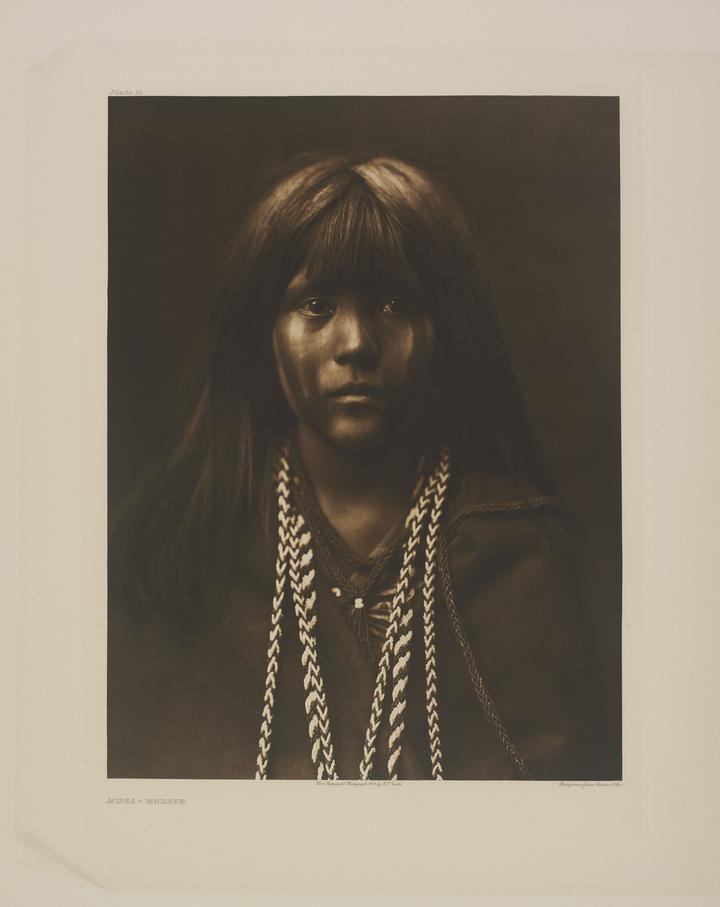
Mosa - Mohave
1 2018-03-16T21:13:01-07:00 Erik Loyer f862727c4b34febd6a0341bffd27f168a35aa637 29482 1 “Mosa –Mohave”, 1903, volume 2, portfolio plate 61, photogravure, 46 x 31 cm., Special Collection, Honnold Library, Claremont. plain 2018-03-16T21:13:01-07:00 Erik Loyer f862727c4b34febd6a0341bffd27f168a35aa637This page is referenced by:
-
1
2018-03-16T21:11:23-07:00
Mosa –Mohave
1
part of Visualizing the "Vanishing Race"
plain
2018-03-16T21:11:23-07:00
Ken Gonzales-Day, Scripps CollegeTaken in 1903, “Mosa” and later included in volume two, will be one of the key images presented to financer J. P. Morgan in 1906 when they finally meet, as Curtis continues his search for a backer for his ambitious project. According to Timothy Egan’s recent biography, Short Nights of the Shadow Cather, Curtis was able to win Morgan over once he showed him the image of Mosa, a young Mohave girl. Curtis took at least two shots of her, one facing away from the camera in a near profile, and the second facing the camera. Her face is painted and she wears a series of braided necklaces, her body enveloped in a dark blanket. The blanket will become a familiar Curtis trick throughout The North American Indian and often served to hide clothing that appeared too modern and threatened to break the nostalgic feel he worked so hard to create. In another image, also from 1903, entitled “Judith – Mohave” one sees another young woman presumably taken against the same plain backdrop but this time her blanket has mysteriously fallen away to reveal her bare breasts (another version of this image was included in The North American Indian). The blanket is draped gingerly over one shoulder and its presence subtly shifts the visual language of the image from “nude” to “naked.” Even the angle at which the photograph was shot suggests that she is turning towards the camera, when in fact she is not. Her blanket and woven necklaces appear strikingly similar to those seen in the “Mosa” images and suggests these items may have been props. Judith’s nudity is all the more startling when the two images are taken together, as they would be in viewing the whole portfolio. With Morgan’s assured support, Curtis is able to finally begin to work on the project nearly full time. His agreement with Morgan stipulated what was to become, a twenty volume illustrated text on Native Americans, complete with an oversized portfolio of prints for each volume. Morgan agreed to give $ 75,000 over a five-year period, and in return he would receive a number of complete sets. Morgan’s money was specifically given to support the fieldwork and in return Curtis promised to produce the subscription sales that would fund the publication and potentially produce his profit. The edition size was set at 500 but by 1930 Curtis only manages to sell about 220 sets. Perhaps the greatest obstacle to selling subscriptions was the hefty price tag, about $3,000 in 1907 and the price rose to about $4,200 by 1924. The volumes were to be bound in leather, would be printed on the finest paper, but by 1912 only the first eight volumes had been completed and all of the Morgan money was gone. Paying for translators, editors, models, transportation, and other related expenses Curtis managed to accrue incredible amounts of debt and had to go back to Morgan for a loan. In an unfortunate turn of events, J. P. Morgan senior died rather suddenly in 1913, but to Curtis’ great relief, his son, J. P. Morgan Jr., agreed to continue funding the project to its completion. One can’t help but wonder if Morgan Sr. would have been so generous. By 1915, ten volumes had been completed, but sales and production were dramatically slowed by the U. S. entry into World War I, and getting the same Dutch paper became impossible. The project was not without its detractors, as becomes clear in these excerpts from a local Tacoma paper, entitled, “Cost Million for History of Indians.” The article begins:Edward S. Curtis wanted some money. He needed a good-sized wad, and he got it. Plucked a big fat pile from the original plucker himself. P. L. U. Plucker of Pluckervllle –from J. Pierp Morgan. Curtis had spent some years learning how to gargle Siwash and Chinook and other Indian dialects. It was about that time that "The Idea" hit Curtis. He was getting together the best collection of Indian pictures in this state. Why not get up the best one in the whole country? Eh, why not? Some Indians, perhaps, wouldn't let you photograph them? Well, that's easy. Ed Curtis would just go back to his pad and pencil. For before he attained the heights of photography, Curtis was an artist. Of course a collection so pretentious would need a historical review of the American Indian. But Curtis was not dismayed. Why couldn’t he write books? Curtis revolved The Idea in his mind quite thoroughly. There was left but one objection – he needed money. That’s when Curtis struck J. Pierp. He had read somewhere that Morgan had oodles of money somewhere he had also read that King Pierp. was bugs on art stuff..Published in 1922, the newspaper also ran a small article on the bottom of the same page noting the Morgan and his son were being called before an ethics boards in Washington D.C.