Versatile - We Sell Brown (Official Music Video) Some content may be offensive. Viewer discretion advised.
1 2018-08-25T06:07:10-07:00 Marc Thorman f2b57c456bb408491ab2cdffaf869c4905420054 30914 2 Written x Directed by Alex Sheehan & Casey Walsh Produced by Victerrific Videography: OUTBURST: https://www.facebook.com plain 2018-09-15T03:48:54-07:00 YouTube 2017-03-28T18:09:49.000Z J9itTOnHUmM OUTBURST PAL Marc Thorman f2b57c456bb408491ab2cdffaf869c4905420054This page is referenced by:
-
1
2018-08-15T23:02:41-07:00
IRISH & IRISH-AMERICAN MUSIC IN THE 20th/21st CENTURIES
66
plain
2024-09-06T00:01:22-07:00
Video Presentation: Irish and Irish-American Music 5 - Irish-American Music in the Early 20th Century
Two developments in the early twentieth century had a radical effect on traditional Irish music. One was the rise of recording technology and the commodification of Irish music and, eventually, dance. Recordings made in the early twentieth century by Irish emigrants circulated by the thousands throughout the U.S. and Ireland. Radio broadcast made the music available to thousands more. Dance music became listening music, and the amateur music making in private settings in Ireland declined, especially as the artists who recorded set an impossibly high standard for most traditional instrumentalists. Regional playing styles also declined, as the most famous of the recordings established the County Sligo regional playing style as a standard.
INTRODUCTION
An equally momentous event was the development of ensemble playing of traditional music. Prior to 1900 tunes were played by solo instrumentalists, perhaps with the accompaniment of a tambourine; in the late nineteenth century, a piano might provide background harmonic accompaniment. Throughout the early 20th century (in addition to solo playing), duets, trios, and larger bands played tunes in unison, with a vamping piano.IRISH MUSIC THRU 1960
Ireland achieved independence in 1922, just as jazz was becoming the most popular music in the U.S. and spreading internationally. Ireland's newly empowered Catholic church, backed by a conservative government, condemned jazz and "jazz dancing." By 1937 all dancing was effectively banned except in approved venues, with ticket revenue and taxes going to the Church and Government. The dances were those
céilí set dances approved by the Gaelic League. With house dances no longer legal, dances moved to larger venues such as local parish halls and village halls where the activities were supervised by the local parish priest.
In order to make the music loud to fill these larger spaces, céilí bands formed, comprised of an assortment of traditional unamplified instruments including fiddle, whistle, flute, and accordion, with the addition of piano and drums to emphasize rhythm.
During the 1950s and 1960s approximately half of the population of Ireland was under 25. In Ireland showbands — singers backed by electric guitars, electric bass, drum set, and often saxophone — performed at dances and toured locally playing American and English pop dance music.IRISH-AMERICAN MUSIC THRU 1960: MARKETING AMERICAN "IRISHNESS"
By the late nineteenth and early twentieth century Irish-Americans were woven into the fabric of mainstream American life. The Irish community had its internationally known heroes — the undefeated boxer John Sullivan, the billionaire miner John MacKay.
In the early twentieth century recordings by Irish immigrants Michael Coleman, James Morrison, and Paddy Killoran (fiddlers) and flutist John McKenna set new standards for Irish dance music with their brilliant playing. Michael Coleman's recordings created an enduring template for traditional music — three tunes played three times each, with changes of key between major and its relative minor and other closely related keys a feature. [Vallely] The recording industry was a boon for many Irish emigrant performers, some of whom became prominent businessmen and socially celebrated figures.
♦♦♦
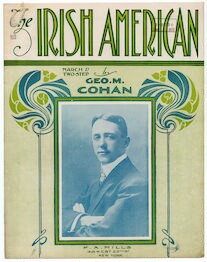
In the field of music and dance, the self-made patriotic Irish-American is best illustrated by the career and songs of George M. Cohan. Though he started out as a poor Irish-American kid from Providence, when he died in 1942 the New York Times praised him as "the greatest single figure the American theatre ever produced – as a player, playwright, actor, composer and producer." In Cohan's hands, "music hall severed its links with immigrant culture and became American." [Vallely]
Cohan's first full-length production, Little Johnny Jones (1904), is often credited as the first American Musical. This hit show is emblematic of the new status of Irish in the United States — successful, patriotic, and assimilated. Johnny Jones, an Irish-American jockey, travels with friends to Ireland to enter a race. In a plot twist his friends must return to New York before him. As they leave he sings "Give my regards to Broadway / Remember me to Harold Square." His heart "yearns for the old time throng" but the old time throng is now in Manhattan, not in Dublin.
In the early part of the twentieth century, Tin Pan Alley songwriters who were not Irish and knew little or nothing of traditional Irish music cranked out thousands of upbeat and sentimental songs that became accepted by the public as authentic examples of mainstream Irish America. Throughout the decades of the 1930s - 1950s American perceptions of Ireland and the Irish were molded by characterizations and stereotypes manufactured by Hollywood. Irish-American actors dominated much of what American and Irish moviegoers saw on the screen. Earlier stereotypes of Irish as shiftless, brutal, and illiterate were replaced by those of the priest, the good cop, and the happy-go-lucky tippler. Hollywood movies popularized St. Patrick's Day as a secular celebration that could be shared by all Americans. In Ireland St. Patrick's Day is a religious holiday. Until the late 1990s, when the American-style celebration was adopted as a tourist attraction, there were no parades, festivals, or drinking bouts on March 17 in Irish cities. The creation of a special day when anyone of any ethnicity can don a "Kiss Me I'm Irish" tee shirt is an American invention.
John Ford's 1952 movie The Quiet Man portrays Ireland as an Edenic never-neverland of emerald landscapes, picturesque cottages and wizened peasants. In Disney Studio's 1959 Darby O'Gill and the Little People, Ireland is a land of leprechauns, pots of gold, and magic fiddles. Irish songs like "Danny Boy" became so well-known and well-liked that they could be covered by Jackie Wilson, a black R&B singer, on American television in the mid-twentieth century.
IRISH & IRISH-AMERICAN MUSIC AFTER 1960
INTRODUCTION
By the 1970s, Ireland had undergone a rapid series of pivotal changes. The self-conscious nativism of the 1940s had given way to an emergent pluralism, urbanisation and instrialisation. Ireland's entry into the European Economic Community was followed by a welcome boost in regional development, improved educational standards and new levels of Irish tourism. By then, the youth of the nation was also being absorbed into the mainstream of American popular culture.
As musicians pondered their new-found notoriety in the 1970s and 1980s, it became self-evident that Irish traditional music had finally migrated beyond its old communal settings and entered the realm of popular culture.
Tape recorders now augmented the oral process, and mass commercial recordings of Irish traditional music became more commonplace. Throughout the 1970s and 1980s, the commercial life of traditional music became intense and competitive. As new concepts of cultural economics and heritage tourism began to emerge, traditional musicians, singers and dancers became marketing icons for the Irish tourist industry.
The past twenty-five years witnessed a succession of new musical liaisons, within which traditional music gelled with rock music, contemporary folk, as well as American and Eastern European folk musics.
Throughout the 1990s, there has been much debate about continuity and change, purism and innovation in Irish traditional music. The subject of conferences and various media exchanges, this debate has been fueled mainly by the growing commercialization of Irish traditional music, which as marginalized local as well as older performers and styles in Ireland and North America.
In the transition from the traditional to the professional domain, younger players were quick to endorse the festival circuit and the career of the celebrity, while any older players were deeply disturbed by the fact that multimedia entrepreneurs were packaging Irish traditional music for mammoth television audiences -- with little regard for the legitimate integrity of the tradition. Many traditional singers resented the fact that popular music celebrities, with no competency in the Irish language, could record hit songs in Irish, which they learnt phonetically. Others were concerned that performers and companies with no previous connections with Irish music were rapidly producing 'Celtic' albums and videos to capitalize on the global market created by Riverdance, and forging commercial links with African, Cajun and other World Music genres which had no basis in music history.
Throughout the 1990s, purists questioned the motives of drinks companies which issued lists of 'official pub sessions' to tourists arriving in Ireland. Their peers in the United States disputed the fact that the term 'fleadh' (which had been associated with communal festivals since the 1950s) was now being used as a marketing vehicle encompassing all types of professional entertainment. Conversely, innovators and administrators within the traditional domain regarded corporate sponsorship as a necessary prerequisite to stage national festivals which helped safeguard the future of the living tradition.
[Ó hAllmhuráin, Gearóid, O'Brien's Pocket History of Irish Traditional Music]FOLK MUSIC REVIVALS AND THE BIRTH OF SESSIONS
ROCK AND ROCK FUSIONS
IRISH & IRISH-AMERICAN MUSIC IN THE LATE 20TH CENTURYIRISH & IRISH-AMERICAN RAP AND HIP HOP
IRISH RAP AND HIP HOP
Wee Goose jokingly describes "Belfast Mentality" as "everyday life in the city of Belfast as summarized into an educational rap song." The song is a modern ballad told from a first-person point of view. The video treats serious topics — drugs, arrests — with cheeky irreverence and ends with a farcical duel. With its ironic tone and matter-of-fact delivery "Belfast Mentality" might also be considered as an extension of "mock epic" literary works that place anti-heroes into ridiculous or trivial situations, making the epic prosaic. Literary critics would not place Wee Goose's only published song in the realm of great works in the mock epic tradition: Don Quixote, Tom Jones, or Joyce's Ulysses. But "Belfast Mentality" is a different sort of product than those novels because it a mini-movie that integrates story, conversational rap, musical background, and images.
Ian Maleney "Rusangano Family: Today what makes an Irish person is a mix of a lot of things." The Irish Times, April 2016.
Hare Squead, "Long Way to Go" (2016)
Interview with Hare Squead by Harriet Gibsone, The Guardian, September 2017
Ben Haggerty (stage name Macklemore) and Ryan Lewis are a Seattle-based hip hop duo formed in 2008. Together they have won four Grammy Awards, and they made history when their first two singles both made Billboard's Hot 100 Chart.
IRISH-AMERICAN RAP AND HIP HOP
Mackelmore's 2017 song "Irish Celebration" refers to his Irish ancestry. The song came under fire in an article by Michael Hugh Walker in The Economist, entitled "Americans - especially Macklemore - take note: real Irish people aren't impressed by your St. Patrick's Day craic [celebration]."
"How romantic a vision that is – petrol bombs, eh? Nothing like ‘em!" Walker comments sarcastically. The author proceeds to call out the "plastic paddy" on other inaccuracies and perceived insensitivities, and concludes:Sadly, sometimes the most offensive concept of what Irishness is comes from a plastic paddy whose Irishness is a bizaare caricature. They believe it is a mixture of militant nationalism, a hatred of partition, an idealisation of the IRA and an obsession with alcohol. [According to Macklemore's song] we [Irish] have whiskey in our veins. [Macklemore] fantasises about when the English came, "the coloniser came / They filled up bottles of gasoline, turned 'em into balls of flame / And hurled 'em to protect what's ours / Don't touch these lucky charms."
[Michael Hugh Walker, "Americans - especially Macklemore - take note: real Irish people aren't impressed by your St Patrick's Day craic," The Independent, March 17, 2017.]Macklemore aside, Irishness is a broad church. No one viewpoint has a monopoly over what Irish nationality is. It's complex and it's multi-layered, and with the greatest respect, the least appropriate people to determine what that is, is a Boston inhabitant who has been living in America his whole life.I love Boston, and I love the adoration which it has for Ireland. But for God’s sake, before you to preach to me about what that is, learn what being Irish can mean.
In a 2011 interview, Macklemore responds to criticism leveled at "Irish Celebration":Kev Storrs: To put together a song like Irish Celebration you need to know a bit about Irish history. Is that something you grew up with?
Macklemore: Yeah I think that obviously I’m coming from the perspective of someone who was born and raised in America, but with a lineage or heritage derived from here. So when I wrote it I wanted to be careful, and more than anything I wanted to show it from my family’s perspective. Like, I don’t know what it’s like to grow up here so that’s not my place.
Kev Storrs: Often Irish Americans tend to think of Ireland as the place their grandparents left, whereas it’s moved on. I think you managed to avoid some of those cliches..
Macklemore: Yeah. I mean the reaction has been pretty good. Obviously there were people who were like “Fuck this Yank”, but really the song is about celebrating life. It celebrates my ancestry and culture.. and the response it got last night makes it worthwhile. All the negative shit that came out of that song has been surpassed by the positive. Any time you have a song that has any sort of political background there’s always going to be two sides. There’s a couple of bars like “Fuck the London guard”, the anti-British stuff.
Kev Storrs: Funny thing is, most people love that line!
Macklemore: Haha I know right! So like that’s the political side but you know overall I think it’s about celebration and life.