Traditional Korean Lion Dance Part 2
1 2020-04-28T07:26:32-07:00 Marc Thorman f2b57c456bb408491ab2cdffaf869c4905420054 30914 1 The second part to the performance of the traditional dance, Hanok Village, Jeonju City, South Korea. "Korean traditional dance originated in ancient ... plain 2020-04-28T07:26:32-07:00 YouTube lisseque 2012-03-08T11:43:42.000Z izhWsAdEU9I Marc Thorman f2b57c456bb408491ab2cdffaf869c4905420054This page is referenced by:
-
1
media/bts-k-pop.jpg
2018-09-01T17:48:05-07:00
SOUTH KOREAN POPULAR MUSIC
28
image_header
2024-02-04T11:39:37-08:00
Header image: K-POP band BTS. Source: Wikipedia via the Korean Culture and Information Service, CC BY 2.0
KOREAN IMMIGRATION AND KOREAN AMERICANS
The 2000 U.S. census counted nearly 1,077,000 Korean Americans and nearly 1.3 million including "mixed blood."
In 1924, the U.S. Congress designated Asia as a "barred zone" from which immigration was totally prohibited. Asians were ineligible for citizenship and thus could not own property. Koreans were also subjected to employment discrimination and housing segregation. The prohibition was finally lifted during the Korean War in 1952, allowing Korean Americans to vote. Thereafter, Korean immigration to the United States mainland occurred in two waves. The first, beginning in 1950, "consists of women who married American soldiers, and children adopted into [mostly white] American families. Nearly 100,000 so-called 'military brides' entered the United States between 1950 and 1989, while approximately 300,000 Korean adoptees entered the United States beginning in 1953."
The second wave of Korean immigrants to mainland America began in 1967 when Koreans came to the U.S. under the occupational and family reunification preferences of the 1965 Immigration Act. Most of these immigrants settled in New York, Chicago, Los Angeles, and New Jersey. According to a BBC News article, nearly sixty percent of second-generation Korean Americans completed a four-year college eduction in 2011. Many enter into presigious fields. On the other hand, many Korean Americans are engaged in low-level jobs.
"In 1994, the National Association of Korean Americans, following the tradition and spirit of the early Korean National Association, was founded in New York, becoming the first national civil and human rights organization of Korean Americans."
[National Association of Korean Americans and U.S. Census Bureau]K-POP
INTRODUCTION
K-Pop is part of the 1990s Korean cultural wave, known as “Hallyu,” occurring during South Korea’s dramatic economic expansion and globalization. From its status after the Korean War as the poorest country in the world, South Korea has become a major world player in manufacture, trade, and finance, and an expert wielder of soft power. The 1988 Olympics held in the gleaming city of Seoul elevated South Korea to international prominence. Psy’s Gangnam Style opened the pop music floodgates in 2012. Armies of boy groups and girls groups followed. K-Pop conquered America in 2017 when boy band BTS rocketed to the top of the U.S. pop charts. BTS now rules a Twitter empire:
There is no K-Pop without MVs — K-Pop is dance, fashion, image, cinematography, color, concept, style, business, collaboration, perfect hair and plastic surgery. K-Pop is everywhere, branded, marketed, and industrialized by conglomerates. The South Korean girl group Red Velvet plays in North Korea for Kim Jong Un. Korean-American Jay Park’s first YouTube video gets 2M views in 24 hours. His albums go multiplatinum internationally in less than a week. 2PM is interviewed on Thai TV. Boy band Big Bang tours the world — twice. Korean breakdance crews stun judges and win one international dance competition after another, then go on to pricey drone endorsement gigs. Language is no barrier to international fandom — there are lots of English words and phrases in K-Pop, or there are captions in several languages, or the words don’t matter, or there aren’t any words, just nonsense syllables.On November 20, 2017 Guinness World Records revealed that BTS had earned a spot in their 2018 edition for "having the world's most Twitter engagements for a music group". That December, they were revealed to be the most tweeted about celebrity in 2017, being "liked or retweeted over half a billion times (502 million)" worldwide, more than Trump and Bieber combined. BTS' achievements led the group to be ranked number one on Forbes Korea Power Celebrity list for 2018, a list ranking South Korea's most powerful and influential celebrities. ["BTS" Wikipedia]
LIFE BEFORE K-POP — THE CHRONOLOGY
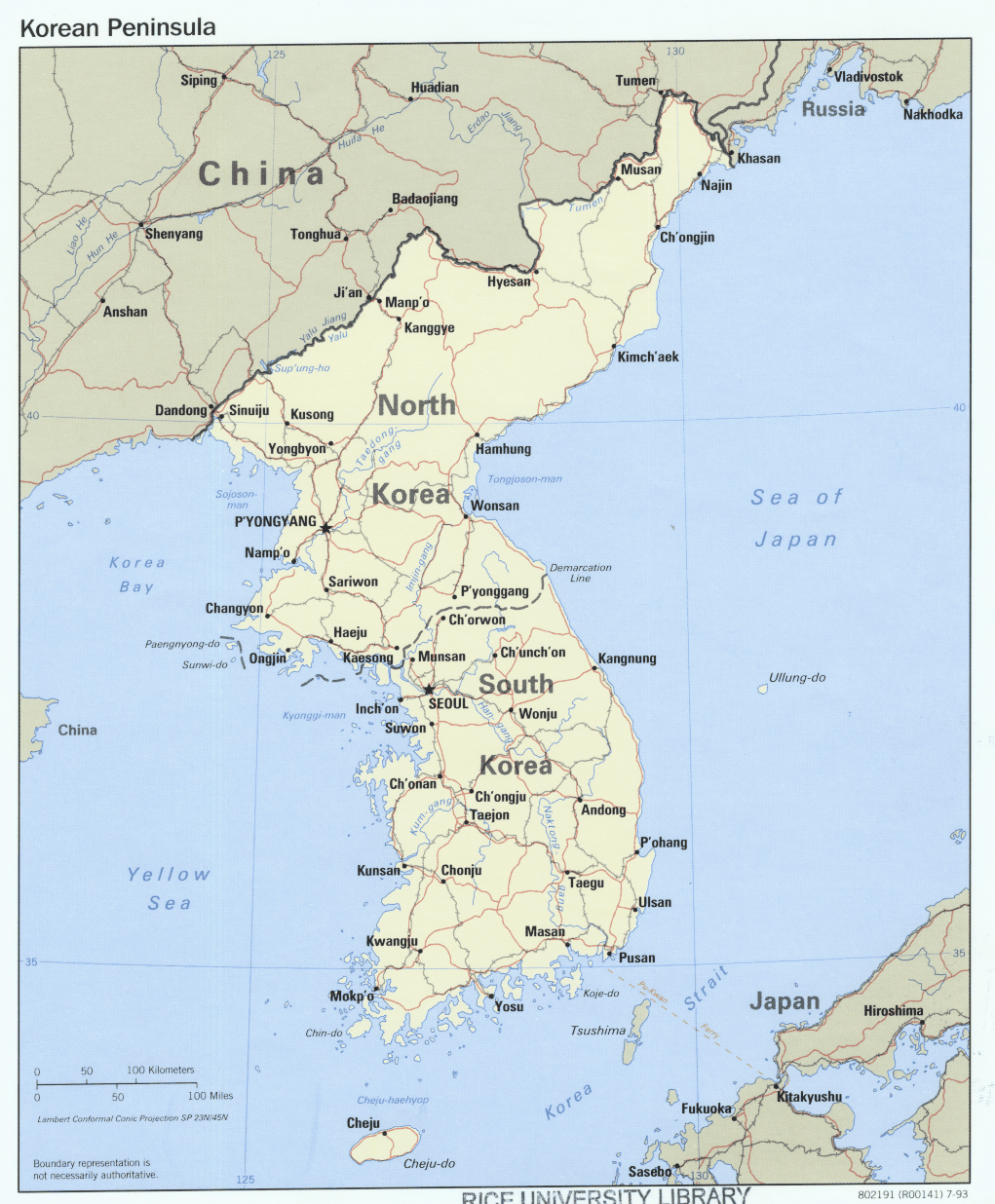
Korean popular musics grew out of conditions of occupation and war. First, Japanese colonial rule from 1910-1945, then after WWII the occupation of South Korea by the U.S., followed by the devastation of the Korean War, and rebuilding under dictator C. H. Park.
Under Japanese occupation, Korea underwent rapid expansion in urbanization, technology, industry, and commerce. The technologies of recording and broadcasting made a wide range of music available. By the 1920s a popular Korean song heard by city dwellers in theaters, bars, movie houses, and cafés might mix European instruments, Korean words, Japanese melody, and the stylings of early American jazz. The first concert of popular music in Korea took place in 1933. By the time of the Japanese surrender in August 1945, Korea was the second-most industrialized nation in Asia after Japan itself.
The victors of World War II divided the peninsula into zones occupied by the the Soviets in the North and the Americans in the South. With no agreement on unification, two separate governments were established. South Korea was officially named the Republic of Korea, or ROK. North Korean forces invaded the South in 1950, beginning the Korean War. The North drew support from China, the South from the U. S. After three bloody years of fighting, in which some 3 million Koreans, 1 million Chinese, and 54,000 Americans were killed, the dividing line between the two antagonistic states was unchanged. [Asia for Educators]
South Korea underwent another revolution: the end of Japanese musical dominance, and the beginning of American musical hegemony. With Korea’s economy devastated by war, the soldiers stationed over a vast network of U.S. military bases were practically the only consumers of music performed and recorded by Koreans, who catered to American tastes by imitating then-current American popular music. In the late 1950s, revenues from performances for U.S. GIs probably exceeded the total export earnings of South Korea. [John Lie, K-Pop: Popular Music, Cultural Amnesia, and Economic Innovation in South Korea, University of California Press.]
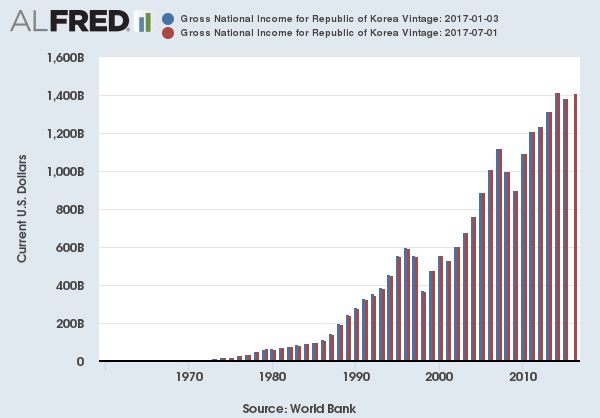
South Korea was under the dictatorship of Chung Hee Park from 1961-1979. Park spurred the growth plan that led to South Korea’s modernization. The beginning of that era saw the growth of recording industry and radio and TV broadcasting, creating a national style of popular song — called trot — that spoke of the post-war experiences of common people in an emotional style that’s been linked to the Korean folk art p’ansori. To a new generation, trot was sloppily sentimental and old-fashioned. To Chung Hee Park, trot reeked of Japanese influence. The new types of popular music in ROK at the beginning of the 60s were exemplified by the pop styling of Myong suk Han's "The Boy in the Yellow Shirt" and Add4's Beatles-influenced pop rock. Most of Korea however, lacking electricity, was without access to American popular music, or found American music loud and alien. In the 1970s average income in ROK shot up by more than 100 percent; but as the Park regime became increasingly authoritarian and repressive, American-style psychedelic rock and folk revival songs were banned, due to concerns over morality or political content.
All of this changed in the 1980s as indicated by this chart showing growth in GNI in South Korea from 1960 to 2017.The crescendo of the government’s crackdown— the ban on long hair in 1970, and on miniskirts in 1973— climaxed in 1975 with Presidential Emergency Decree Number 9. The 1975 edict banned South Korean records and 261 foreign songs, on the grounds of everything from “negative influences on national security” to “pessimistic content.” Later that year, in December, Sin [leader of Add4] was imprisoned in connection with a sensational marijuana scandal. Thereafter, and until the mid-1980s, rock music was silenced in the South Korean soundscape, along with the nascent culture of rock music, including sexy clothing. [John Lie]
With an extraordinary and unprecedented rise in wealth in the ROK, the younger generation was able to become independent and create a market for popular music idioms of the West that had long been suppressed by the military government. The puritanical stance of the government and the sanctimoniousness of the student protest music were upset by a new art form — the music video. The rise of MTV and Michael Jackson's superb dancing skills brought popular music and dance together and set the stage for K-Pop's focus on the integration of music, dance, and image. Wan-Son Kim, the "Korean Madonna," and Nam-jung Pak, the "Korean Michael Jackson," sang peppy songs and became known for their dynamic dancing. K-Pop's idol groups were prefigured by Sobangch'a ("Firetruck") in 1987. That same year, massive political protests by all segments of society across South Korea led to the transition to political democracy.South Korea in the mid-1980s was a morass of change and contradiction. Affluence and poverty, starkly juxtaposed, coexisted with a military rule that seemed permanently engaged in surveillance and discipline. Students and workers demonstrated; riot police beat them into submission. Popular music was part and parcel of the entrenched struggles. [John Lie]
TRADITIONAL KOREAN CULTURAL MEMES IN TOPP DOGG's "ARARIO"
"Arario" by Topp Dogg is an irreverent yet affectionate reference to "Arirang," an ancient Korean folk song so well-known that it is often referred to as the unofficial national anthem.
The tune, costumes, instruments, dance forms, and images in the video of "Arario" are instantly recognizable as references to Korean classical and folk traditions. "Arario" is an interesting mixture of old and new, traditional and modern, folk and commercial, local and global.
The video begins with closeups of women playing gaegums, the instrument most emblematic of dynastic Korea. The scene opens out to reveal colorful barrel drums in the center. Dancers move in a circle around them, playing the drums and gongs of Korea's most famous folk music, pungmul. Popping up throughout the video are dancers in traditional masks worn in Korean folk dances. Also joining the party is the masked lion dancer, the Korean version of a Chinese traditional dance form. At times the band members imitate Hallyangmu, the dance of Confucian scholars who were high-status members of the leisure class in Jeosheon society. In the last minute or so, the piercing sound of the traditional reed instrument, the taepyeongso, joins in for the climax.
The taepyeongso can also be heard (and seen) in this extract from a 2017 performance by Korean rock band AUX:PROMINENT MALE K-POP GROUPS 2009-2015
- SUPER JUNIOR "Sorry, Sorry" (2009)
- 2PM "Hands Up" (2011)
- B.A.P. "No Mercy" (2012)
- G DRAGON "Crayon" (2012)
- BIG BANG "Bang Bang Bang" (2015)
- EXO "Call Me Baby" (2015)
- IKON "Dumb and Dumber" (2015)
- BTS "Dope" (2015), surpassed 350 million views on YouTube in August 2018.
PROMINENT FEMALE K-POP GROUPS 2010-2017
- WONDER GIRLS "Tell Me" (2010)
- 2NE1 "I Am The Best" (2011)
- HYUNA "Bubble Pop" (2011)
- GIRLS GENERATION "I Got a Boy" (2012) (see also)
- RED VELVET "Happiness" (2017)
SOUTH KOREAN RAP & HIP HOP
OLD SCHOOL
In this video from 2006, a late seventeenth-century German instrumental composition is arranged for traditional Korean gayegeums, and combined with old-school hip hop elements: DJ and beat box. The dancers are b-boys from the world champion crew Last For One.CONTEMPORARY
SOUTH KOREAN RAPPERS KEITH APE, JayAllDay, & Okasian. The third rapper, Loota, is Japanese. The last rapper in the video, Kohh, is the current superstar of Japanese rap. CLICK the CC icon for English translation. Some content may be offensive.Viewer discretion advised.
"It G Ma" is heavily influenced by trap, obviously modeled on Atlanta rapper OG Maco's "U Guessed It." The salty, rowdy style of the song is purposefully at odds with K-Pop, the girl band and boy bands promoted by the Korean recording industry. “It G Ma,” says Keith Ape, “is not necessarily a rap about struggle, but it’s definitely using the method of a turn-up to appeal to people who are antisocial, people not accepted in what’s considered mainstream, people who feel alone and disconnected.”“It G M' has made a proportionately larger impact in the United States than in South Korea. Last month, a remix was released featuring the hyperenergetic American rappers ASAP Ferg and Waka Flocka Flame, the oddball Father as well as the dexterous Korean-American rapper Dumbfoundead. It’s on iTunes, but no version of “It G Ma” is commercially available at any South Korean music retail outlets. [Jon Caramanica, "Getting Rowdy: Keith Ape and Real Rap in Korea," New York Times, August 13, 2015]
RESOURCES
- https://www.koreanculture.org/
- http://sori.nyc/about/
- https://asiasociety.org/arts
- https://www.koreasociety.org
REFERENCES
Euny Hong, The Birth of Korean Cool: How One Nation is Conquering the World through Pop Culture, Picador, New York, 2014.
John Lie, K-Pop: Popular Music, Cultural Amnesia, and Economic Innovation in South Korea, University of California Press, 2015.
Mark James Russell, K-Pop Now! The Korean Music Revolution, Tuttle Publishing, 2015.
Mark James Russell, Pop Goes Korea: Behind the Revolution in Movies, Music, and Internet Culture, Stone Bridge Press, Berkeley, CA, 2008.
Eun-Young Jung, "Transnational Migrations and YouTube Sensations: Korean Americans, Popular Music, and Social Media," Ethnomusicology, 58:1 (Winter 2014), 54-82. Available on JSTOR through Brooklyn College Library
Choe Sang-Hun & Mark Russell, "Bringing KPop to the West," The New York Times, March, 2012.
Aja Romano, "How K-pop Became a Global Phenomenon," Vox, February 2018.GROUP TOPICS
K-POP
How did K-Pop develop (post 1992)? Who are the primary original figures? In what ways does K-Pop draw on American popular music, and in what ways does it create its own identifying characteristics? Who are the main K-Pop musical groups?
How is K-Pop structured in terms of production and marketing? What are positive and negative outcomes of the K-Pop industry? How has K-Pop culture become globalized?SOUTH KOREAN RAP & HIP HOP
How and when did American hip hop culture begin to manifest in South Korea? Who were the original rappers? How has South Korean rap developed since its beginnings? Are there distinctive elements of South Korean rap and hip hop that distinguish it from its American roots? What are the opportunities for South Korean rap vs. obstacles to its wider acceptance (cultural, governmental, technological)?
.jpg)