"The mob went happily down Broadway..."
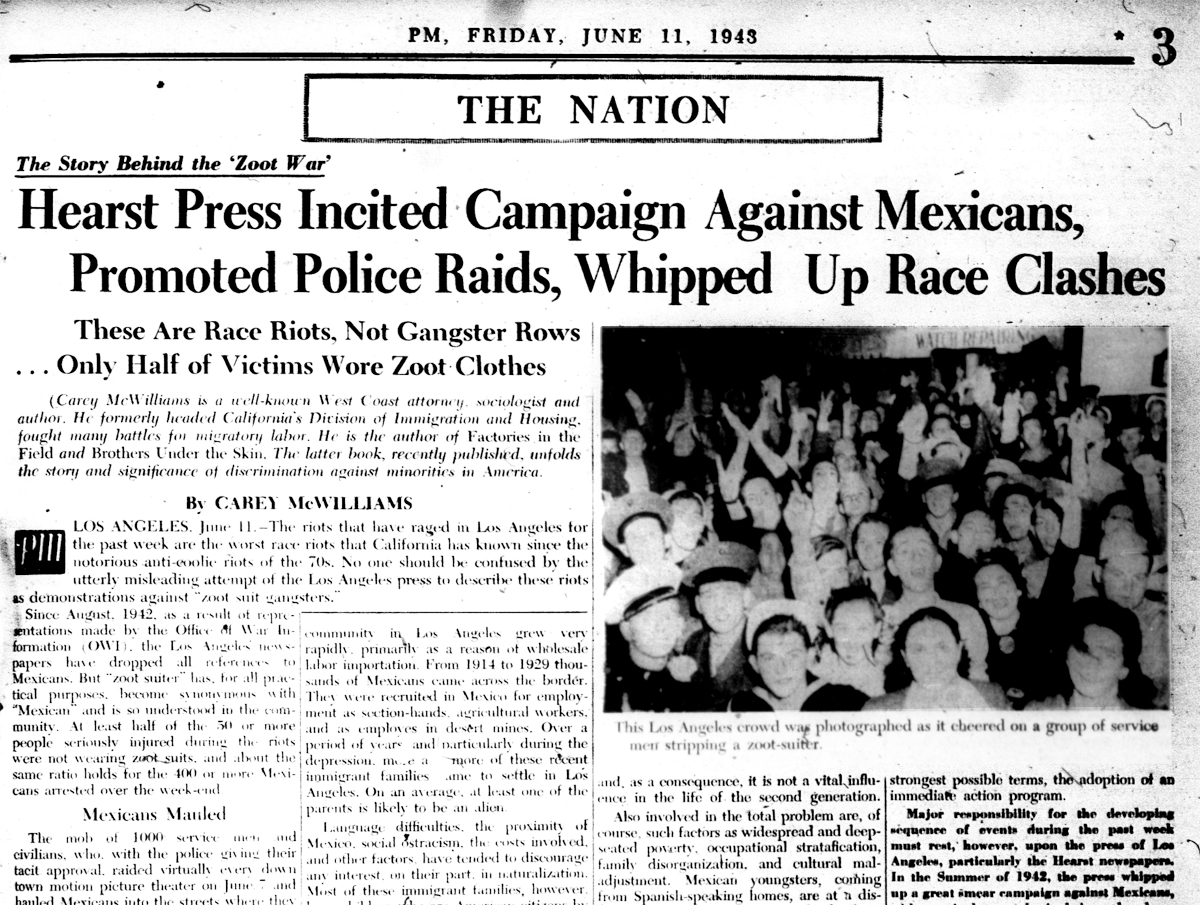
Carmen Theater is not the only theater that appears in reports from the event; in commentary from the five days of violence, many different theaters are named. At times reports broadly referred to Downtown Los Angeles’ relation to theaters, as with an entry from the Atlanta Daily World from that week. The article describes how “with increasing intensity every night, serious rioting has taken place” unexpectedly “even down on Broadway in the theatre district” (Levette). A feature in the Los Angeles Times quotes a Navy spokesman sending a warning to avoid theaters and other public places of recreation, stating that “it is advisable for all Navy personnel to stay off the streets and out of theaters and cocktail lounges” (“City, Navy Clamp Lid”). At the same time that it alerts Navy personnel to possible danger downtown, this article also rehearses a routine story, describing how “groups of servicemen roamed the streets, beating and disrobing zoot suit wearers whom they encountered on the sidewalks…in some cases taking youths from streetcars and out of moving-picture shows and manhandling them.” The violence of these acts is emphasized by renowned Los Angeles journalist, lawyer, and activist Carey McWilliams in his reporting at PM:
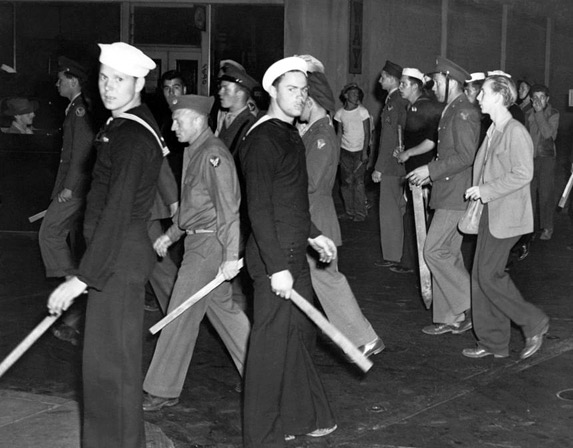

McWilliams adds dimension to the written narrative of the incident, by including details ignored by many contemporaneous journalists. First, he highlights race in describing who was pulled from movie theaters and streetcars. Not “youths,” “boys,” “customers,” nor “zoot suit wearers,” but “Mexicans.” Even the headline used for the article “Hearst Press Incited Campaign Against Mexicans, Promoted Police Raids, Whipped Up Race Clashes” explicitly refers to the significance of race and ethnicity in the riot. Second, like few other news stories from the time, McWilliams describes how attackers “did settle, in a few cases, for a Negro.” While race -- along with the attacks on African American men during the riot -- is considered in PM, and in the black newspapers Atlanta Daily World and the California Eagle, it was not mentioned in mainstream press accounts. The Los Angeles Times only brings up the issue of race to report Eleanor Roosevelt’s commentary about discrimination as an influence on the riots. The New York Times largely ignores the issue.The mob of 1000 servicemen and civilians who with the police giving their tacit approval, raided virtually every downtown motion picture on June 7 and hauled Mexicans into the streets where they were beaten, and, in several cases, stripped naked and left lying unconscious on the pavements, was looking for Mexicans, but they did settle, in a few cases, for a Negro. It cannot be too strongly emphasized that these were race riots.
The differences in reporting carried over into how the event was depicted in the national magazines Life and Time. Life depicts the events ambivalently, being careful not to characterize the sailors as the aggressors (“Soon combatants were seeking each other out in restaurants, theaters and bars”), while at the same time the short article does acknowledge that “Los Angeles has the biggest Mexican population of any city in the U.S.,” going on to say that “other observers recognized race prejudice as a factor which led servicemen to beset swarthy civilian youths wherever they saw them.”Time magazine took an even more sympathetic approach to the racialized population targeted in the riot, identifying without qualifications how race marked the Mexican American and Black youths for attack. The feature describes the downtown scene as a twisted carnival:
The mob went happily down Broadway, repeating in every theater, the Rialto, the Tower, Loew’s. Others dropped street-cars, pulled off zooters, Mexicans or just dark-complexioned males. On went the mob, ripping pants, beating the young civilians, into the Arcade, the Roxy, the Cameo, the Broadway, the Central and the New Million Dollar theaters.”
This page has paths:
- Pachuco Goes to the Movies Veronica Paredes