Ejected Spectatorship I: Race, Gender, and Space
A theoretical approach reaching its highest popularity in the 1970s, film theory around spectatorship and the cinematic apparatus brought together psychoanalytic and semiotic approaches to explore the charged relationship between the cinema spectator and the screen. In this type of analysis, film content becomes nearly irrelevant, as was the case in Christian Metz’s article “The Imaginary Signifier” from 1975. Applying Saussurean semiotics and Lacanian concepts to film theory, Metz proposed that it is not only the cinematic “signified,” i.e. a film’s content, its narrative, audio-visual composition, which is imaginary in cinema; the signifier, cinema as a system and/or apparatus is also imaginary – producing different levels of identification for the spectator modeled on Lacanian psychoanalysis. Through Metz’s “Imaginary Signifier,” the spectator becomes an omniscient, all seeing subject – primarily identifying with himself perceiving, and secondarily identifying with the characters portrayed on the screen. While this cursory summary only begins to hint at the debates in film studies stirred by the contributions of spectatorship and apparatus theories, most significant for this section is how Metz focused on the perceptual and psychic dimensions of identification involved in acts of cinematic spectatorship. While early on Laura Mulvey protested the totalizing nature of apparatus theories such as Metz’s, which ignored the influence of gender on any levels of identification, challenges to this conception of spectatorship began to proliferate in film and media studies with more frequency in the late 1980s.
Particularly pertinent for this project are reframings of film spectatorship that address the impact of race and ethnicity on identification. Focusing on black men as spectators, Manthia Diawara’s article “Black Spectatorship: Problems of Identification and Resistance,” (1988) outlines a “heuristic device” encapsulated in the interchangeability of the terms “black spectator” and “resisting spectator.” Though this is not meant to imply an exclusive relationship between the two, Diawara interrupts the previous theories of spectatorship that describe the position of the spectator with “recourse to the psychoanalytic account of [Lacan’s] mirror phase.” While Diawara means “black male spectators” in this article when he writes “black spectators,” his criticism against apparatus theory is significant for marginalized spectators generally. Consider the following construction’s usefulness in understanding black female spectators, Chican@ spectators, pachuc@ spectators: “spectators are socially and historically as well as psychically constituted” (846). He continues by pointing out the limitations of theories like Metz’s for these racialized, gendered, or sexualized spectators, “it is not clear whether the experiences of black spectators are included in this analysis.” For Diawara, however, his analysis is invested only in exploring the “racialized” component, or more specifically the experience of the “black [male] spectator.”
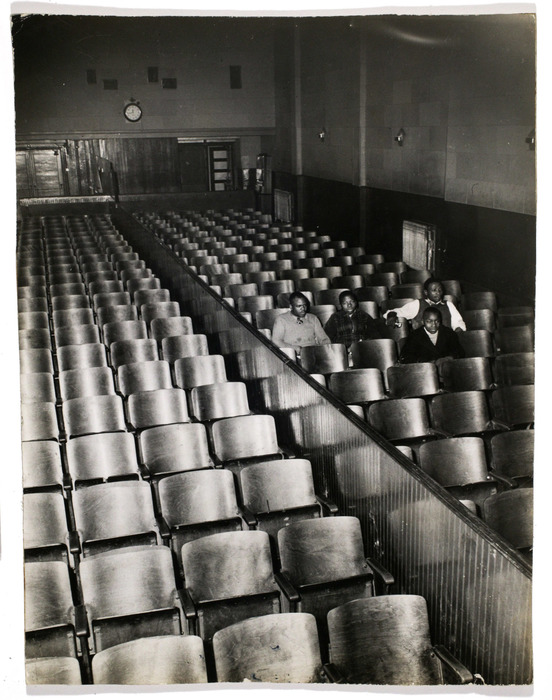
In Black Looks (1992), bell hooks’ chapter on “The Oppositional Gaze” made an important intervention to theorizing the “black spectator,” accounting for the “black female spectator.” hooks’ “oppositional gaze” objected both to the rigidity of theories around masculine spectatorship, represented here by Diawara’s “resistant spectatorship,” as well the lacunae of feminist theories of the gaze and spectatorship, which focused exclusively on gender through the perspective of white women, ignoring race and class as influences on the spectator’s experience. With the “oppositional gaze,” hooks described how looks and the act of looking are fraught for black female spectators, embedded in relations of power and submission in a white supremacist society. For their radical interventions, both Diawara and hooks primarily focused on spectatorship through the individual’s relationship to film content, paying little attention to the site of the movie theater or to the social dimensions of the moviegoing experience.
This page has paths:
- Pachuco Goes to the Movies Veronica Paredes