Constructing Data
What and How to Collect
Roopika Risam (on reproducing colonial knowledge and also on archive that contextualize colonial knowledge- think of Vanishing Race)Participatory and Community Based archive- example Lesbian Herstory Archives pg 140 Intersectional Feminism
Posner radical new digital humanities (shifts focus from mainstream to marginalized but also develops ways of representing people's lives in data "as they have been experienced, not as they have been captured and advanced by businesses and governments".
How to Encode Information
For digital collections, item information is frequently encoded in relational databases. A relational database is a structured set of data that contains a series of formally described tables from which data can be queried or organized in different ways. This structure enhances searching, browsing, and exhibition functions by enabling users to access items and reassemble collections based on tabular information.To create a collection with these functions, you can either build a relational database or use a content management system (CMS) that functions as a relational database, such as Wordpress [2].
Either way, before getting started you will want to develop a metadata schema for your collection. Metadata, or data about data, "provides a means of indexing, accessing, preserving, and discovering digital resources" [3]. While metadata can serve different functions related to these tasks, in this workshop we will be primarily concerned with its descriptive function [4]. Specifically, you will encode individual items with descriptive metadata and develop a schema to ensure that all of the items in your collection are described consistently to facilitate human and computational analysis. To create your metadata schema, it is generally advisable to build upon established ontologies and/or controlled vocabularies. Not only will this help you structure your data, but, ultimately, it will allow you to integrate your collection into Linked Data initiatives.
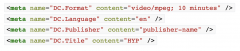
Over the years, Dublin Core (DC) has become one of the most popular ontologies and many CMSs developed and used by digital humanists integrate or are built upon DC standards, including Scalar, Omeka, CollectiveAccess, and Mukurtu.
In addition to Dublin Core, there are also specialized ontologies for visual culture (VRA Core) audiovisual content (PBCore), bibliographic information (BIBO), and media resources (IPTC), among others.
"Rather than flattening data into binaries to fit existing data models and international standards, we strive to represent uncertainty, historical contingency, conflict, variation, instability, and multidimensionality. The stakes are high: in an age when we recognize the right to be forgotten, we must also weigh the danger...of hiding our history" [5].
This page has paths:
- Data for Humanists Andrea Davis
This page references:
- Metadata Functions
- Custom Database
- Trevor Owens, "Defining Data for Humanists: Text, Artifact, Information or Evidence?"
- Relational Databse
- Gilliland, Introduction to Metadata
- Schwartz and Crompton, "Remaking History"
- Ontology
- Controlled Vocabulary
- Dublin Core Metadata Initiative (DCMI) Metadata Terms
- Encoding