Thanks for your patience during our recent outage at scalar.usc.edu. While Scalar content is loading normally now, saving is still slow, and Scalar's 'additional metadata' features have been disabled, which may interfere with features like timelines and maps that depend on metadata. This also means that saving a page or media item will remove its additional metadata. If this occurs, you can use the 'All versions' link at the bottom of the page to restore the earlier version. We are continuing to troubleshoot, and will provide further updates as needed. Note that this only affects Scalar projects at scalar.usc.edu, and not those hosted elsewhere.
12019-02-17T14:18:29-08:00Andrea Davise50475e163fb87bc8bd10c6c0244468fd91e8da5316362plain2019-02-17T14:21:39-08:00Andrea Davise50475e163fb87bc8bd10c6c0244468fd91e8da5"An ontology is a formal, machine-readable specification of a conceptual model in which concepts, properties, relationships, functions, constraints, and axioms are all explicitly defined. While an ontology is not technically a controlled vocabulary, it uses one or more controlled vocabularies for a defined domain. Identifying an existing ontology, or developing an appropriate ontology, is the first step in expressing data as linked open data (LOD)." "Glossary" in Murtha Baca, ed., Introduction to Metadata, Third (Los Angeles: Getty Research Institute, 2016), http://www.getty.edu/publications/intrometadata/.
This page is referenced by:
1media/1505283b821541de196157757c467ead.jpg2019-01-04T13:05:44-08:00Constructing Data293plain2019-02-19T13:20:35-08:00As a model of knowledge, datasets not only represent information for the purposes of study. They also embody a range of ideas and practices related to the broader politics of representation, inclusion, and access. Therefore, as Trevor Owens of the Library of Congress explains, constructing a dataset requires careful "choices about what and how to collect and how to encode the information" [1].
Collecting
Roopika Risam (on reproducing colonial knowledge and also on archive that contextualize colonial knowledge- think of Vanishing Race) Participatory and Community Based archive- example Lesbian Herstory Archives pg 140 Intersectional Feminism Posner radical new digital humanities (shifts focus from mainstream to marginalized but also develops ways of representing people's lives in data "as they have been experienced, not as they have been captured and advanced by businesses and governments".
Collection Activity
Encoding
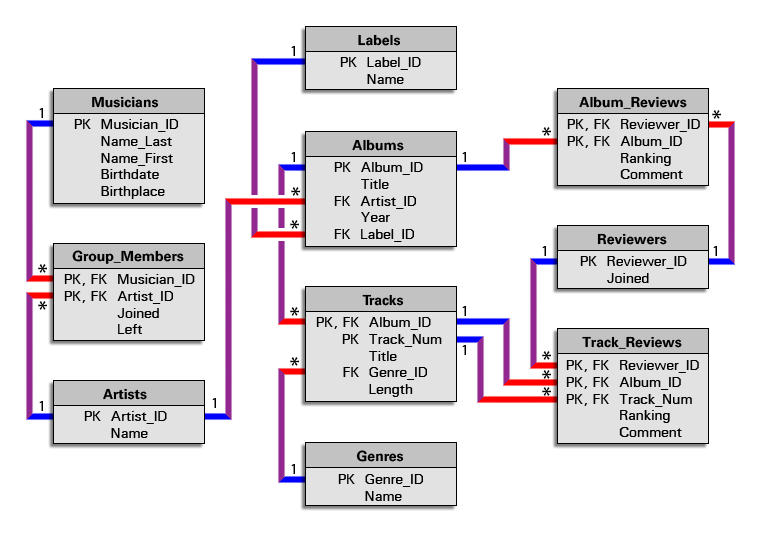
For digital collections, item information is frequently encoded in relational databases. A relational database is a structured set of data that contains a series of formally described tables from which data can be queried or organized in different ways. This structure enhances searching, browsing, and exhibition functions by enabling users to access items and reassemble collections based on tabular information. To create a collection with these functions, you can either build a relational database or use a content management system (CMS) that functions as a relational database [2].
Either way, before getting started you will want to develop a metadata schema for your collection. Metadata, or data about data, "provides a means of indexing, accessing, preserving, and discovering digital resources" [3]. While metadata can serve different functions related to these tasks, in this workshop we will be primarily concerned with its descriptive function [4]. Specifically, you will learn how to encode individual items with descriptive metadata and develop a schema to ensure that all of the items in your collection are described consistently to facilitate human and computational analysis.
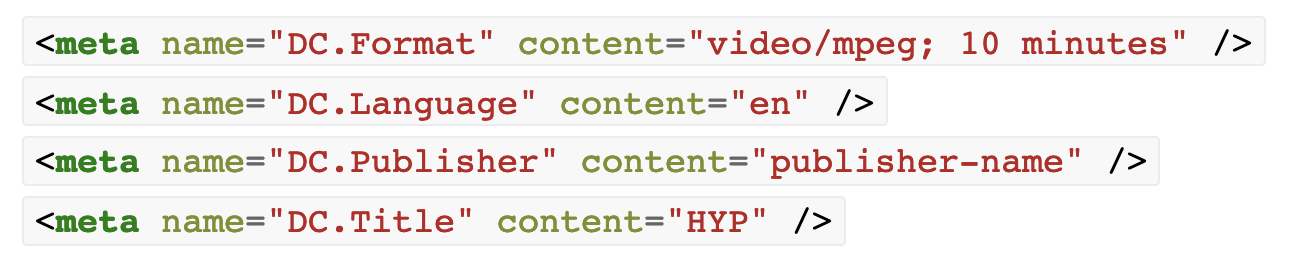
To create your metadata schema, it is generally advisable to build upon established ontologies and/or controlled vocabularies. Not only will this help you structure your data, but, ultimately, it will allow you to integrate your collection into Linked Data initiatives. For the purposes of this workshop, we will build our schemas on Dublin Core (DC), which is one of the most popular ontologies for describing digital resources. Dublin Core consists of fifteen elemental terms (in italics below) and a series of qualified terms that extend or refine the original fifteen elements. Before building metadata schemas based on Dublin Core, it is worth drawing attention to DC alternatives and ontological critiques. While Dublin Core is explicit in its cross-disciplinary aim to transcend the " boundaries of information silos on the Web and within intranets," there may collections that call for more specialized ontologies, such as the VRA Core for visual culture, the PBCore for audiovisual content, and the IPTC for media resources [5]. Alternatively, there may be reasons to eschew established ontologies altogether.
For example, as Michelle Schwartz and Constance Crompton write about Lesbian and Gay Liberation in Canada (an interactive digital resource for the study of lesbian, gay, bisexual, and transgender history in Canada from 1964 to 1981): "rather than flattening data into binaries to fit existing data models and international standards, we strive to represent uncertainty, historical contingency, conflict, variation, instability, and multidimensionality. The stakes are high: in an age where we recognize the right to be forgotten, we must also weight the danger... of hiding our history" [6]. Accordingly, the objective of the next activity is to practice using metadata to structure a collection, not to convince you that all collections should be encoded with Dublin Core.
Metadata Schema Activity
In this activity you will develop a metadata schema for your collection based on Dublin Core. Your schema should include your selected DC terms with collection-specific directions and examples for each term (along the lines of the example below). To complete this activity, consult the Dublin Core Elements and Qualifiers manuals; note that each term is optional and can be repeated; and keep in mind that you can link DC terms, like "subject" or "coverage," to controlled vocabularies, such as those developed by the Library of Congress and Getty Institute.