Thanks for your patience during our recent outage at scalar.usc.edu. While Scalar content is loading normally now, saving is still slow, and Scalar's 'additional metadata' features have been disabled, which may interfere with features like timelines and maps that depend on metadata. This also means that saving a page or media item will remove its additional metadata. If this occurs, you can use the 'All versions' link at the bottom of the page to restore the earlier version. We are continuing to troubleshoot, and will provide further updates as needed. Note that this only affects Scalar projects at scalar.usc.edu, and not those hosted elsewhere.
The Blue Age of Comic BooksMain MenuOrigin StoryThe Medium of Comic BooksA History of SuperheroesCollectors vs. CodesDigitizationRemediationAffective EconomicsDiversityComic Book Culture"All-New, All-Different"Works CitedAboutAdrienne Reshad50361f9620298d1a7721e2e43586ad5dad217b6
Guided Reading
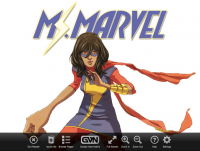
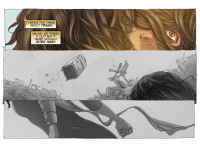
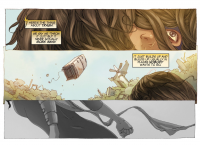
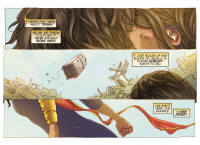
12017-12-19T08:46:57-08:00Adrienne Reshad50361f9620298d1a7721e2e43586ad5dad217b62680110gallery2017-12-20T15:21:15-08:00Adrienne Reshad50361f9620298d1a7721e2e43586ad5dad217b6Another kind of remediation occurs through the introduction of guided reading. Guided reading directs the reader’s eye through the digital comic by enlarging individual panels and directing the visual narrative. Rather than view a comic in single or sets of pages, as one would while reading a printed comic book, the reader follows a predetermined pathway. Although one page and two page views are still options presented to the reader, guided reading radically differentiates contemporary digital comics from printed comic books. Guided reading eliminates a prerequisite understanding of the internal logic of comic book narratives and therein enables the expansion of comics’ readership, in both size and composition. Further, some digital-native comics (comics produced digitally for digital consumption) are only navigable in guided view and may include dynamic features such as animation but later be presented in traditional static format when distributed in print volumes (one example being Ms. Marvel Infinite #1, written by G. Willow Wilson and illustrated by Adrian Alphona).
What makes a digital comic book different from a print comic book is the logic by which it is remediated. A digital comic book is not nor will it ever be understood as being the same as a print comic book because it has the potential to be (and do) so much more.
This page has paths:
12017-12-20T04:36:36-08:00Adrienne Reshad50361f9620298d1a7721e2e43586ad5dad217b6"Beta Ray Bill"Adrienne Resha5Secondary pathway focused on media theoryplain2017-12-20T11:21:02-08:00Adrienne Reshad50361f9620298d1a7721e2e43586ad5dad217b6
12017-12-20T04:26:40-08:00Adrienne Reshad50361f9620298d1a7721e2e43586ad5dad217b6"Alpha Flight"Adrienne Resha8Primary pathway containing all pagesplain2017-12-20T11:20:01-08:00Adrienne Reshad50361f9620298d1a7721e2e43586ad5dad217b6