Thanks for your patience during our recent outage at scalar.usc.edu. While Scalar content is loading normally now, saving is still slow, and Scalar's 'additional metadata' features have been disabled, which may interfere with features like timelines and maps that depend on metadata. This also means that saving a page or media item will remove its additional metadata. If this occurs, you can use the 'All versions' link at the bottom of the page to restore the earlier version. We are continuing to troubleshoot, and will provide further updates as needed. Note that this only affects Scalar projects at scalar.usc.edu, and not those hosted elsewhere.
ARTH3810 2019F Class Projects (Publication)Main MenuThe Tent Room at Rideau HallKyle Kreutner, Page 1 of 6The Webley Shacks: Unconventional Furniture Use in the Context of Ceaseless SurveillanceJose BawaganImperial Theater By Munawar MobinKeagan F - CSTM Sound HistoryIntroductionThe Mayfair TheatreSimran S.An Investigation of Hospital Interiors Effect on Patients144 Loretta Avenue North, Aidan MacNaullAidan MacNaull 144 Loretta Avenue NorthWest Block - Canada's New House of Commonsby Devon RudykRideau Street Chapel: The Effects of Relocation on the Experience of an Interiorby Ty FollisThe Church of St. Andrew's OttawaDavid Bastien-AllardMaking the Past Present: Union Station Restoration – A Political Facelift?by Vivian AstroffDelegation of the Ismali ImamatThe National Arts Centre: Reflecting on its Past and PresentSaint Paul University - A Shift in ValuesReem SiageFilm in Ottawa: The Mayfair theatreby Giovanna Maria SangCGM -An Investigation of Hospital Interiors Effect on PatientsThe Chateau LaurierBy Jessica El-GhazalReusable Space: The Senate of Canada Buildingby Syenne HolderNational Gallery of Canada - Seeing the Colonnade Through a Semiological Lens by Ricky TongRickyTHE OTTAWA STATIONEhidiamen Iyamabo, HomePageAVRC81ff8dad33b7fe77eee9a543209e890531c75438
History of the site
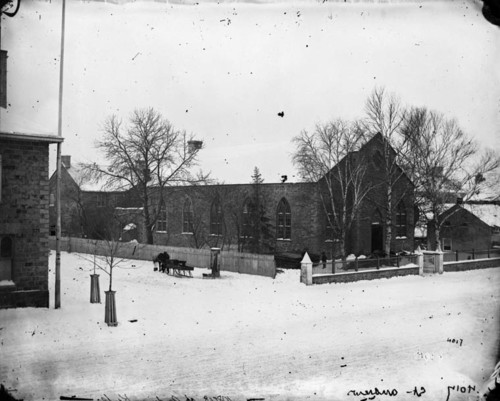
1media/OLD building St.Andrew.jpeg2019-11-27T19:45:21-08:00David Bastien-Allard15cbbe80ff02f08766f960e93fd0ad5dc41dd2e1358168David Bastien-Allardplain9402202019-12-07T15:44:59-08:00David Bastien-Allard15cbbe80ff02f08766f960e93fd0ad5dc41dd2e1
William James Topley/Library and Archives Canada/PA-009220
The original site was purchased from Nicholas Sparks for 200 pounds sterling of the lawful money of Upper Canada during the early 19th century[1]. The buyers were Thomas McKay, Daniel O’Connell, William Stewart and John Low; Their hope for the site was to build the first Presbyterian church in Ottawa for the Irish and Scottish workers of the Rideau Canal[2].
The first building erected on the site was a small chapel built on an A-frame wood structure, sadly the chapel was destroyed in a fire a few months after completion[3]. This unfortunate event was however the first step that would lead to the construction of a more permanent church.
The construction of the new building was a team effort from the masons working on Rideau Canal and the Presbyterian congregation of Ottawa. The development began in 1827 and was completed during the winter of 1828[4]. The church of St. Andrew was a small building designed to host 300 people[5], most of the design was based around the particular needs of the small Irish and Scottish community, the architecture of the building was very simple and rudimentary. The church of St. Andrew was at first more utilitarian than decorative[6], the main reason why there was so little decoration and visual attributes to the building was because of the difficulty to access refined materials in Ottawa. This was mostly due to oppression and financial difficulty.
In 1854, due to higher demand in the community, the church was expanded and modified in order to make it more functional. The changes included adaptations to the new needs of the growing community and focused on offering more seating spaces[7]. During the following years, the building was pushed as much as possible in terms of capacity and efficacy, however it was still inefficient and unable to fully serve the community. For that reason, after a few years of prosperity, the church was put down and rebuilt[8].
1media/church st andrew (2).jpgmedia/pews small.jpg2019-11-27T19:52:14-08:00David Bastien-Allard15cbbe80ff02f08766f960e93fd0ad5dc41dd2e1The Interior DecorDavid Bastien-Allard13David Bastien-Allardplain2019-12-07T16:06:40-08:00David Bastien-Allard15cbbe80ff02f08766f960e93fd0ad5dc41dd2e1
1media/altar st andrfew.jpg2019-11-27T19:51:11-08:00David Bastien-Allard15cbbe80ff02f08766f960e93fd0ad5dc41dd2e1The Configuration of the ChurchDavid Bastien-Allard6David Bastien-Allardplain2019-12-07T15:53:19-08:00David Bastien-Allard15cbbe80ff02f08766f960e93fd0ad5dc41dd2e1
1media/St-Andrews-Court5 (1).jpg2019-11-27T19:49:57-08:00David Bastien-Allard15cbbe80ff02f08766f960e93fd0ad5dc41dd2e1The Church AdditionDavid Bastien-Allard5David Bastien-Allardplain2019-12-07T15:51:42-08:00David Bastien-Allard15cbbe80ff02f08766f960e93fd0ad5dc41dd2e1
1media/Illustration+of+St.jpgmedia/Illustration+of+St.jpg2019-11-27T19:42:29-08:00David Bastien-Allard15cbbe80ff02f08766f960e93fd0ad5dc41dd2e1The Church of St. Andrew's OttawaDavid Bastien-Allard20David Bastien-Allardgallery9402192019-12-07T15:36:18-08:00David Bastien-Allard15cbbe80ff02f08766f960e93fd0ad5dc41dd2e1
1media/St-Andrews-Court2small.jpg2019-11-27T19:53:17-08:00David Bastien-Allard15cbbe80ff02f08766f960e93fd0ad5dc41dd2e1The Incorporation of the AdditionDavid Bastien-Allard4David Bastien-Allardplain2019-12-07T16:08:09-08:00David Bastien-Allard15cbbe80ff02f08766f960e93fd0ad5dc41dd2e1
Contents of this path:
1media/Illustration+of+St.jpgmedia/Illustration+of+St.jpg2019-11-27T19:42:29-08:00David Bastien-Allard15cbbe80ff02f08766f960e93fd0ad5dc41dd2e1The Church of St. Andrew's Ottawa20David Bastien-Allardgallery9402192019-12-07T15:36:18-08:00David Bastien-Allard15cbbe80ff02f08766f960e93fd0ad5dc41dd2e1
1media/St-Andrews-Court5 (1).jpg2019-11-27T19:49:57-08:00David Bastien-Allard15cbbe80ff02f08766f960e93fd0ad5dc41dd2e1The Church Addition5David Bastien-Allardplain2019-12-07T15:51:42-08:00David Bastien-Allard15cbbe80ff02f08766f960e93fd0ad5dc41dd2e1
1media/altar st andrfew.jpg2019-11-27T19:51:11-08:00David Bastien-Allard15cbbe80ff02f08766f960e93fd0ad5dc41dd2e1The Configuration of the Church6David Bastien-Allardplain2019-12-07T15:53:19-08:00David Bastien-Allard15cbbe80ff02f08766f960e93fd0ad5dc41dd2e1
1media/church st andrew (2).jpgmedia/pews small.jpg2019-11-27T19:52:14-08:00David Bastien-Allard15cbbe80ff02f08766f960e93fd0ad5dc41dd2e1The Interior Decor13David Bastien-Allardplain2019-12-07T16:06:40-08:00David Bastien-Allard15cbbe80ff02f08766f960e93fd0ad5dc41dd2e1
1media/St-Andrews-Court2small.jpg2019-11-27T19:53:17-08:00David Bastien-Allard15cbbe80ff02f08766f960e93fd0ad5dc41dd2e1The Incorporation of the Addition4David Bastien-Allardplain2019-12-07T16:08:09-08:00David Bastien-Allard15cbbe80ff02f08766f960e93fd0ad5dc41dd2e1