Thanks for your patience during our recent outage at scalar.usc.edu. While Scalar content is loading normally now, saving is still slow, and Scalar's 'additional metadata' features have been disabled, which may interfere with features like timelines and maps that depend on metadata. This also means that saving a page or media item will remove its additional metadata. If this occurs, you can use the 'All versions' link at the bottom of the page to restore the earlier version. We are continuing to troubleshoot, and will provide further updates as needed. Note that this only affects Scalar projects at scalar.usc.edu, and not those hosted elsewhere.
A Nostalgic Filter: A University of Pittsburgh ExhibitionMain MenuFrontispieceGolden BooksFront GalleryMaking CopiesFront GalleryGender & ExperienceHallwayPoetry & SongRotundaSacred TimeBack GalleryMobility & TravelSide GalleryResourcesAcknowledgements
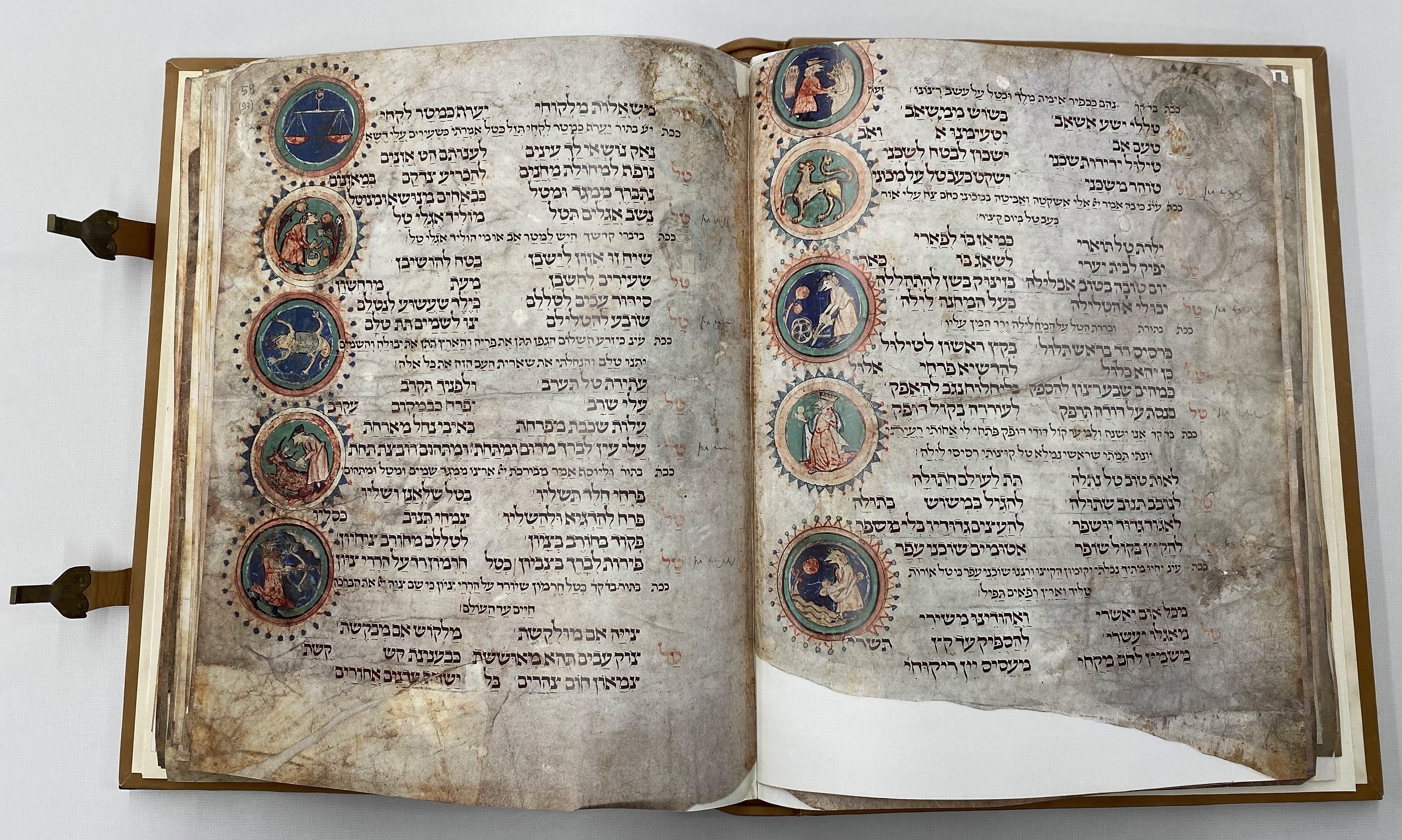
Worms Mahzor
1media/Zodiac Signs and Labors of the Months.jpg2020-09-28T09:00:20-07:00Maria-del-Carmen Barriosfd0af0128e32d75657356cbd7d3bd07b0c7fdd7f3809811plain2020-11-12T09:04:06-08:00Maria-del-Carmen Barriosfd0af0128e32d75657356cbd7d3bd07b0c7fdd7f
Jerusalem, National Library of Israel, MS 4° 781
This Hebrew liturgical book was created by the scribe Simcha ben Yehuda and likely taken from its point of origin in Würzburg, Germany to Worms shortly thereafter when its owners sought safety from the horrific violence of the Rintfleisch massacre of 1298. Its modern history is likewise marked by close encounters with vicious antisemitism; during Kristallnacht in 1938 it was moved from the synagogue to the nearby cathedral of Worms by Friedrich Maria Illert, a local archivist hoping to save the medieval treasure from destruction. Illert succeeded; in 1957 the book entered the collection of the National Library of Jerusalem in Israel, where it remains to this day. Ashkenazi Jews used the Mahzor (literally ‘cycle’) to celebrate the annual recurrence of the High Holy Days, including Rosh Hashanah and Yom Kippur. The cyclical passage of time is also evident in the book’s representation of the Signs of the Zodiac and the Labors of the Months. The bird-headed figures in these medallions reflect a general reluctance to depict human figures in Jewish religious manuscripts during this period; they also lend a lighthearted atmosphere to the laborers that reap and sow the fields and figures like Virgo, depicted with an elegant crown.
To the best of our knowledge, this manuscript has yet to be fully digitized and made available online. If you would like to bring an open-access digitization to our attention, please contact the UAG at Pitt.
This page has paths:
1media/Marginalia_5.jpgmedia/Labors of the Month October.jpg2020-09-28T08:50:28-07:00Maria-del-Carmen Barriosfd0af0128e32d75657356cbd7d3bd07b0c7fdd7fSacred TimeMaria-del-Carmen Barrios16Back Galleryvisual_path10221022020-11-17T09:48:36-08:00Maria-del-Carmen Barriosfd0af0128e32d75657356cbd7d3bd07b0c7fdd7f
This page references:
1media/Zodiac Signs and Labors of the Months_thumb.jpg2020-10-18T15:54:38-07:00Zodiac Signs and Labors of the Months1Facsimile of the Worms Mahzor, fols. 58v-59rmedia/Zodiac Signs and Labors of the Months.jpgplain2020-10-18T15:54:39-07:00