Thanks for your patience during our recent outage at scalar.usc.edu. While Scalar content is loading normally now, saving is still slow, and Scalar's 'additional metadata' features have been disabled, which may interfere with features like timelines and maps that depend on metadata. This also means that saving a page or media item will remove its additional metadata. If this occurs, you can use the 'All versions' link at the bottom of the page to restore the earlier version. We are continuing to troubleshoot, and will provide further updates as needed. Note that this only affects Scalar projects at scalar.usc.edu, and not those hosted elsewhere.
Unpinning History: Japanese Posters in the Age of Commercialism, Imperialism, and ModernismMain MenuIntroductionJapan in the Age of Commercialism, Imperialism, and ModernismThe Rise of Tourism and the Era of Ocean LinersThe Rise of Tourism and the Development of Railway NetworksProvocation of Citizenship: Posters for the Ministry of CommunicationsExhibition CultureBijin: Posters with a Beautiful WomanArrival of Modern Commercial DesignBibliographyCollection NoteReuse and Remix this Exhibition
Yosano Akiko, Travels in Manchuria and Mongolia: A Feminist Poet from Japan Encounters Prewar China
12020-05-07T16:03:41-07:00Anne-Marie Maxwell326ac6eff123bb3f77fb517c66299be8b435b479371405plain2020-05-07T22:03:49-07:00Rika Hiroa7d304a4e042125c916f0732fd77fbe42f9203aa“Leaving the South Manchurian Railway Company offices, we drove over to Siping Street, the thriving center of the inner city, and looked over the city from the roof of Jishun Shop, which was effectively a small Mitsukoshi in Fengtian’s Chinatown. The imperial palace of the first two emperor of the Qing, Taizu, and Taizong, was located at the center of the inner city, and its yellowish-brown bricks appeared close. In the Wensu Pavilion among these palace buildings were stored the thirty-six thousand volumes of the Siku quanshu (Complete Writings of the Four Treasuries). The palaces were ordinarily open for viewing, but because of the recent incident we had to pass this up. From what we had seen and according to a map of the city, the architectural style of the old city walls seemed to preserve an ancient style from the Han dynasty. Namely, the outer wall, the inner wall, and the walls of the imperial palace formed a triangular shape. The outer wall may have been an “outer fortification” in antiquity. The Jishun Shop was set up as a European-style department store. The employees of this Chinese shop received customers marvelously, to an extent surpassing that of the Japanese. I was concerned if there were clerks fluent in Japanese. It was rare in a Japanese-owned shop anywhere on the mainland for clerks to speak such a polite Chinese. It will be very discouraging for Sino-Japanese friendship and the spread of Japanese goods if we don’t change our practice of belittling the Chinese people and the Chinese language.”
Yosano Akiko, Travels in Manchuria and Mongolia: A Feminist Poet from Japan Encounters Prewar China trans. by Joshua A. Fogel (New York: Columbia University Press, 2001), 127-128.
This page is referenced by:
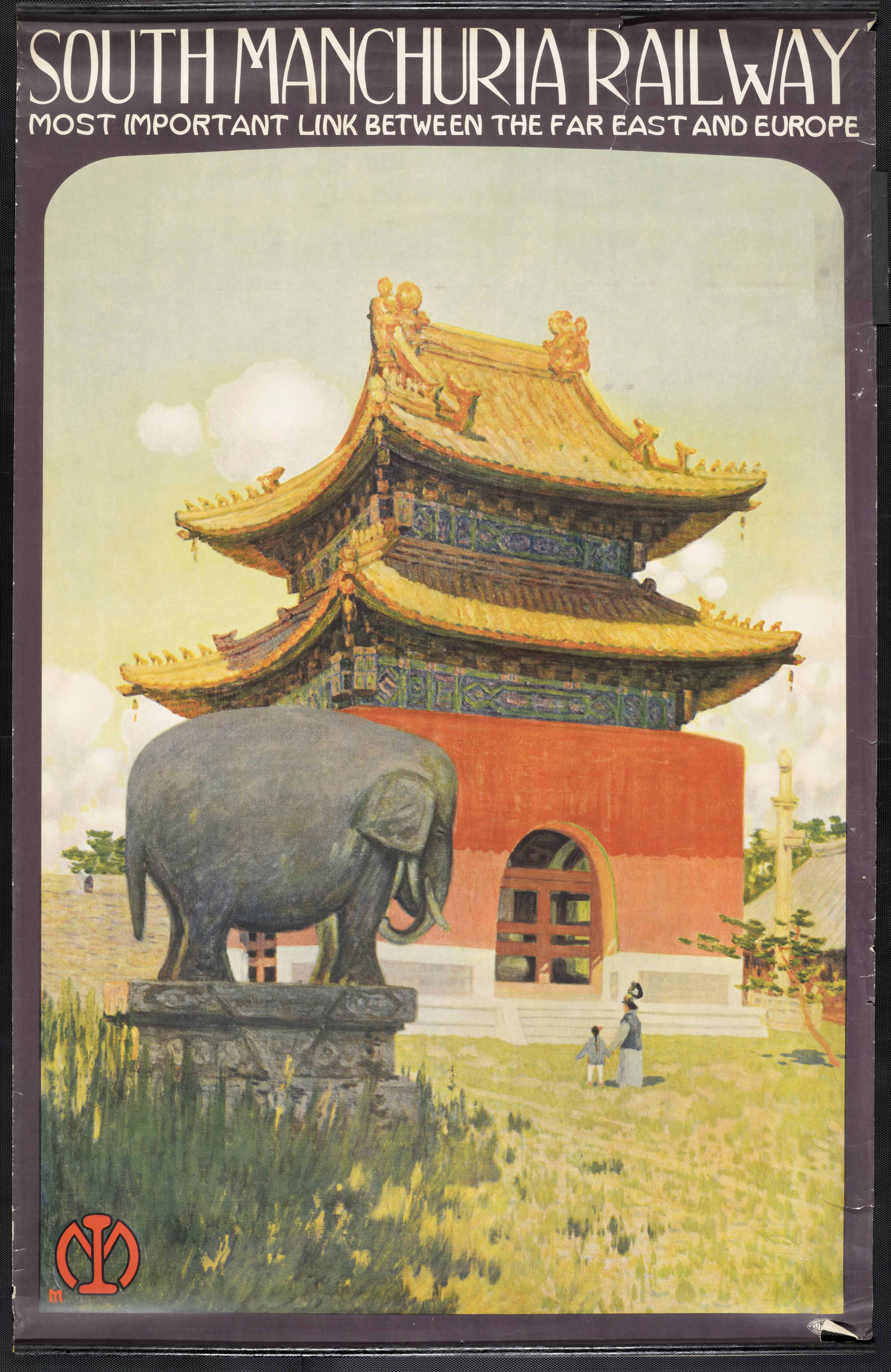
12020-04-29T14:59:06-07:00South Manchuria Railway: Most important link between the Far East and Europe [Fuling Mausoleum]16plain2022-11-03T15:05:23-07:00Depicted in yōga style, or Western painting technique, Mayama Kōji’s poster incorporates ethnically diverse elements under the oversight of the South Manchurian Railway Co. Following the First Sino-Japanese War (1894–1895) and the Russo-Japanese War (1904–1905), Japan gathered railway rights in the Korean Peninsula and southern branch of the Chinese Far East Railway, respectively. The South Manchuria Railway Co. was established as a result of these territorial expansion plans. Using light brushwork echoing that of impressionist painters in the West, Mayama depicts The Fuling Tomb, the mausoleum of the founding emperor of the Qing dynasty in Shenyang of northeastern China. Shenyang, or Mukden, as it was known to local Manchurians, was the site of the decisive battle in 1905 through which Japan seized the territorial rights to operate the South Manchuria Railway. The imperialist message is reinforced by the emptiness and desolation of the scene depicted; by depriving the Manchurian landscape of its humanity and focusing on the monument in the past, colonialist power is preemptively excused of the atrocities they would go on to commit. (Amanda Douglas and Cole Sweetwood)
Curator's Note: To read more about the Fuling Tomb, see Yosano Akiko's Travelogue entry.