Thanks for your patience during our recent outage at scalar.usc.edu. While Scalar content is loading normally now, saving is still slow, and Scalar's 'additional metadata' features have been disabled, which may interfere with features like timelines and maps that depend on metadata. This also means that saving a page or media item will remove its additional metadata. If this occurs, you can use the 'All versions' link at the bottom of the page to restore the earlier version. We are continuing to troubleshoot, and will provide further updates as needed. Note that this only affects Scalar projects at scalar.usc.edu, and not those hosted elsewhere.
12016-04-05T16:52:43-07:00Calvin Schermerhorn72410f8bbde58a1e8e60023cf6749d711494714689066Chapter 1plain2016-04-05T17:25:21-07:00Calvin Schermerhorn72410f8bbde58a1e8e60023cf6749d7114947146African-descended Virginians tied together and marching reluctantly through the Virginia countryside in the early months of 1818 embodied a central if tragic act in the human drama of U.S. commercial development. At least twenty-seven souls in a coffle driven by horsemen traveled southwest from Petersburg, a port town of seven thousand residents, to Raleigh, North Carolina, where they would turn right and head west. Their passage was part of a process of modern development, the antecedents of which had uprooted over 20 million Africans, 12 million of whom were embarked on Atlantic passages, the survivors landing in the Americas. Descendants of those forced migrants were embarking on another passage, this one south by southwest to the newest, most robust frontier of global staple crop production. That was the lower South. For the captives, it was an abrupt departure from the lands in which their ancestors’ bones were buried and the worlds in which they dwelt with their concerns.
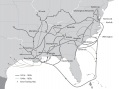
The subjects of this chapter joined hundreds of thousands more along the paths of the interstate slave trade. Francis Everod Rives and his partners Peyton Mason Sr. and Peyton Mason Jr. transported two coffles of enslaved Virginians to the lower South in 1818, making a fortune and pushing forward the process of economic modernization.
12016-04-05T17:16:34-07:00Routes of the U.S. Domestic Slave Trade2The Business of Slavery and the Rise of American Capitalism, p.14media/Slave-Routes 13 12 23.jpgplain2016-04-05T17:20:14-07:00