Thanks for your patience during our recent outage at scalar.usc.edu. While Scalar content is loading normally now, saving is still slow, and Scalar's 'additional metadata' features have been disabled, which may interfere with features like timelines and maps that depend on metadata. This also means that saving a page or media item will remove its additional metadata. If this occurs, you can use the 'All versions' link at the bottom of the page to restore the earlier version. We are continuing to troubleshoot, and will provide further updates as needed. Note that this only affects Scalar projects at scalar.usc.edu, and not those hosted elsewhere.
The Terracotta Army: An Army Underground Main MenuCoverfThe Fall and Death Of the First EmperorPit 1Pit 2Pit 3WeaponryExterior PitsBibliographyChristopher Thompsonbc1a952a757fd7cb7755f72554309b1754e05e33
Discovery of the Pits
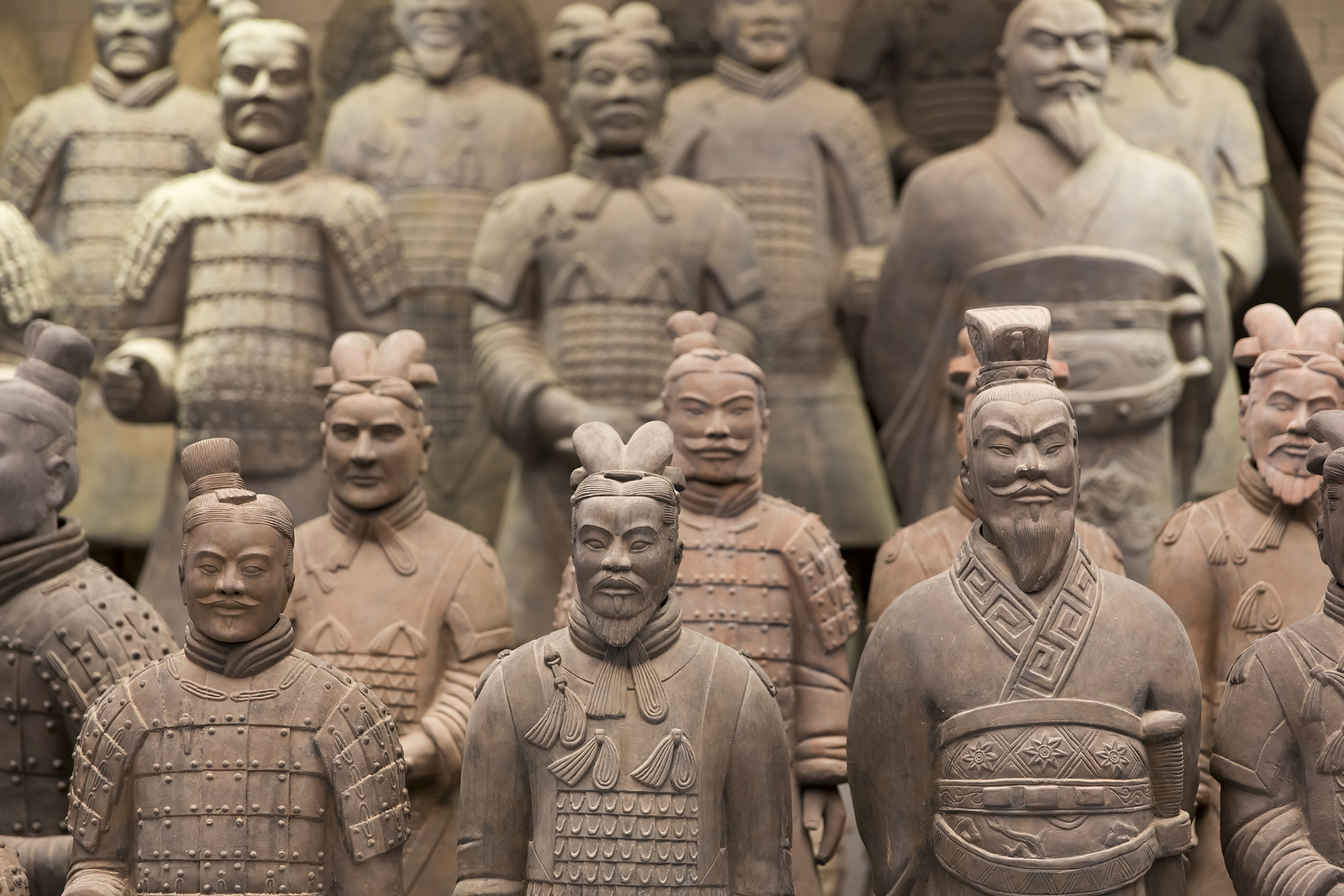
12016-12-01T20:01:47-08:00Christopher Thompsonbc1a952a757fd7cb7755f72554309b1754e05e331344648image_header2016-12-12T18:08:56-08:00Christopher Thompsonbc1a952a757fd7cb7755f72554309b1754e05e33On a cold spring day in March 1974, three Chinese farmers from the small village of Xiyang were instructed to dig a well. They dug a hole and they came across a layer of hard burnt earth. They proceeded to dig and eventually uncovered fragments of clay figures, leaving them unsure as to what they found. [4] News quickly reached the general public, and as a result, culture centers from all over China rushed there to discover what it was. For months following this discovery archaeology departments from around the world participated in one of the most important archaeology excavations of its time. This was not, however, the first time someone had stumbled upon these clay figurines. Clay figurines have been found in Han, Qing, and Ming dynasty tombs indicating that grave diggers had already reached the terracotta army in the past. [1]
With this finding, archaeologists did not just uncover the burial ground of the First Emperor of China: they opened a window into the past. Without many written records, little to nothing was known about warfare of this time. Although the Qin were known to be militaristic, information on their military formations, armor, chariots, and weapons were unknown. [5] Historians believed that the Qin armies introduced chariots and crossbows, but they had no idea what they looked like or how they were used. This was all changed with the discovery of the terracotta army. The incredible discovery of the terracotta army has greatly helped historians uncover information from a time that has little to no written historical records. This underground army, however, does not tell us everything. The terracotta army left historians with unanswered questions, but primarily gave insight into the military history of the Qin dynasty.
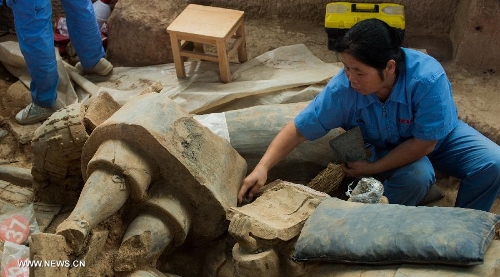
12016-12-05T18:30:48-08:00Archaeologists5Uncovering these figures a very slow and patient process. Archaeologists spend a long time brushing them off to prevent any damage to these 2 thousand year old figures.plain2016-12-12T17:55:40-08:00
12016-12-05T18:33:12-08:00Researchers3While many were still in tact, some of the figures found in the pits were broken and required reassembly.plain2016-12-05T18:36:25-08:00