Libraries and Archives
The National Gay Archive
Jim Kepner settled in Los Angeles with his private collection of books, periodicals, buttons, posters, and more related to gay and lesbian life in 1951. As the collection grew, he began allowing others to access the materials, though it was still kept in his apartment in Torrance. In 1975 he named it the West Gay Archives (WGA), and in 1979 a board of directors was created and it opened as the National Gay Archives: Natalie Barney/Edward Carpenter Library (NGA), in an office space in Hollywood.[1] At the time of its opening as the NGA, the collection contained close to 9,000 books alone.[2]
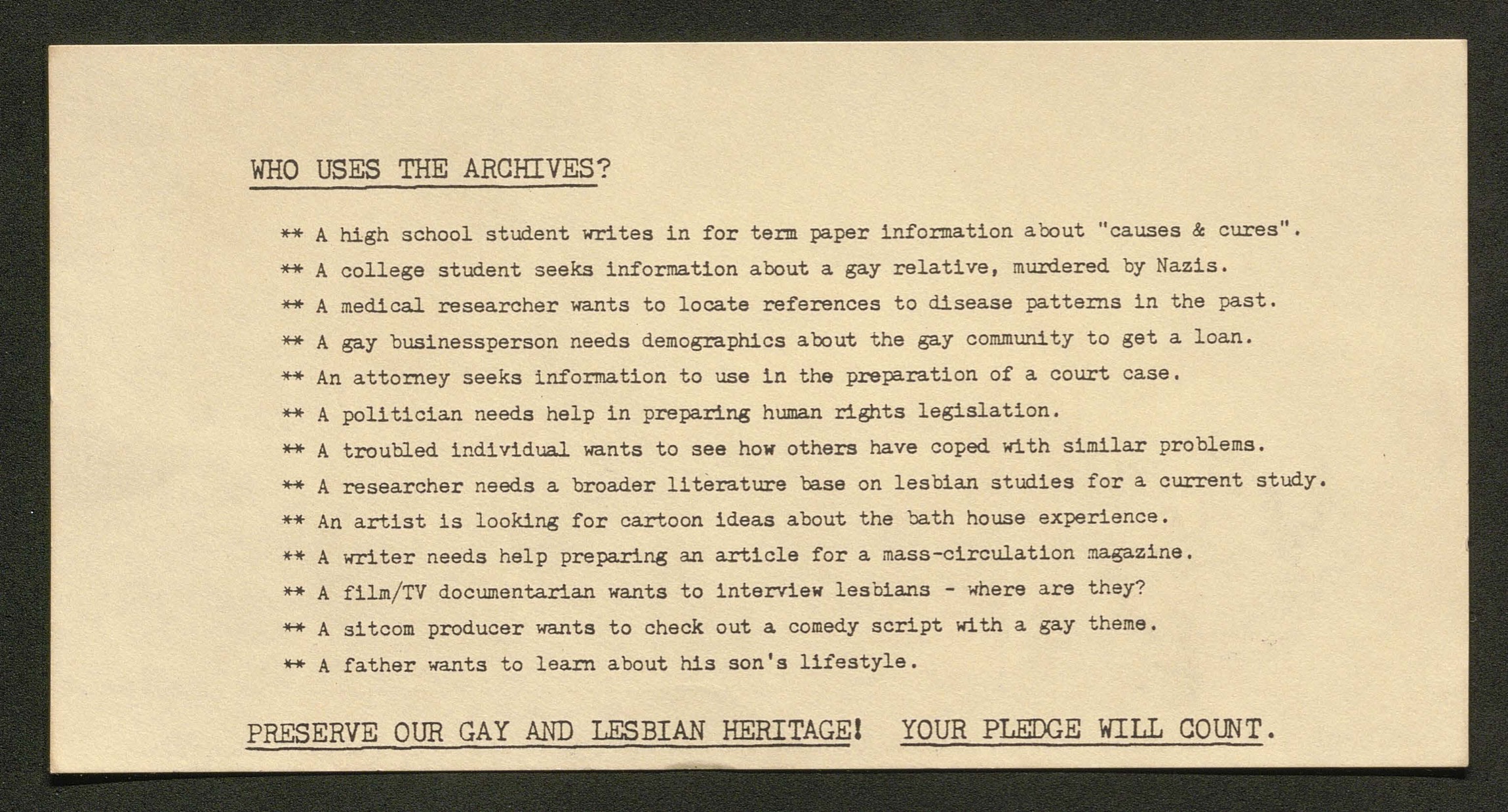
“...in the heart of Hollywood, the Archives is reached by wending along a patio where dozens of cats crouch among trees and shrubs and broken pieces of pottery. Scholar, high school student, college students from all over the country, and attorneys preparing briefs are among the many who avail themselves of Kepner’s collection.”[3]
International Gay and Lesbian Archive
In 1984, the NGA changed its name to the International Gay and Lesbian Archive (IGLA); the number of books in the collection grew to 21,056.[4]
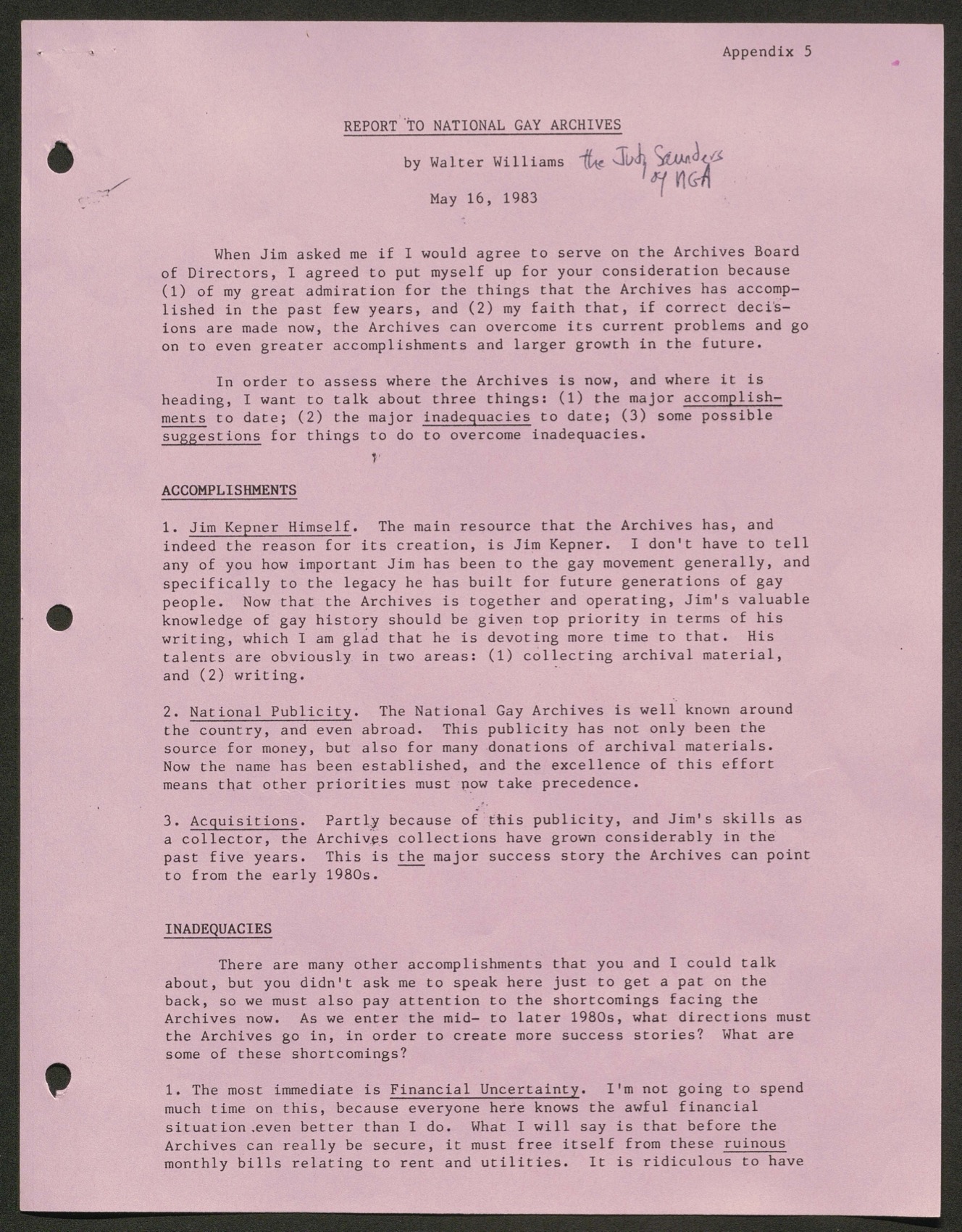
Jim’s role as curator was invaluable, but volunteers and information professionals helped to maintain the growing collection of books, papers, and objects. Those Jim worked with marveled at his strengths as a resource for knowledge on gay history and his devotion to collecting and maintaining archival materials. In meetings during the early years of the NGA, Walter Williams, Board President, proposed that Jim should have more time to split his focus between these two areas: collecting materials and writing. In order for Jim to have more time to write, Walter proposed hiring a professional archivist or librarian to handle collection organization and maintenance.[5]
The Library Committee
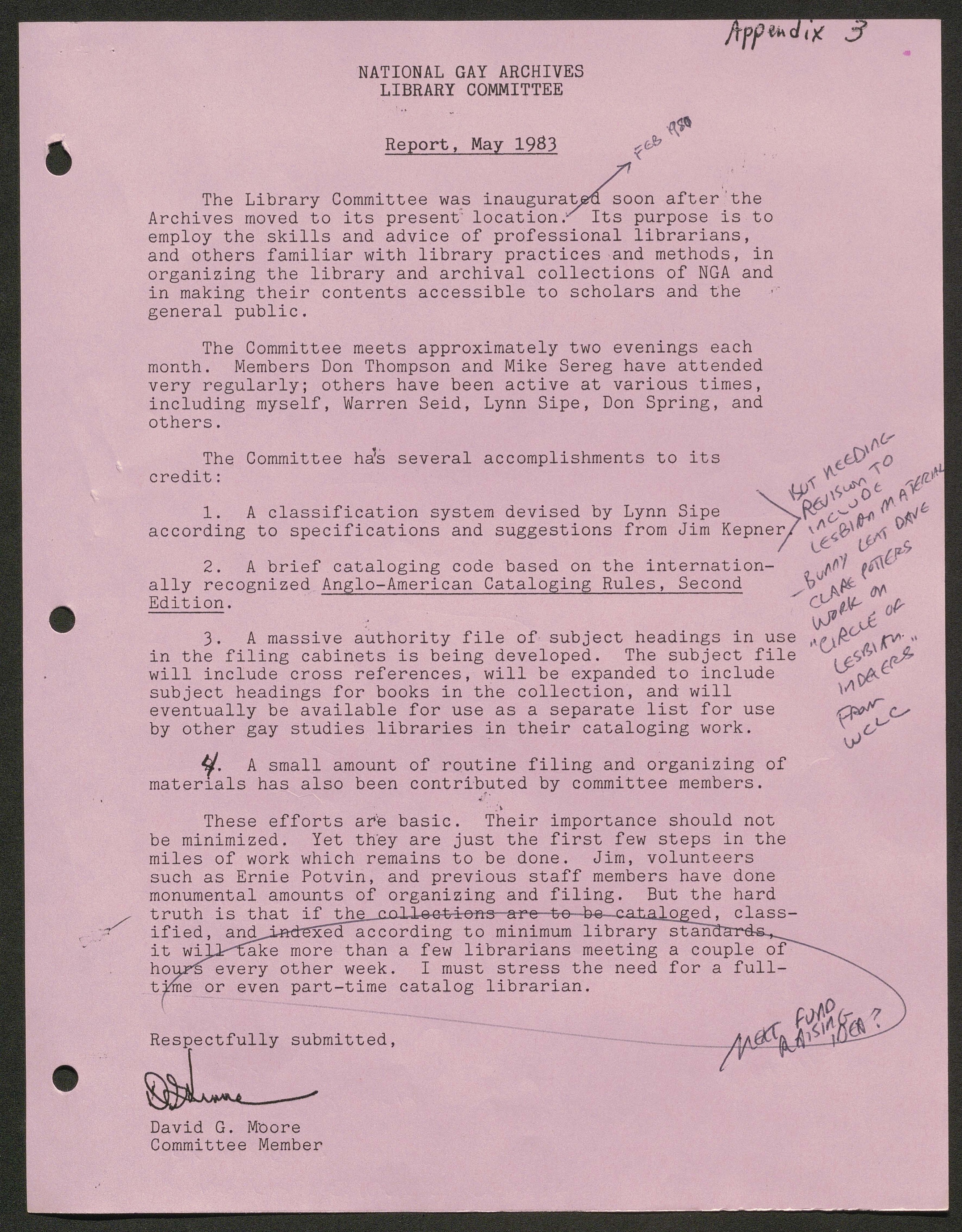
The Library Committee was established in February 1980, and acted as a group of librarians or people familiar with library practices to decide how IGLA’s books and archival materials should be made accessible. By 1983, the committee had created a classification system based on Jim Kepner’s knowledge of the collection, used a cataloging code based on the Anglo-American Cataloging Rules, second edition, and developed an authority file of subject headings to organize the filing cabinets. Their recommendation was that the collection should be “cataloged, classified, and indexed according to minimum library standards,” and stressed the need for a part-time or full-time catalog librarian to accomplish this.[6]
Access and security were highly discussed topics, especially as the Archive had been broken into repeatedly since its opening in 1979. In Walter William’s 1983 Report, we also have Bunny or June’s notes in the margins.
On the topic of “Improve security” Walter suggests that the Archive’s front door be locked at all time; that there should be a desk in order to monitor people coming and going from the Archive; people should need to get approval before visiting; upon leaving people should be searched; manuscripts and materials should be locked away with the need for staff to retrieve them for visitors; and that street entrance at all is a mistake.[7]
The margin note accurately calls out these practices as a road to obsolescence reading, “Walter has the establishment elitist ideas of a successful participant in the ‘system’ and no idea of the dangers inherent (for us) in such exclusivity.” These restrictive rules often are what keeps people from feeling comfortable, welcome, and coming back to archives, especially archives that function as a community space. Another bullet point from Walter was that the archive should remain a quiet space for researchers, the contrarian in the margins writes, “nobody agreed w/ [with] Walter about this.”[8] These dialogues about how to protect and preserve history that is so often under attack, and still provide an inclusive, open, and welcoming space are still enduring in community archives. It is often rules like this that delineate a community space with autonomy, and an archive that is part of a corporate or bureaucratic body, policing the work being done by its members.
The Curator
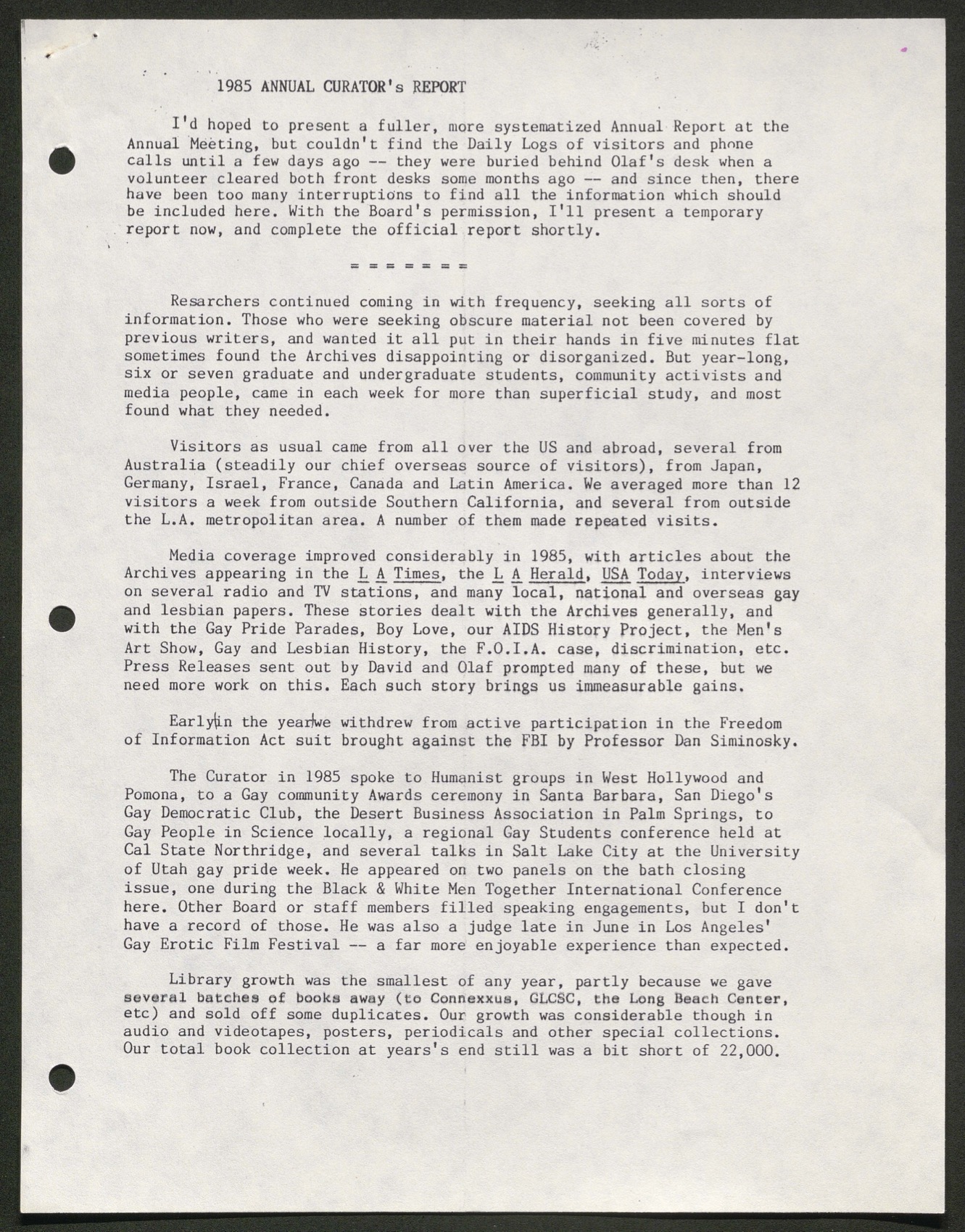
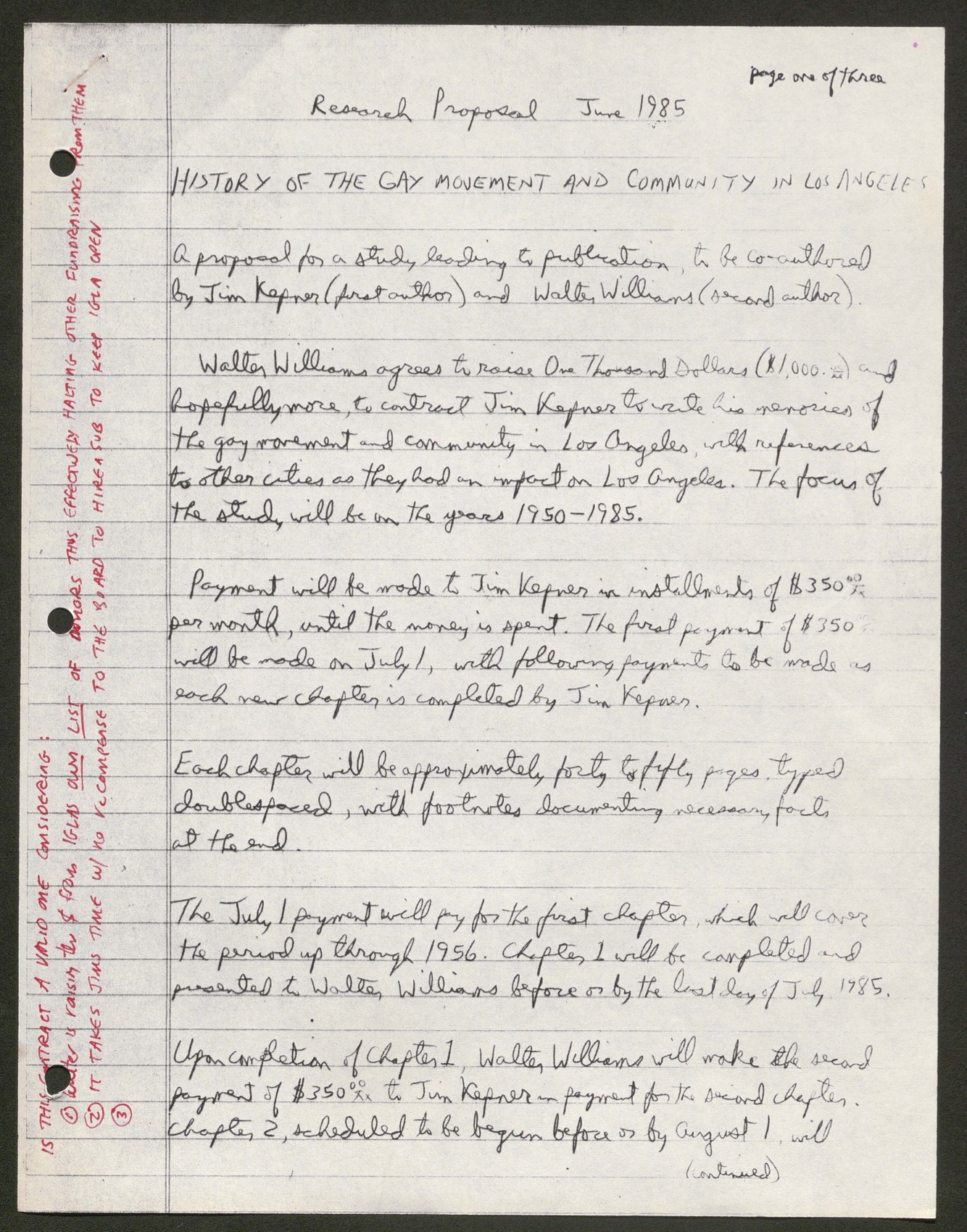
Jim’s perspective of the goings-on at the archive were in his detailed Curator’s Reports, summarizing visitors and archive users, growth of the collection, volunteer activities, finances, press and talks, general news, and updates on the building or conditions. His writing is in third person, always referring to himself as “the curator”, and at times has the tone of an omnipresent narrator of his own life. This was most noticeably in 1985, when Jim recounts his writing process of a history of the Gay Movement in Los Angeles in the Curator’s Report for 1985. Jim and Walter Williams proposed that he should write a history of the Gay Movement in LA from the 1950s to the 1980s. A contract was written up, and signed by Jim, Walter, and witness Gary W. Booher.[9]
These materials in the Mazer Archive also have been annotated most likely by either Bunny or June in red pen. One of these notations on the contract is the question, “Is this contract a valid one considering: 1. Walter is raising $ [money] from our list of donors thus effectively halting other fundraising from them, 2.It takes Jim’s time w/ [with] no recompense to the board to hire a sub to keep IGLA open.”[10] Similar concerns arose, shown as Jim narrates his experience writing the book, and the dissolution of the contract in Curator’s Report for 1985. Jim writes, “Disagreements arose over how the material should be organized, what was to be included, how long the stipend was to continue (the contract included contradictory terms)...he [Jim] in fact received no income for the period of writing time. This, Jim felt, invalidated the contract. Writing continued, however, almost every day, and the Curator is sincerely grateful to Walter for getting it moving at long last.”[11]
Bunny and June
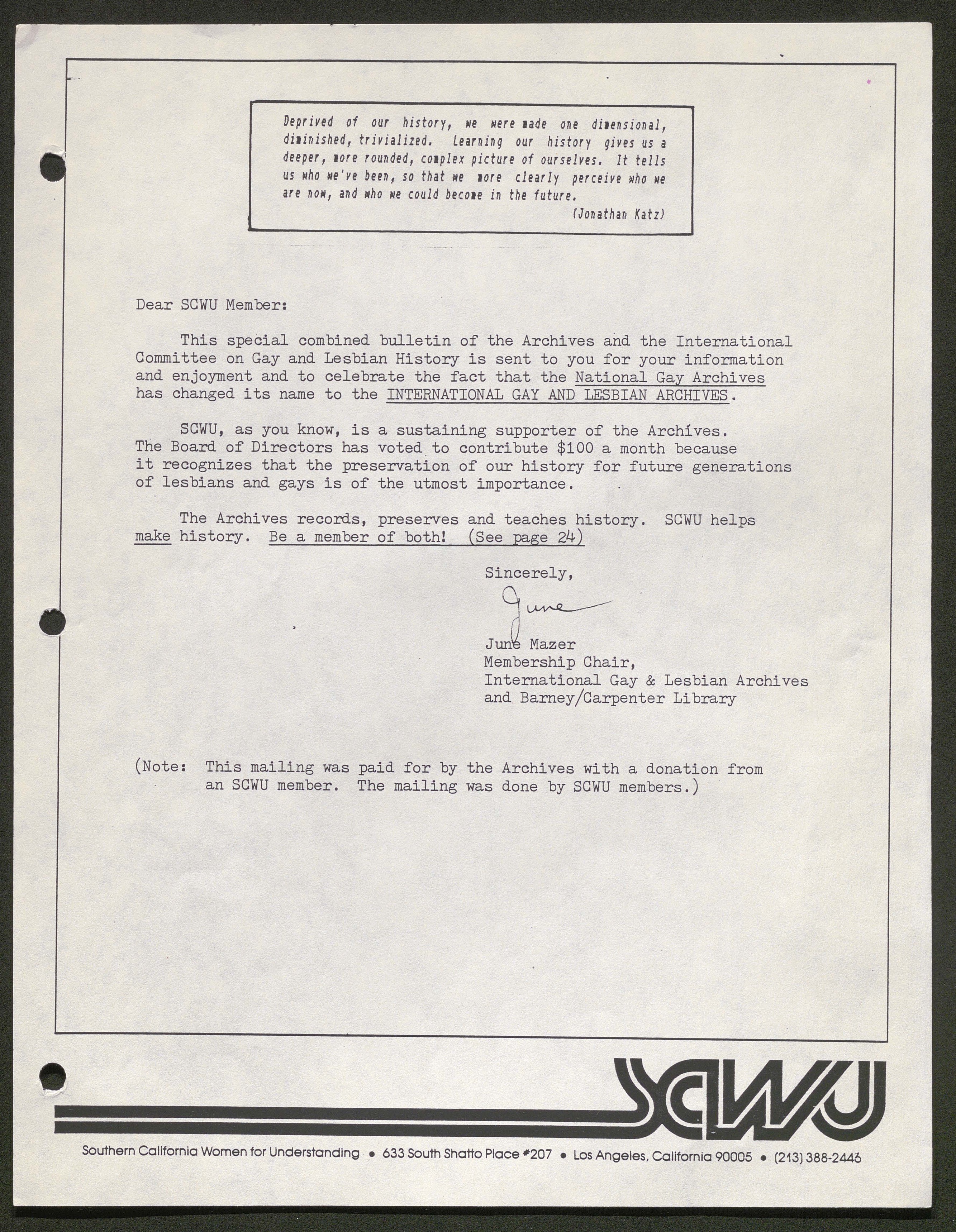
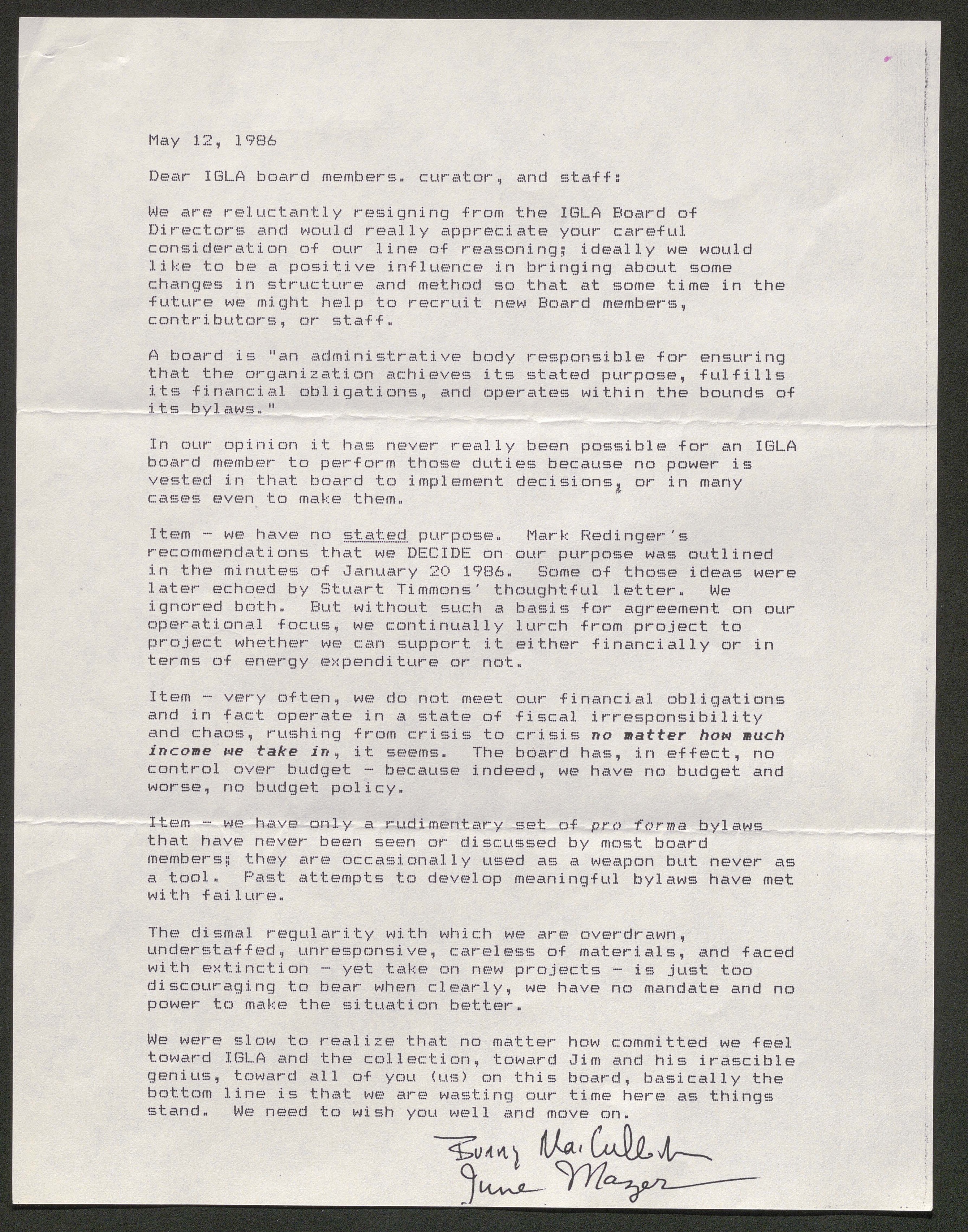
Bunny MacCulloch and June Mazer were both involved with IGLA through their work at Southern California Women for Understanding (SCWU), which was a major financial donor of IGLA; Bunny and June later served on IGLA’s Board of Directors; June as the Membership Chair and Vice President, Bunny working on Video and Audio interviewing Project and Visuals Collection.[12]
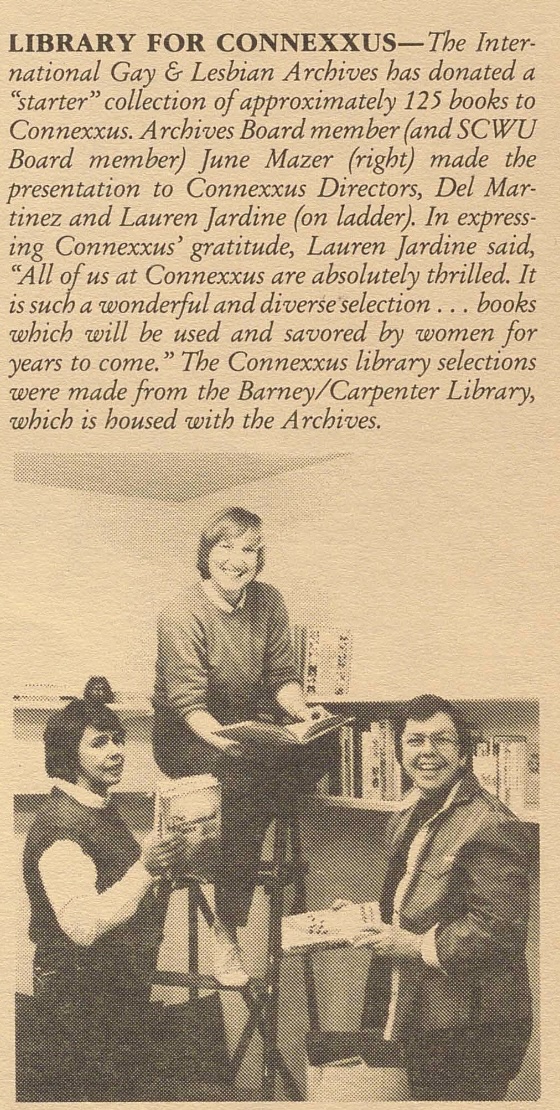
June was largely responsible for IGLA’s successful membership campaigns that raised significant amounts of money and generated new interest in the Archive.[13] In 1985, June also made a presentation to Connexxus’ Board of Directors, announcing that IGLA would donate a collection of 125 books to Connexxus Women’s Center.[14]
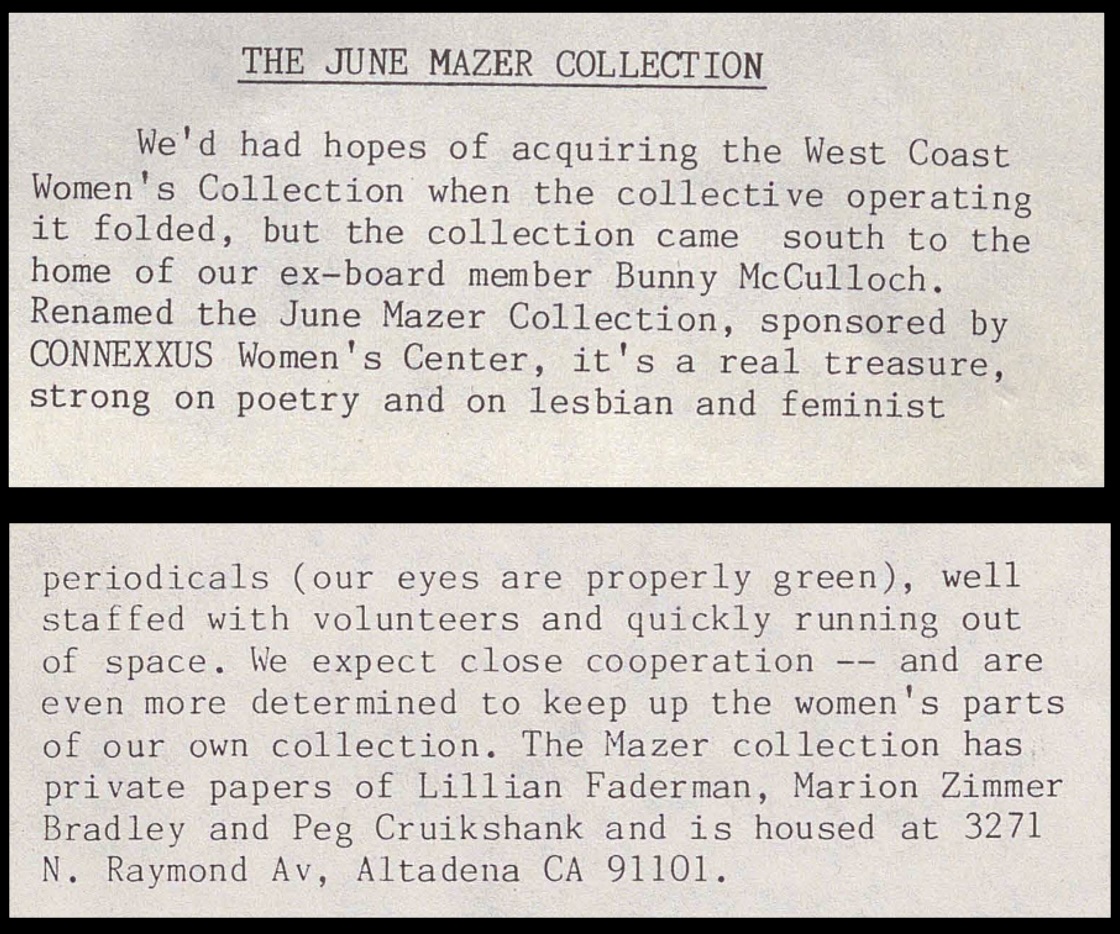
Bunny and June both resigned from IGLA’s Board in 1986, citing differences in how they thought the Board should function. In 1987, IGLA apparently hoped to acquire the West Coast Lesbian Collection, but of course Bunny and Connexxus Women’s Center took charge of it, then renaming it the June L. Mazer Lesbian Archives in honor of June, who had passed away earlier that year. IGLA announced this in their November 1987 Bulletin, saying that the two organizations would stay in close cooperation.[15]
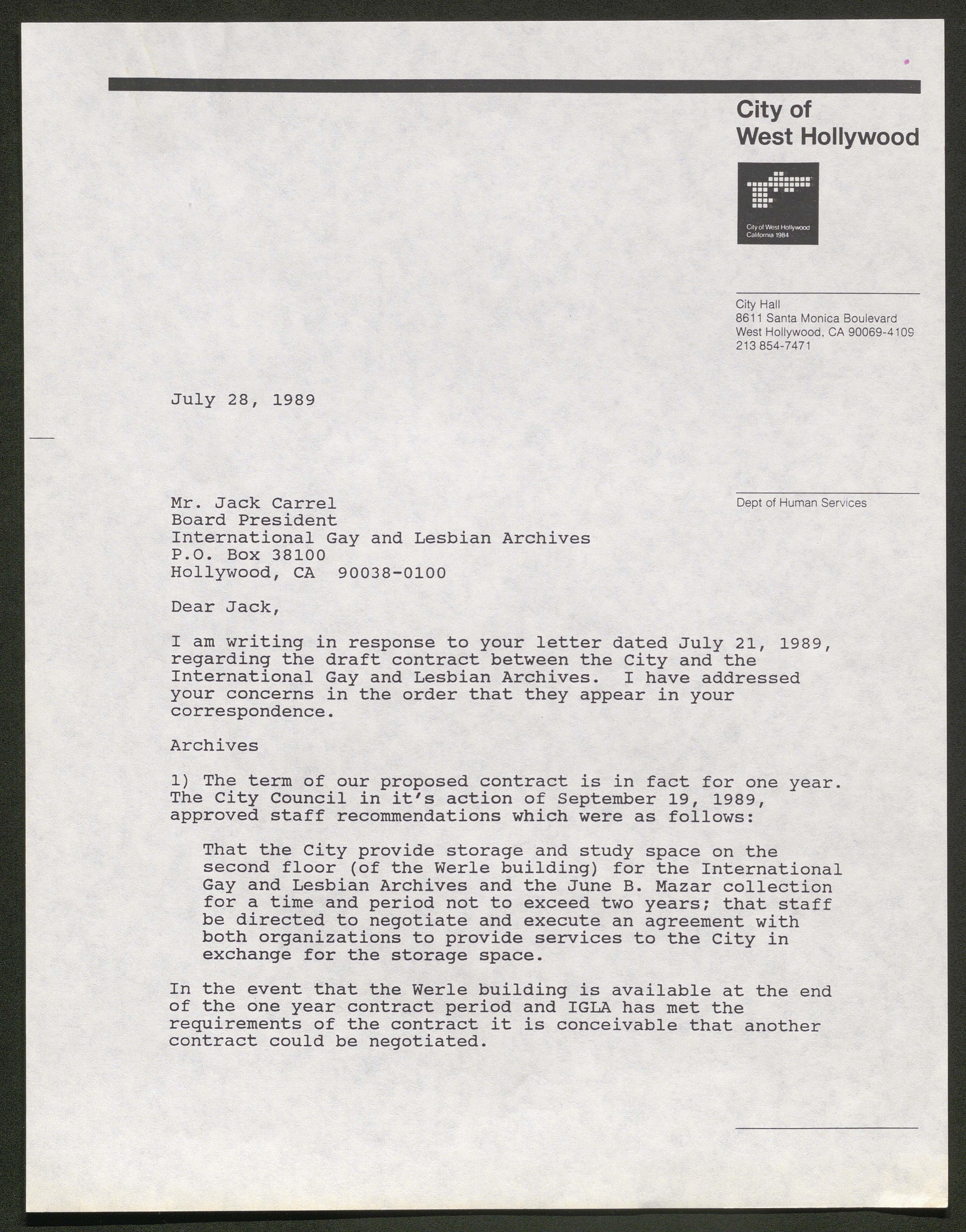
Their continued communication must have stayed amicable, as in 1989, early contracts with the City of West Hollywood included giving IGLA and the Mazer Archive space on the second floor of the Werle Building (which today is the current location of the Mazer).[16] The two archives would share the second floor! If you’ve ever visited the Mazer Archives, you would see how enormous a task this would have been, as the Mazer is already bursting with materials, even with a majority of collections in storage or located at UCLA.
The One Institute
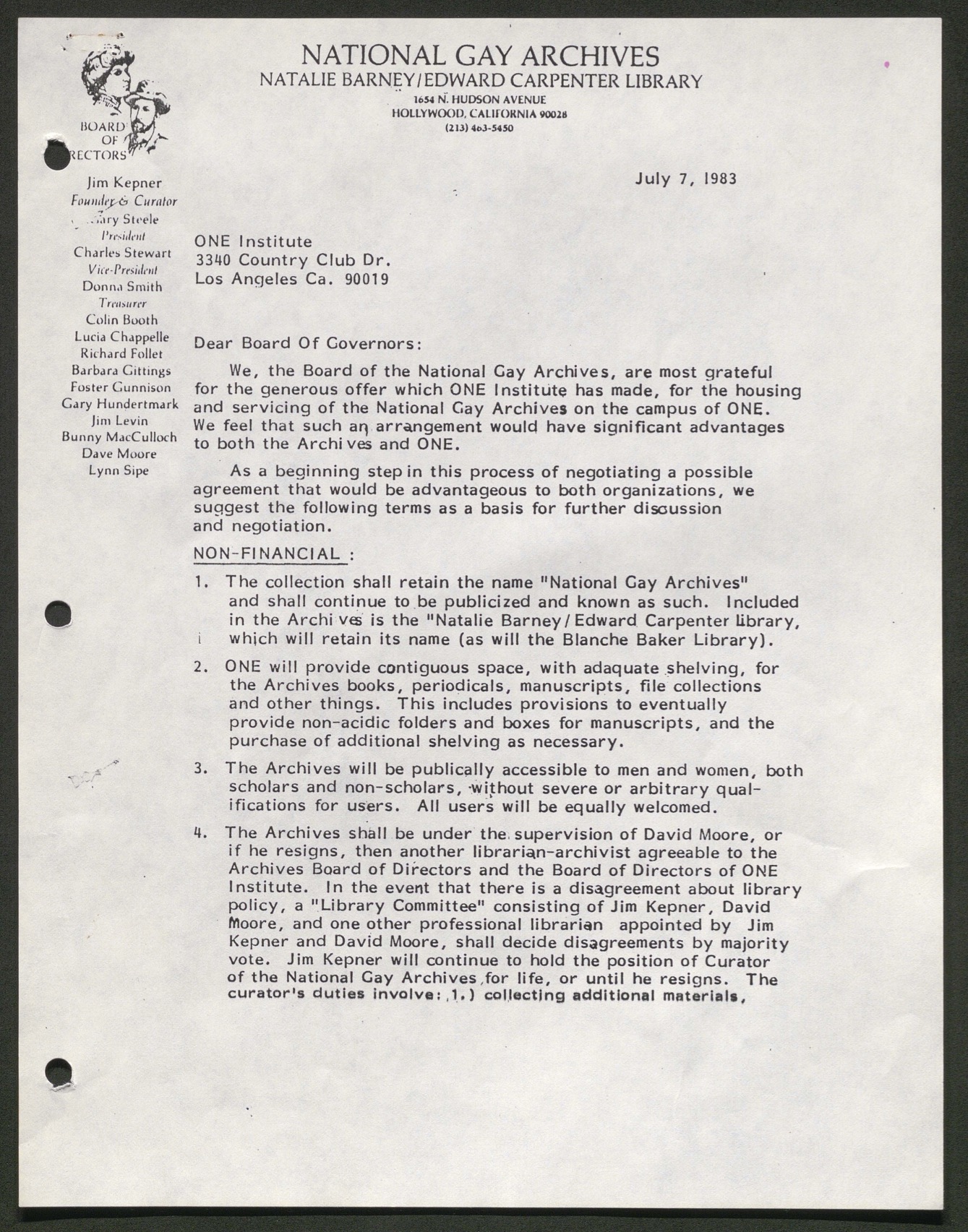
Jim Kepner was deeply involved in the Mattachine Society, and subsequently contributed frequently to ONE Magazine, the publication of ONE Inc. (today known as the ONE Institute). In 1983, shortly before the NGA changed its name to IGLA, ONE Inc. offered to house and care for the full collection at their location at the Millbank Estate, owned by philanthropist Reed Erickson.[17] The collection never made it though, Erickson shortly after asked ONE Inc. to leave the estate,[18] meaning the agreement between ONE and IGLA was renegotiated.[19]
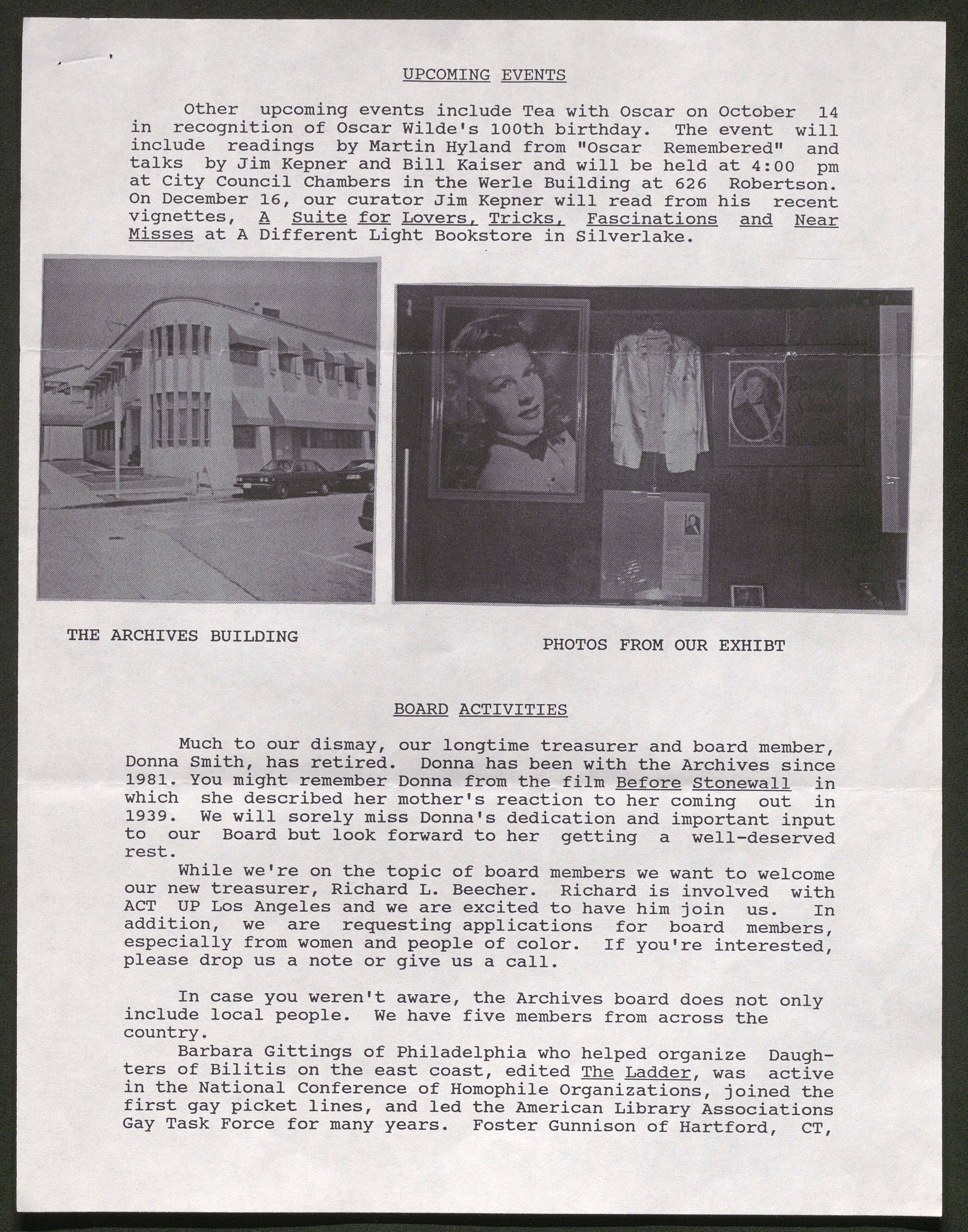
In 1988, IGLA would move into the Werle Building with the June L. Mazer Lesbian Archives. The partnership between IGLA and the ONE eventually was made official in 1994, when the two organizations merged, becoming an LGBTQ archive under the name ONE Institute; then in 2000 the collection would move to its current location provided by University of Southern California (USC), though the ONE still maintains a gallery space on the first floor of the Werle Building today.[20]
Other documents on IGLA:
Citations
[1] Loni Shibuyama, “Administrative History,” Jim Kepner Papers, Coll2011-002, ONE National Gay & Lesbian Archives, Los Angeles, California.
[2] “Archives report #2,” Drawer 01-02, Folder 12, Subject Files, June L. Mazer Lesbian Archives, Los Angeles, California.
[3] Marc Kessler, “Preserving Gay Roots,” Guardian, October 1979, Drawer 01-02, Folder 14, Subject Files, June L. Mazer Lesbian Archives, Los Angeles, California.
[4] Jim Kepner, “Curator’s Report 1984,” Drawer 01-02, Folder 12, Subject Files, June L. Mazer Lesbian Archives, Los Angeles, California.
[5] Walter Williams, “Report to National Gay Archives,” Drawer 01-02, Folder 12, Subject Files, June L. Mazer Lesbian Archives, Los Angeles, California.
[6] “Library Committee Report, May 1983,” Drawer 01-02, Folder 12, Subject Files, June L. Mazer Lesbian Archives, Los Angeles, California.
[7] Walter Williams, “Report to National Gay Archives.”
[8] Walter Williams, “Report to National Gay Archives.”
[9] “Research Proposal June 1985,” Drawer 01-02, Folder 13, Subject Files, June L. Mazer Lesbian Archives, Los Angeles, California.
[10] “Research Proposal June 1985.”
[11] Jim Kepner, “Curator’s Report 1985,” Drawer 01-02, Folder 12, Subject Files, June L. Mazer Lesbian Archives, Los Angeles, California.
[12] June Mazer, “Letter to SCWU members,” Drawer 01-02, Folder 13, Subject Files, June L. Mazer Lesbian Archives, Los Angeles, California.
[13] Jim Kepner, “Curator Report, 1984,” and “IGLA Membership Committee report, 1984,” Drawer 01-02, Folder 12, Subject Files, June L. Mazer Lesbian Archives, Los Angeles, California.
[14] “Library for Connexxus,” Drawer 01-02, Folder 14, Subject Files, June L. Mazer Lesbian Archives, Los Angeles, California.
[15] “Archive's Bulletin, November 1987,” Drawer 01-02, Folder 12, Subject Files, June L. Mazer Lesbian Archives, Los Angeles, California.
[16] “Letter from Lloyd Long to Jack Carrel,” Drawer 01-02, Folder 13, Subject Files, June L. Mazer Lesbian Archives, Los Angeles, California.
[17] About ONE,” ONE Institute, accessed March 13, 2024. https://www.oneinstitute.org/about/
[18] “About ONE,” ONE Institute.
[19] “Letter to ONE Board of Governors from the Board of Directors National Gay Archives,” Drawer 01-02, Folder 13, Subject Files, June L. Mazer Lesbian Archives, Los Angeles, California.
[20] “About ONE,” ONE Institute.
This page has paths:
- Highlights from the Subject Files Bonnie Morris/Julia Tanenbaum/Angela Brinskele
This page has tags:
This page references:
- Who Uses the Archive?
- Letter from the National Gay Archives Board of Directors to ONE Institute Board of Governors
- National Gay Archives Report to National Gay Archives, 1983
- Letter from Bunny MacCulloch and June Mazer to IGLA Board of Directors
- National Gay Archives Library Committee Report, 1983
- Letter from Lloyd Long to Jack Carrel
- Curator's Report, 1985
- Library for Connexxus
- Archive's Bulletin, November 1987
- Research Proposal June 1985
- IGLA Letter to supporters
- Letter to SCWU members