Introduction to Rebooting Electronic Literature
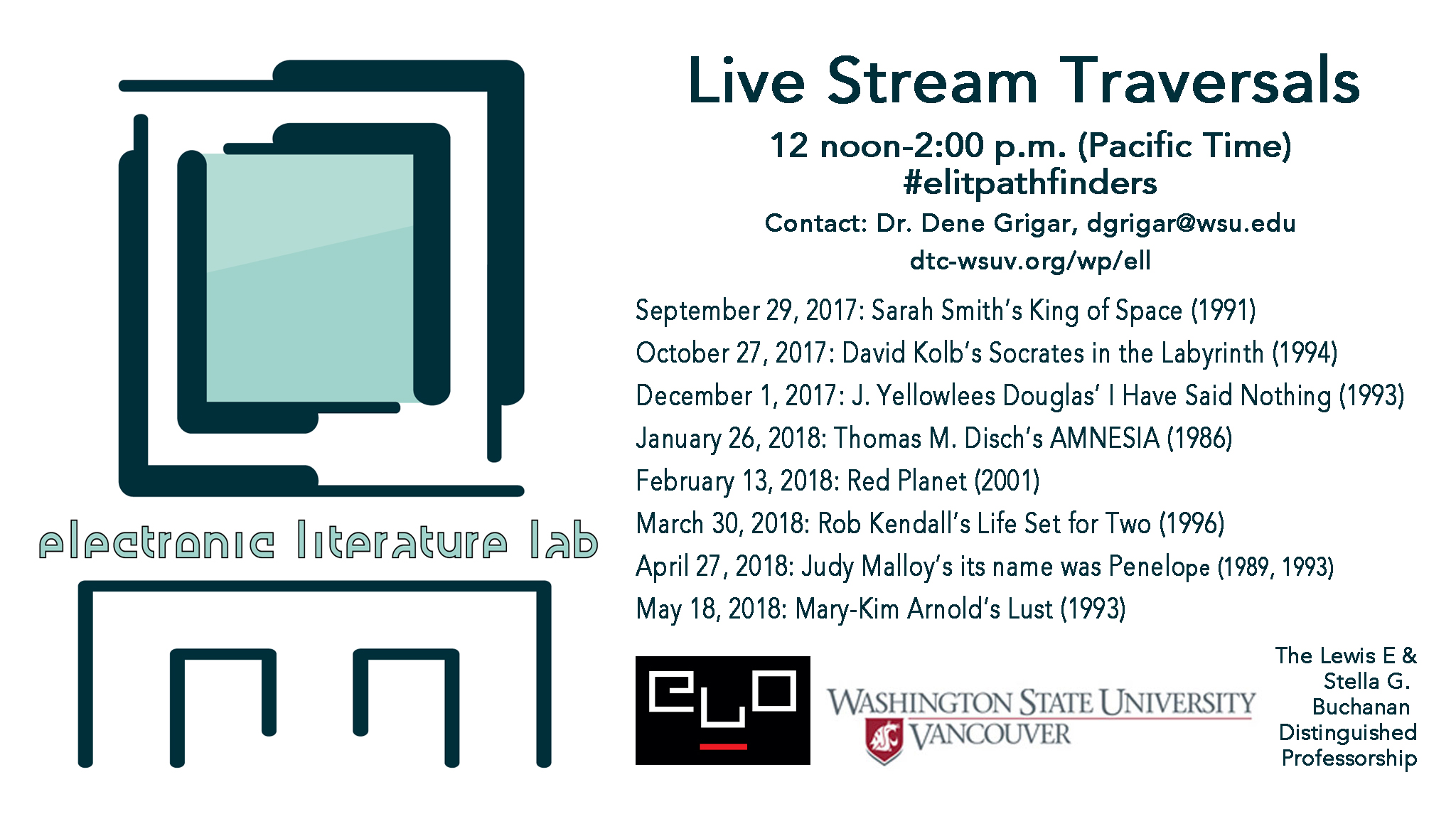
Rebooting Electronic Literature is an open-source, multimedia book that documents seven pre-web works of electronic literature held in the Electronic Literature Lab (ELL) library at Washington State University Vancouver. The seven works selected for this project are among the most unique and fragile. Sarah Smith's King of Space (1991), the first documented e-lit work of science fiction, was produced with the early hypertext authoring Hypergate. David Kolb's Socrates in the Labyrinth (1994) is one of a handful of hypertext essays produced during the pre-web period and certainly the only one focusing on philosophy. J Yellowlees Douglas' "I Have Said Nothing" (1994), which—along with Michael Joyce’s afternoon: a story—appeared in W. W. Norton & Co.’s Postmodern American Fiction (1997), the only works of electronic literature ever published in one of Norton’s many collections. Thomas M. Disch's AMNESIA (1986) is a text adventure game, the only published by Electronic Arts and one of a handful authored by a prominent print writer. Rob Kendall's A Life Set for Two (1996) is an animated poem programmed by the artist in Visual Basic. Judy Malloy's its name was Penelope, Version 3.0 (1993) is a retooling of Version 2.0 (1990) by Mark Bernstein from the original BASIC program into the Storyspace aesthetic. Finally, Kim Arnold's "Lust" (1994) packaged with Douglas’ in The Eastgate Quarterly Review, Volume 1, Number 2 is a hypertext that straddles the genre of fiction and poetry.
These seven works were produced with programming languages like Visual Basic and Applesoft BASIC, custom authoring systems like Hypergate and the King Edward Adventure game authoring system, or the proprietary software Storyspace. All require a degree of interactivity between the reader and the work. They were also among the first computer-based works of literature to be sold commercially in the U.S. Due to their availability through commercial distribution, these works were influential in shaping literary theory and criticism currently used today to discuss born digital writing. To date, none have been migrated to a more contemporary format and only two––AMNESIA and its name was Penelope––have been emulated for access by a contemporary public. Thus, these are works in danger of becoming inaccessible to the public because they were produced on and for computer platforms that today are obsolete.
The documentation methodology, built from the Pathfinders approach pioneered by Dene Grigar and Stuart Moulthrop [1] centers on two important processes: First, live performances––or what Moulthrop and Grigar called Traversals (7)––streamed on YouTube of readers and/or authors performing the work on the hardware and software on which the works were originally intended; second, the addition of audience engagement via Facebook, Twitter, and YouTube live chat. Along with videos of the live stream Traversals and screenshots of social media posts, the book features images of the packaging of the work, such as folios, floppy disks, manuals, and paper inserts. It also includes historical information about the work and critical essays.
In developing the project, we aim to provide information helpful to scholars. Publication dates, versions, and production methods have been vetted by publishers and artists when possible with the intent of clearing up discrepancies relating to this information as well as offer previously unknown details about these works. Douglas' "I Have Said Nothing," for example, shows a 1993 publication date in some databases but actually appeared first in The Eastgate Quarterly Review of Hypertext in the winter of 1994. The title screen of Malloy’s its name was Penelope, Version 3.0 shows a copyright date of 1992, but the work was not published until 1993. The cultural importance of dates is seen most clearly, however, with Smith’s King of Space. Begun in 1988, it was published in 1991 on 3.5-inch floppy disk by Eastgate Systems, Inc. with its early hypertext authoring program, Hypergate, which was also "operational" by that date. [2] By 1990, however, the company had licensed Storyspace from Riverrun, Ltd., owned by Joyce, Jay David Bolter, and John Smith, and abandoned further development of Hypergate and works built on it. Thus, correcting the record with precise information ensures authority control, and mitigates potential confusions and ambiguity, most importantly, helps to explain the development trajectory of particular works.
This open-source, multimedia book is made possible by the Lewis E. and Stella G. Buchanan Distinguished Professorship and support by Washington State University Vancouver. Many other individuals and organizations provided support for our research.
Creative Media & Digital Culture Program at Washington State University Vancouver, Professor Nicholas Schiller served as the lead co-author of the book. Undergraduate research assistants in the Electronic Literature Lab undertook much of the content development for the book. Vanessa Rhodes wrote the descriptions of the physical artifacts relating to the seven works; Veronica Whitney and Katie Bowen photographed the physical artifacts and optimized them for presentation; and Mariah Gwin created the video clips from the video captured from the live stream and prepared them for the book. Greg Philbrook provided technical support for most of the traversals and interviews. Finally, we adapted the design that Professor Will Luers, faculty member in the CMDC program, created for Pathfinders.
Finally, we thank the Electronic Literature Organization for its leadership in developing methods for evaluating quality of digital creative and critical works and its insights into cataloging its growing body of digital fiction, poetry, and other literary forms––activities from which this research grows.
These seven works were produced with programming languages like Visual Basic and Applesoft BASIC, custom authoring systems like Hypergate and the King Edward Adventure game authoring system, or the proprietary software Storyspace. All require a degree of interactivity between the reader and the work. They were also among the first computer-based works of literature to be sold commercially in the U.S. Due to their availability through commercial distribution, these works were influential in shaping literary theory and criticism currently used today to discuss born digital writing. To date, none have been migrated to a more contemporary format and only two––AMNESIA and its name was Penelope––have been emulated for access by a contemporary public. Thus, these are works in danger of becoming inaccessible to the public because they were produced on and for computer platforms that today are obsolete.
The documentation methodology, built from the Pathfinders approach pioneered by Dene Grigar and Stuart Moulthrop [1] centers on two important processes: First, live performances––or what Moulthrop and Grigar called Traversals (7)––streamed on YouTube of readers and/or authors performing the work on the hardware and software on which the works were originally intended; second, the addition of audience engagement via Facebook, Twitter, and YouTube live chat. Along with videos of the live stream Traversals and screenshots of social media posts, the book features images of the packaging of the work, such as folios, floppy disks, manuals, and paper inserts. It also includes historical information about the work and critical essays.
In developing the project, we aim to provide information helpful to scholars. Publication dates, versions, and production methods have been vetted by publishers and artists when possible with the intent of clearing up discrepancies relating to this information as well as offer previously unknown details about these works. Douglas' "I Have Said Nothing," for example, shows a 1993 publication date in some databases but actually appeared first in The Eastgate Quarterly Review of Hypertext in the winter of 1994. The title screen of Malloy’s its name was Penelope, Version 3.0 shows a copyright date of 1992, but the work was not published until 1993. The cultural importance of dates is seen most clearly, however, with Smith’s King of Space. Begun in 1988, it was published in 1991 on 3.5-inch floppy disk by Eastgate Systems, Inc. with its early hypertext authoring program, Hypergate, which was also "operational" by that date. [2] By 1990, however, the company had licensed Storyspace from Riverrun, Ltd., owned by Joyce, Jay David Bolter, and John Smith, and abandoned further development of Hypergate and works built on it. Thus, correcting the record with precise information ensures authority control, and mitigates potential confusions and ambiguity, most importantly, helps to explain the development trajectory of particular works.
This open-source, multimedia book is made possible by the Lewis E. and Stella G. Buchanan Distinguished Professorship and support by Washington State University Vancouver. Many other individuals and organizations provided support for our research.
Creative Media & Digital Culture Program at Washington State University Vancouver, Professor Nicholas Schiller served as the lead co-author of the book. Undergraduate research assistants in the Electronic Literature Lab undertook much of the content development for the book. Vanessa Rhodes wrote the descriptions of the physical artifacts relating to the seven works; Veronica Whitney and Katie Bowen photographed the physical artifacts and optimized them for presentation; and Mariah Gwin created the video clips from the video captured from the live stream and prepared them for the book. Greg Philbrook provided technical support for most of the traversals and interviews. Finally, we adapted the design that Professor Will Luers, faculty member in the CMDC program, created for Pathfinders.
Finally, we thank the Electronic Literature Organization for its leadership in developing methods for evaluating quality of digital creative and critical works and its insights into cataloging its growing body of digital fiction, poetry, and other literary forms––activities from which this research grows.
This page has paths:
- Rebooting Electronic Literature Dene Grigar