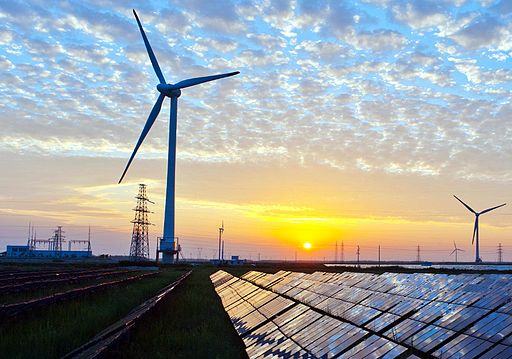
Renewable Energy on the Grid
1 2017-12-06T07:48:54-08:00 Klara Beinhorn c060574480f918c78093f5a48ae976084fc06ec2 27049 1 Photo by Kenueone. Taken 5 August 2016. Creative Commons License 1.0 Universal Public Domain Dedication. Available at https://commons.wikimedia.org/wiki/File:Renewable_Energy_on_the_Grid.jpg. plain 2017-12-06T07:48:54-08:00 Klara Beinhorn c060574480f918c78093f5a48ae976084fc06ec2This page is referenced by:
-
1
2017-12-05T09:49:12-08:00
Progress Through Action
10
By Klara Beinhorn
plain
2017-12-07T09:02:21-08:00
A coalition named “We Are Still In” consists of states, cities, universities, faith groups, and environmental activists who pledge to still take part in the Paris Climate Agreement despite the United States backing out. Journalist for National Geographic, Stephen Leahy, discusses how in November, the United Nation climate negotiations (known as COP 23) took place in Bonn, Germany. The United States came to the conference without any intention of promoting renewable energy options, for David Banks, Trump’s special adviser on energy and environment, argued the increase use of coal, gas, and oil was a “global reality.” He said the U.S. wants to help poor countries utilize coal and natural gas energy and warned for others not to try block those efforts. The America’s Pledge report was released in Bonn and estimated the “We Are Still In” coalition represents more than half of the U.S. economy (Leahy). “We Are Still In” represents those who aren’t letting the backing out of the Paris Climate Agreement determine their environmental impact. Even as our government may be a friend to oil, half of the U.S. economy is determined to follow the agreement’s terms on their own emissions proving there is a foundation to build off of in the fight for environmental justice. Following the terms to the Paris Climate Agreement is a positive step towards promoting environmental justice because the cleaner we get, the less pollution minority and low-income groups unequally face.
Environmental justice and climate racism is a tangible issue in the United States affecting many low-income individuals and minorities. As the Trump administration proves to be a friend to oil, it is society’s duty to push for the increased investment into renewables instead of oil infrastructure. Taking steps such as the “We Are Still In” coalition provides a base for a movement to wean ourselves off of petroleum products. In simple terms, the more we wean off of oil and switch to sources such as renewables, fewer refineries will be needed which cuts back on the unequal distribution of pollution caused by refineries. Although shifting to renewables completely is highly unlikely and far off into the future, the conversation needs to shift about oil infrastructure and the meaning behind it. Oil should be seen as temporary solution until we can find a better fix, meaning long-term petroleum infrastructure should not be implemented. Society needs to act against climate racism just as the “We Are Still In” coalition acted on their own behalf, not the government's. Part of our duty as citizens is to look out for those less represented. We need to look out for those who lack the political representations in order to fight against the climate racism being implemented upon them. Climate injustice is a concrete issue where one entity doesn’t have the power to solve all the issues, for society needs to come together and recognize environmental racism is real and push for more renewables.
Works Cited- Leahy, Stephen. “Half of U.S. Spending Power Behind Paris Climate Agreement.” National Geographic. 15 Nov. 2017. Web. 18 Nov. 2017.