Thanks for your patience during our recent outage at scalar.usc.edu. While Scalar content is loading normally now, saving is still slow, and Scalar's 'additional metadata' features have been disabled, which may interfere with features like timelines and maps that depend on metadata. This also means that saving a page or media item will remove its additional metadata. If this occurs, you can use the 'All versions' link at the bottom of the page to restore the earlier version. We are continuing to troubleshoot, and will provide further updates as needed. Note that this only affects Scalar projects at scalar.usc.edu, and not those hosted elsewhere.
Performing Archive
Main Menu
Visualizing the “Vanishing Race”: the photogravures of Edward S. Curtis
Front Page for Visualizing the "Vanishing Race" path
Curtis' Image and Life: The Network of The North American Indian, Inc.
An experiment with data visualization approach to understand and contextualize Curtis' images and his life
Media, Technology and Mediations
Curtis's Technology, Relationships to Media and Style
Contextualizing Curtis, The North American Indian, and Race
the collection of essays from the contributors
Consulting with Tribes as Part of Archive Development
Introduction to Consulting with Tribes by Ulia Gosart
Contributing Archives
Information on how to participate in Performing Archive
Browsing the Media
A path of paths that allow users to cut through the collection in a variety of ways.
Acknowledgements and Project Information
Project Network
Jacqueline Wernimont
bce78f60db1628727fc0b905ad2512506798cac8
David J. Kim
18723eee6e5a79c8d8823c02b7b02cb2319ee0f1
Stephan Schonberg
23744229577bdc62e9a8c09d3492541be754e1ef
Amy Borsuk
c533a79d33d48cbf428e1160c2edc0b38c50db19
Beatrice Schuster
a02047525b31e94c1336b01e99d7f4f758870500
Heather Blackmore
d0a2bf9f2053b3c0505d20108092251fc75010bf
Ulia Gosart (Popova)
67c984897e6357dbeeac6a13141c0defe5ef3403
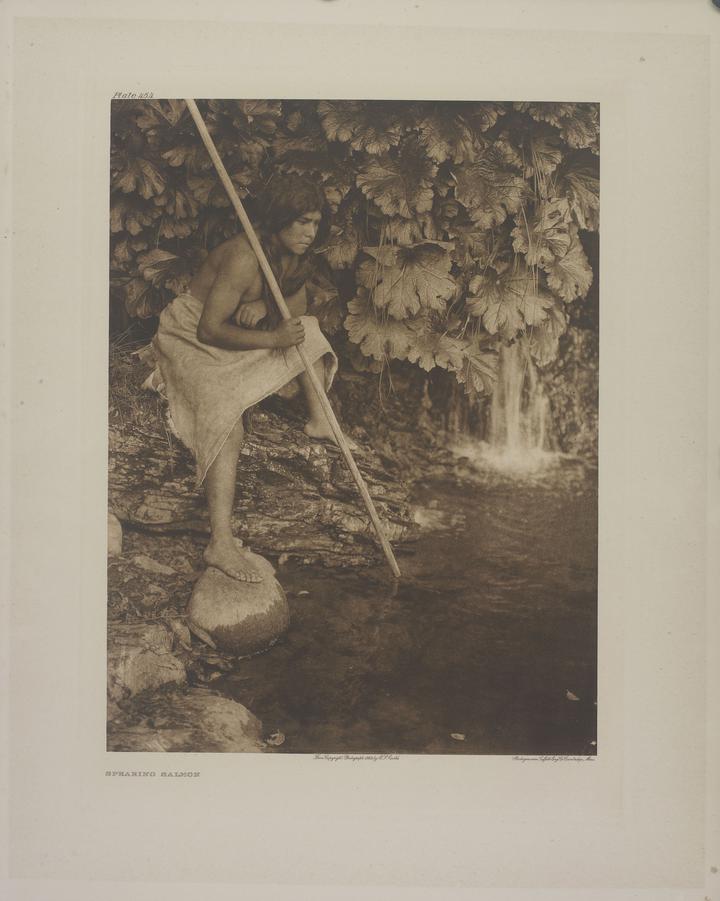
Spearing Salmon
1 2018-03-16T21:13:08-07:00 Erik Loyer f862727c4b34febd6a0341bffd27f168a35aa637 29482 1 “Spearing Salmon”, 1923, volume 13, portfolio plate 454, photogravure, 46 x 31 cm., Special Collection, Honnold Library, Claremont. plain 2018-03-16T21:13:08-07:00 Erik Loyer f862727c4b34febd6a0341bffd27f168a35aa637This page is referenced by:
-
1
2018-03-16T21:07:26-07:00
Warm tones and Wigs
1
part of Visualizing the "Vanishing Race"
plain
2018-03-16T21:07:26-07:00
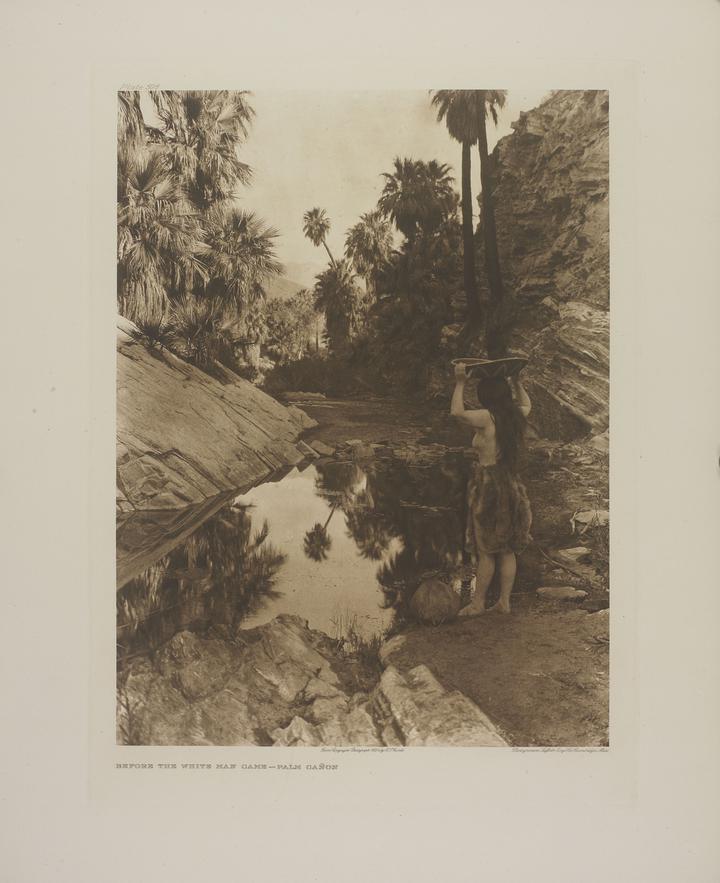
Ken Gonzales-Day, Scripps CollegeIn the caption to “The Offering - San Ildefonso”, Curtis wrote, “A pinch of cornmeal tossed into the air as an offering to the numerous deities of the Tewa, but especially the sun, is a formality that begins the day and precedes innumerable acts of the most commonplace nature." In this, as in all of the images included in The North American Indian, Curtis cleverly reduced the contrast that would have normally been present in a black and white silver gelatin print made from the same dry-plate negative by replacing the conventional black and white tones with brown and warmed toned highlights. The images are often incorrectly referred to as being sepia prints, but in fact there are numerous reference to what is actually a “brown” ink. The images are not produced with a photographic toning process but rather created from inked photogravure plates. Black and white photographic chemicals and paper were widely available by the first years of the twentieth century, but Curtis’ consciously sought to emulate earlier photographic processes, and was clearly encouraging viewers to imagine either, a sepia toned print, in which the tones are achieved by a chemical reaction, and not from a pigment. Or the brown tones could also suggest other earlier photographic printing techniques found in albumen prints usually associated with the cabinet card and the carte de visite made popular during the Civil War. By invoking earlier photographic processes, Curtis’ choice of tonality subtly served to mask the fact that the vast majority of his images were taken in the first three decades of the twentieth century. The impact of this tonal shift in the individual images becomes clearer when one compares the high resolution image scans created from The North American Indian portfolios held in Special Collections at the Honnold Library of the Claremont Colleges and available through the Claremont Colleges Digital Library against the some of the black and white copy print images that are available through “Curtis North American Indian Photograph Collection” in the Prints & Photographs Online catalog of the Library of Congress. These warm tones obviously added a nostalgic feel to the images, even in the 1910s and 20s, as one can see when comparing two of his well-know “Indian” re-enactments above. “Spearing Salmon,” vol. 13, plate 454, and “Before the White Man Came,” vol. 15, plate 508, which show a young man and a young woman, each wrapped in a “primitive” bit of fabric, respectively. By comparing such highly constructed scenes against one of the later portraits, for example, that of “Sam Ewing,” vol. 14, plate 437, one begins to get a sense of the impact of the brown pigment, which literally “tints” Ewing’s seemingly ambivalent response to Curtis’ request for a photo. Ewing poses with uncovered short hair and obviously refused to cover his modern clothing with a blanket. Sir Caspar Purdon Clarke, curator of the Metropolitan museum of art, responded to Curtis use of the brown tones as early as 1907 when he told a newspaper reporter:I find the photographs the only solution of the problem, how to render the Indian artistically depicted. There is something even in the: best work on canvas —In the colors of his skin and dress, which spoils the picture from my point of view, but in the monotone there is no disturbance of harmony, and your selection of the moment for proper lighting and grouping is generally happy.Curtis never denied paying his models, interpreters, or informants and there is no doubt that he consciously sought to produce a picturesque, or a pictorialist view in The North American Indian. It is also widely acknowledged that he went to great efforts to stage or restage cultural and spiritual practices. In the portraits and in many of the more elaborately staged scenes as well, one finds that he sought out, used, and reused various props, as seen in the Upshaw image, vol. 4, plate 139, jewelry as in the Mosa portrait, vol. 2, plate 61, clothes, which were often drawn from the families and communities he was photographing, and of course various blankets of all shapes and sizes. In another example, simply entitled “A Klamath,” vol. 13, plate 441, Curtis photographed an elderly gentleman in full Native attire but this time it is Curtis who informs the reader, “The entire costume here depicted is alien to the primitive Klamath. The feather head-dress and fringed shirt and leggings of deerskin were adopted by this tribe within the historical period, along with other phases of the Plains culture, which extended its influence to the Klamath country by way of Columbia river and the plains of central Oregon.” This image is a helpful reminder that Native cultures continue to evolve and change; they may alter and adopt new cultural practices from others Native communities, as with the war bonnet or feathered headdress. In spite of where specific cultural practices emerged, it is important to remember that Native culture and practices continue to grow and change, but are obviously no less “authentic” today than they were a century ago, even if they look very different. In addition to items Curtis found, or borrowed, he was said to have carried a number of props with him. He certainly carried a backdrop, and probably had a blanket or two. Given his tight budget, one suspects that much of the jewelry was probably borrowed and it is rare to find items reoccurring though more than one or two volumes. There is however, one object that recurs though many of the volumes with unsettling persistence. Once spotted, its presence is both understandable and yet completely undermines the truth claims he, and others, so often tried to make for the project. A 1911 article in the San Francisco Call, explained, “…Curtis, of course, takes with him a complete photographic equipment, for photographs from life and absolutely true to life, unposed, are the basic feature of the record which he is making.” But any claims that his images are unposed are wiped away the moment one detects the repeated use, and reuse, of a long black wig, used for a number of his male models and appears in more than one portfolio, on more than one model. Writing in the introduction to volume one, Curtis asserts that, “…one may treat limitless subjects of an aesthetic character without in any way doing injustice to scientific accuracy or neglecting the homelier phases of aboriginal life.” But one can’t help but believe that even his best intentions in 1907, were not sustainable as he faced increasing pressure to complete the project. By the time he photographs “Salmon Fishing” it would appear that there is something more than artistic license at work? Largely photographed in the early decades of the twentieth century, the wearing of long hair by Native men, which had been such an important part of traditional culture was openly discouraged as an extension of assimilationist practices that sought to “civilize” Native peoples at places like the Carlisle Indian Industrial School (1879-1918), which as noted, regularly shorn the hair of young men and boys on arrival. School officials regularly took “before” and “after” pictures of their student in order to demonstrate their success in forcing children from nearly forty different tribes into mainstream culture. The school’s slogan, “To civilize the Indian, get him into civilization. To keep him civilized, let him stay." By the twenties and thirties, long hair and traditional costumes were increasingly rare occurrence on reservation land and Curtis had to make a choice: Either stop the project, or hire a series of young men and women to perform before for the camera, much like the actors in his economically disastrous motion picture. Taken individually, some of the images may appear compelling, fantastical, artificial, but when taken together as a group they greatly undermine the years of research and hard work contributed not only by him, but by his many assistants, collaborators, translators, patrons, models, and suggests either a lapse in judgment, or the desperation of a man struggling to bring the project to an end.