Scalar's 'additional metadata' features have been disabled on this install. Learn more.
Performing Archive
Main Menu
Visualizing the “Vanishing Race”: the photogravures of Edward S. Curtis
Front Page for Visualizing the "Vanishing Race" path
Curtis' Image and Life: The Network of The North American Indian, Inc.
An experiment with data visualization approach to understand and contextualize Curtis' images and his life
Media, Technology and Mediations
Curtis's Technology, Relationships to Media and Style
Contextualizing Curtis, The North American Indian, and Race
the collection of essays from the contributors
Consulting with Tribes as Part of Archive Development
Introduction to Consulting with Tribes by Ulia Gosart
Contributing Archives
Information on how to participate in Performing Archive
Browsing the Media
A path of paths that allow users to cut through the collection in a variety of ways.
Acknowledgements and Project Information
Project Network
Jacqueline Wernimont
bce78f60db1628727fc0b905ad2512506798cac8
David J. Kim
18723eee6e5a79c8d8823c02b7b02cb2319ee0f1
Stephan Schonberg
23744229577bdc62e9a8c09d3492541be754e1ef
Amy Borsuk
c533a79d33d48cbf428e1160c2edc0b38c50db19
Beatrice Schuster
a02047525b31e94c1336b01e99d7f4f758870500
Heather Blackmore
d0a2bf9f2053b3c0505d20108092251fc75010bf
Ulia Gosart (Popova)
67c984897e6357dbeeac6a13141c0defe5ef3403
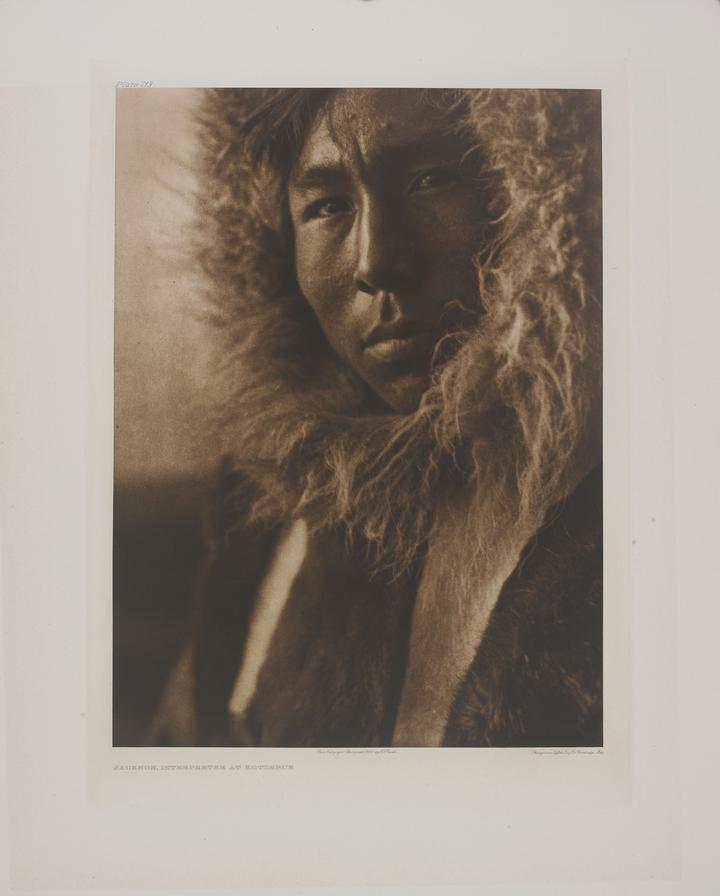
Jackson, Interpreter at Kotzebue
1 2018-03-16T21:12:56-07:00 Erik Loyer f862727c4b34febd6a0341bffd27f168a35aa637 29482 1 “Jackson, Interpreter at Kotzebue”, volume 20, portfolio plate 713, photogravure, 46 x 31 cm., Special Collection, Honnold Library, Claremont. plain 2018-03-16T21:12:56-07:00 Erik Loyer f862727c4b34febd6a0341bffd27f168a35aa637This page is referenced by:
-
1
2018-03-16T21:12:56-07:00
Jackson and Curtis at the end
1
part of Visualizing the "Vanishing Race"
plain
2018-03-16T21:12:56-07:00
Ken Gonzales-Day, Scripps CollegeIn 1927, Curtis buys a small forty-foot long boat, and sets off with Beth, and a small crew to document Native communities in Alaska. In the same year, Clara files an affidavit to recover unpaid alimony from Curtis when she read’s of her ex-husband’s adventures, and immanent return to Seattle. She has Curtis picked up by police and he spends two nights in jail. When the judge finally asked Curtis just how much money had been paid by the Morgan estate over the length of the project, Curtis sheepishly offered, “…about 2.5 million when it’s done.” But he went on to explain all the expenses related to the project, and detailed the sad state of his finances. He explained his personal, professional and financial obligations to complete the project against all odds. In the end, the Judge dismissed the case. As a result of his still growing debt, Morgan forced Curtis to transfer the copyright for all of the images and the text to the Morgan Company in 1928, but they had agreed to see the project through to the end! The final volume was unceremoniously released in 1930, bringing to a close a project that had spanned over three decades and left Curtis with almost nothing to show for it. Curtis photographs “Jackson,” his Native guide, interpreter and informant for volume eighteen. It is a striking portrait. Despite the crisis at home, Curtis’ eye continued to evolve as a photographer through the many years he worked on The North American Indian, and while he has made use of off-center compositions many times before, this particular image stands out. In the image, he has allowed the figure to fill the frame, without giving in to the usual melodramatics. Wrapped in a fur-lined coat, one encounters Jackson’s gaze. Jackson is looking at Curtis, but he also seems to be looking through Curtis. Little attention has been paid to the compositional development of Curtis’ work as a portrait photographer, but there can be little doubt that as the modern world seemed to shrink in around him, Curtis increasingly moves ever closer to his subject, limiting the vantage point, increasingly focuses almost exclusively on the face, or upper body. In this image, there is still enough peripheral information to build a compelling portrait that is closer to a modern day snapshot, a farewell, that would scarcely serve the needs of the ethnologist, who typically preferred images with as much clarity as possible, a consistent focal distance, the figure or action located in the center of the frame, and perhaps a ruler or grid somewhere in the background to provide scale. A financial failure, the remaining materials amassed for The North America Indian project, including the photogravure plates, were sold to Charles Lauriat Co. for $1,000 plus royalties in 1935. On Oct. 19th, 1952, at the age of 84, Curtis died alone in a small apartment in Los Angeles. Among his few belongings, was one complete set of The North American Indian. In the early 1970s Curtis' original copper plates and photogravures were rediscovered at Lauriat's Book Shop in Boston and purchased by a group of New Mexico investors. It included all of the original copper plates used for The North American Indian. The newly assembled collection was then sold to another group of investors, also in New Mexico, and led by Mark Zapin in the mid-70s. The Zaplin Group retained the plates until 1982 when they were sold to a California-based investment group led by Kenneth Zerbe. He still owns them. In 2012, a complete set sold for $1.44 million dollars at auction.