Ebony Juniors - UK Junior Panorama 2017
1 2023-02-21T21:06:25-08:00 Marc Thorman f2b57c456bb408491ab2cdffaf869c4905420054 30914 1 CAPCA/BAS UK Junior Panorama Steelband Competition 2017 Band: Ebony Steel Band Juniors (1st Place) Tune: Good Morning ... plain 2023-02-21T21:06:25-08:00 Marc Thorman f2b57c456bb408491ab2cdffaf869c4905420054This page is referenced by:
-
1
media/parade-header.png
2018-09-02T15:02:28-07:00
CALYPSO, SOCA, AND CARNIVAL
34
image_header
2026-07-03T15:34:11-07:00
Header image: Urbanmatter, West Indian American Day Carnival Association. Used with permission.
INTRODUCTION
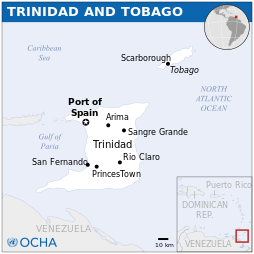
Trinidad and Tobago
The Republic of Trinidad and Tobago is one of the twenty-three states and territories that comprise the West Indies.
Trinidad is one of the wealthiest nations in the Caribbean. Oil and natural gas extraction, and heavy industry form the backbone of the economy. The population [estimated at 1.5 million] is mainly comprised of Blacks (the descendants of former slaves), East Indians (originally brought to the island as contract laborers from northern India), Whites, and Chinese, many of whom are racially and culturally intermixed. [Nations Encyclopedia]
The population of Tobago was 60,874 at the 2011 census. Tobago's population is primarily of African descent, although with a growing proportion of Trinidadians of East Indian descent and Europeans. Between 2000 and 2011, the population of Tobago grew by 12.55 percent, making it one of the fastest-growing areas of Trinidad and Tobago. Tobago's main economy is based on tourism, fishing, and government spending, government spending being the largest. ["Tobago," Wikipedia]
Immigration to the United States
The Caribbean Region is the source of the United States' earliest and largest Black immigrant group and the primary source of growth of the Black population in the U.S. The region has exported more of its people than any other region of the world since the abolition of slavery in 1834. [Wikipedia]
According to the 2010 Census there are approximately 240,000 Trinibagonians living in the United States. Most immigrated in two surges: More than 56,000 Trinidadians and Tobagonians legally migrated to the United States from 1966-1975 after the abolition of restrictive national-origins quotas via the U.S. Immigration and Nationality Act of 1965. This initial wave consisted largely of the educated elite, white-collar professionals. Emigration surged again in the late 1980s when falling global oil prices sent the Trinidadian and Tobagonian economy into a deep recession. The Trinbagonian community is the second-largest English speaking Caribbean community in the United States, second to Jamaican Americans. Most West Indian Americans reside in New York City, including approximately 87,000 Trinbagonians.
Historical Overview
Spanish colonization of Trinidad began in the 1500s. By the middle of the eighteenth century the island was still the least developed colony in the Caribbean. Spain enticed settlers by offering land grants and tax exemptions, as long as the settlers were Catholic and swore allegiance to Spain. Thousands of French colonists and free Blacks from the surrounding French colonies emigrated to Trinidad, bringing African slaves with them. Their experience in planting sugar led to vast plantations that required yet more slaves to be imported.
In 1802 Spain ceded the island to Britain. Under British rule Creole [a mix of African languages, Spanish, and French] and all other non-British cultural expressions were attacked and made illegal. Slaves were emancipated in 1834, free trade adopted in 1846, and more than 150,000 immigrants from India, China and Madeira brought in between 1845 and 1917. These indentured labourers came on short contracts, after which they were free to return home or buy plots of land. The Indians worked mainly on the sugar plantations and introduced the cultivation of rice there. [TheCommonwealth.org]
The Spanish had killed all the indigenous people of Tobago by the time Dutch colonists arrived in the seventeenth century. The smaller island was fought over by European colonists until 1814 when it was finally ceded to the British. The abolition of slavery, natural disasters, and a weakened sugar market led to the collapse of Tobago's economy and in 1888 the island was amalgamated with Trinidad.
In the 1920s labor organized and calls for representation and independence gained strength. But it was not until 1945 that universal suffrage was instituted and not until 1960 that the islands achieved full internal self-government. In 1962 Trinidad and Tobago declared independence.
MUSIC OF TRINIDAD AND TABAGO
The music of Trinidad and Tobago is best known for calypso, soca, and steelpan, all of which are important to the development of carnival in Trinidad and Tobago, and to the carnival tradition of the West Indian Day Parade in New York City.
CALYPSO
Calypso is a form of folk music that originated in Trinidad in the eighteenth century and spread rapidly throughout the West Indies. The music originated amongst Trinidad's large population of former slaves. Its complex, syncopated rhythm clearly reflects traditional African rhythms. The lyrics of the earliest Calypso songs were in Trinidadian patois, a remnant of the early French colonization of Trinidad. Subsequently, when the British took over, the primary language of Calypso music became English.
Not unlike the griots of Africa, the calypsonians were often the most important and popular critics of the political situation and were able to keep leaders and public figures accountable through their lighthearted but very incisive accounts of indiscretions, poor choices, or dishonesty. Renowned for its magnificent carnivals, and for inventing the 20th century's only new acoustic instrument — the steel pan —Trinidad is also the birthplace of these great storytelling poets such as Lord Kitchener and Mighty Sparrow.From its earliest days, calypso music served as a forum for the expression of social and political views within the Caribbean. Remarkably, the criticism mounted by calyp-sonians was not limited to broad appeals against inequality, racism, poverty, and oppression, but tackled precise specificity laws, domestic policy, proposed legislation, foreign policy, labor relations, actions by public figures, and even speeches given by notable persons. Thus, in addition to humorous rivalries between singers, songs about the beauty of the land, and compositions with a ribald flavor, calypsos were composed with such titles as "Prison Improvement," "Shop Closing Ordinance," "The Commissioner’s Report," "The European Situation," "Devaluation," "Slum Clearance," "Reply to the Ministry," and, fittingly, "The Censoring of Calypsoes Makes Us Glad." [What-when-how.com]
Harry Belafonte
The widespread success of the Andrews Sisters' "Rum and Coca-Cola" was a major breakthrough for calypso in the U.S., but it was Harry Belafonte who put calypso to the international stage in 1956 with his groundbreaking album Calypso, the first million-selling album by a solo artist. Harry Belafonte was born in Harlem in 1927. Both his parents were partially of Jamaican descent. As a child, Belafonte spent eight years in Jamaica. Besides his singing career Belafonte gained an international reputation as actor, civil rights activist, and humanitarian activist.
Calypso topped the charts for a staggering 31 weeks and stayed on the charts for 99 weeks, earning its current ranking of number four on Billboard's Top 100 list. Ironically, the songs on Calypso are not really calypso at all, but a pop version of Jamaican mento folk music. The hit songs on the album were "Jamaica Farewell" and "Banana Boat (Day-O)." Both songs are Jamaican folk songs that were arranged by Brooklyn native Irving Burgie, whose mother was from Barbados, West Indies and whose father was from Virginia.
Harry Belafonte, "Banana Boat Song (Day-O)" 1956
Belafonte followed up Calypso with another smash hit album, Jump Up Calypso, in 1961. The album was more authentically calypso than the 1956 Calypso album in that the arrangements included the The Trinidad Steel Band; however, most of the songs are in fact traditional Jamaican mento songs arranged by Burgie and other American commercial arrangers or jazz artists to appeal to a mainstream American audience. Two of the songs were composed by calypsonians: "Sweetheart from Venezuela" is a song by Lord Melody, and "Jump in the Line" by Lord Kitchener. The chorus "Shake Senorita" was added to "Jump in the Line," and the song was registered under Belafonte's pseudonym, Raymond Bell. Kitchener never received credit or royalties from Belafonte's recording.
This recording artist brought calypso to the international stage in 1956 with his groundbreaking album Calypso, the first million-selling album by a solo artist. Calypso topped the charts for a staggering 31 weeks and stayed on the charts for 99 weeks, earning its current ranking of number four on Billboard's Top 100 list. The hit songs on the album were "Jamaica Farewell" and "Banana Boat (Day-O)." Both songs were written by Brooklyn native Irving Burgie, whose mother was from Barbados, West Indies and whose father was from Virginia.
Harry Belafonte was born in Harlem in 1927. His mother was a housekeeper of Jamaican descent, child of a Scottish mother and black father. Belafonte's father was a Martiniquan chef, child of a Jamaican mother and a Dutch Jew. As a child, Belafonte spent eight years in Jamaica. Besides his singing career Belafonte gained an international reputation as actor, civil rights activist, and humanitarian activist. [Wikipedia]U.S NAVY STEEL BAND
Steelpan Ambassadors: The US Navy Steel Band, 1957–1999Univ. Press of Mississippi, 2017“Maybe you won't like steel band. It's possible. But it's been said that the Pied Piper had a steel band helping him on his famous visit to Hamelin.” When the US Navy distributed this press release, anxieties and tensions of the impending Cold War felt palpable. As President Eisenhower cast his gaze towards Russia, the American people cast their ears to the Atlantic South, infatuated with the international currents of Caribbean music. Today, steelbands have become a global phenomenon; yet, in 1957 the exotic sound and the unique image of the US Navy Steel Band was one-of-a-kind. Could calypso doom rock 'n' roll? Band founder Admiral Daniel V. Gallery thought so and envisioned his steelband knocking “rock 'n' roll and Elvis Presley into the ash can.”
From 1957 until their disbandment in 1999, the US Navy Steel Band performed over 20,000 concerts worldwide. In 1973, the band officially moved headquarters from Puerto Rico to New Orleans and found the city and annual Mardi Gras tradition an apt musical and cultural fit. The band brought a significant piece of Caribbean artistic capital—calypso and steelband music—to the American mainstream. Its impact on the growth and development of steelpan music in America is enormous.
Steelpan Ambassadors uncovers the lost history of the US Navy Steel Band and provides an in-depth study of its role in the development of the US military's public relations, its promotion of goodwill, its recruitment efforts after the Korean and Vietnam Wars, its musical and technological innovations, and its percussive propulsion of the American fascination with Latin and Caribbean music over the past century.
[https://books.google.com/books/about/Steelpan_Ambassadors.html?id=G2olDwAAQBAJ]
CARNIVALSTEEL PAN MUSIC
How a steel pan (or steel drum) is made:
Steel pan soloist Jaden plays "Human Nature" (Michael Jackson, 1982):
Ebony Steel Band Juniors win 1st Place in 2017 UK Junior Steelband Competition with Peter Ram's "Good Morning," arranged by David Ijaduola:READING
Ray Allen and Lois Wilcken, "Introduction" and Don Hill, "'I Am Happy Just to Be in This Sweet Land of Liberty' The New York City Calypso Craze of the 1930s and 1940s" in Island Sounds in the Global City
Ray Allen, "J'ouvert in Brooklyn Carnival: Revitalizing Steel Pan and Ole Mas Traditions" in Western Folklore 56 (Summer/Fall 1999)REFERENCES
Donald Hill and Roger Abrahamson, "West Indian Carnival in Brooklyn," Natural History 88.
Ray Allen, "Is Brooklyn J'Ouvert Dead?," CityLore, 2017.
Donald Hill, Calypso Callaloo: Early Carnival Music in Trinidad, Temple University Press, 2006.
Ray Allen and Lois Wilcken (eds.), Island Sounds in the Global City: Caribbean Popular Music and Identity in New York, New York Folklore Society and the Institute for Studies in American Music at Brooklyn College.
Gage Averill, "'Pan Is We Ting': West Indian Steelbands in Brooklyn," in Kip Lornell and Anne K. Rasmussen (eds.), The Music of Multicultural America, University Press of Mississippi, Jackson, 2016.
Holger Henke, The West Indian Americans, Westport: Greenwood Publ., 2000.
GROUP TOPICS
The group will not be able to fully cover all the suggested topics below. The emphasis should be on the first two listed. The remaining topics, if any/all are to be covered by the group, are great examples of hybridization; however, the focus should be contemporary popular music and the extension of Carnival traditions in the US, particularly NYC.- The West Indian American Carnival and J'Ouvert in Brooklyn
- The origin and development of soca
- Chutney music
- Rapso
- Music TT
INTRODUCTION

CC BY 3.0. Wikipedia
Historical Overview
Spanish colonization of Trinidad began in the 1500s. By the middle of the eighteenth century the island was still the least developed colony in the Caribbean. Spain enticed settlers by offering land grants and tax exemptions, as long as the settlers were Catholic and swore allegiance to Spain. Thousands of French colonists and free Blacks from the surrounding French colonies emigrated to Trinidad, bringing African slaves with them. Their experience in planting sugar led to vast plantations that required yet more slaves to be imported.
In 1802 Spain ceded the island to Britain. Under British rule Creole [a mix of African languages, Spanish, and French] and all other non-British cultural expressions were attacked and made illegal. Slaves were emancipated in 1834, free trade adopted in 1846, and more than 150,000 immigrants from India, China and Madeira brought in between 1845 and 1917. These indentured labourers came on short contracts, after which they were free to return home or buy plots of land. The Indians worked mainly on the sugar plantations and introduced the cultivation of rice there. [TheCommonwealth.org]
The Spanish had killed all the indigenous people of Tobago by the time Dutch colonists arrived in the seventeenth century. The smaller island was fought over by European colonists until 1814 when it was finally ceded to the British. The abolition of slavery, natural disasters, and a weakened sugar market led to the collapse of Tobago's economy and in 1888 the island was amalgamated with Trinidad.
In the 1920s labor organized and calls for representation and independence gained strength. But it was not until 1945 that universal suffrage was instituted and not until 1960 that the islands achieved full internal self-government. In 1962 Trinidad and Tobago declared independence.
MUSIC OF TRINIDAD AND TABAGO
The music of Trinidad and Tobago is best known for calypso, soca, and steelpan, all of which are important to the development of carnival in Trinidad and Tobago, and to the carnival tradition of the West Indian Day Parade in New York City.
CALYPSO
Calypso is a form of folk music that originated in Trinidad in the eighteenth century among the large population of slaves, and spread rapidly throughout the West Indies. Its complex, syncopated rhythm clearly reflects traditional African rhythms. The lyrics of the earliest Calypso songs were in Trinidadian patois, a Creole language formed from French, combined with West African, Spanish, and indigenous influences. Subsequently, when the British took over, the primary language of Calypso music became English.
From its earliest days, calypso music served as a forum for the expression of social and political views within the Caribbean . . . Not unlike the griots of Africa, the calypsonians were often the most important and popular critics of the political situation. Calypsonians were able to keep leaders and public figures accountable through their lighthearted but very incisive accounts of indiscretions, poor choices, or dishonesty. In addition to humorous rivalries between singers, songs about the beauty of the land, and compositions with a ribald flavor, calypsos were composed. Song titles included "Prison Improvement," "The Commissioner’s Report," "The European Situation," "Slum Clearance," "Reply to the Ministry," and, fittingly, "The Censoring of Calypsoes Makes Us Glad." [What-when-how.com]
Calypsonians had a long history of rejection by society in many forms and fashions. Despite these attitudes, by 1930 there was growing support from a cross section of society, especially the business community. This business interest together with a new crop of very talented calypsonians such as Wilmouth Houdini and Roaring Lion were key factors in the development and success of the calypso during the period between 1934 and 1950, when calypsonians began to travel to New York on contract to record. This period is known as the “Golden Age Of Calypso” and is characterized by the development of the “Calypso Tent”, professionalization of calypsonians, access to recording facilities, and business sponsorship for local and international promotion of the art form.
Legendary Calypsonians
Lord Kitchener (Aldwyn Roberts, 1922 – 2000)
Kitchener was born in Arima and moved to the capital Port of Spain in 1943. There he gained a reputation as a songwriter, singer, and guitarist in live performances during Carnival seasons, as there was no recording industry in Trinidad at the time. In early 1946, he won his first official Road March title with "Jump In The Line." His international reputation launched two years later when he arrived in England and sang "London Is the Place for Me" on a Pathé newsreel.
Kitchener's first weeks in England were spent singing to bemused audiences in pubs, but within six months he had broken into the London nightclub circuit with his own band. The key to his success was an ability to reach beyond the Caribbean diaspora. . . In 1951 he was on film again, leading the pitch invasion at Lords which followed the West Indies cricket team's first victory over England. By then, he was a chronicler of the Caribbean experience in Britain. There were calypsos like "I Can't Stand The Cold In Winter" and "If You're Brown." Peter Mason, The Guardian, February 2000
He moved to Manchester in the north of England, and opened his own club. He toured the United States in the mid-1950's, and even as an expatriate he continued to have hits in Trinidad. When he toured in Africa his music was embraced in Ghana, where calypso became an influence on high-life music After 16 years abroad Lord Kitchener returned to Trinidad in 1963 and won the Road March competition three years running, as well as in 1967 and 1968; he won five more Road Marches from 1970 to 1976. John Pareles, New York Times, February 2000
The Mighty Sparrow (Slinger Francisco, b. 1935)
Sparrow is known as the "Calypso King of the World." He has won Trinidad's Carnival Road March competition eight times, Calypso King/Monarch eight times, and the Calypso King of Kings title twice. He began recording in the mid 1950s, including his most famous song "Jean and Dinah" celebrating the departure of U.S. troops from Trinidad. The Mighty Sparrow, like Lord Kitchener, helped popularize calypso in the U.K. and the U.S. In 1960 he returned to Trinidad and won second Kingship and third Road March title with "Ten to One Is Murder" (an autobiographical song about an incident in which Sparrow allegedly shot a man). He won further titles in the 1960s and 1970s and continued to enjoy great popularity in Trinidad. He recorded prolifically, with forty albums released in the 1960s and 1970s.The Mighty Sparrow: " Mas in Brooklyn" 1969
Sparrow recognized the advantages of using New York as a base for recording and international touring, and by the mid-1960s moved his operation and family to Jamaica, Queens. He became a fixture in Brooklyn’s Labor Day Carnival, regularly appearing at the big Dimanche Gras show at the Brooklyn Museum. He wrote a number of calypsos about life in New York, bookended by his 1969 classic "Mas in Brooklyn" and his provocative 1991 "Crown Heights Justice." In 2020, he released Live at 85!, a recording from December 2019 of a show at Joe's Pub in New York City.
Calypso Rose (Linda McCartha Monica Sandy-Lewis, b. 1940 in Tobago)Calypso Rose started writing songs at the age of 13. Over the years, she has composed more than 1000 songs and recorded more than 20 albums. Considered the "Mother of Calypso," Rose was the first female calypso star. Her influence over the calypso music genre forced the renaming of the Calypso King competition to the Calypso Monarch instead. Her lyrics frequently address social issues like racism and sexism. Rose is also a queer icon, having come out as gay in interviews and stating that she was married to a woman for 17 years. Throughout her career she has been celebrated as an advocate for the LGBTQ community in the Caribbean. In addition to writing songs about social issues, Rose is also an activist and was given the title of UNICEF Goodwill Ambassador for former child soldiers along with performing at numerous events for social change. She has received every award available to living artists in the Caribbean including the Order of the Republic of Trinidad and Tobago, the country’s highest honor.
She currently resides in Queens, New York, and regularly returns to Trinidad and Tobago in addition to touring.
Calypso Rose: "Calypso Queen" 2016The Calypso Craze
The huge American military presence in Trinidad during World War II was a crucial factor in the development of the calypso industry and the popularization of calypso. In September 1940, President Franklin D. Roosevelt and Prime Minister Winston Churchill finalized a deal that gave Britain 50 aging naval destroyers in exchange for rent-free leases to build military bases in British territories, including Trinidad. The U.S. built the sprawling Naval Base Trinidad at Chaguaramas and an Army air base at Waller Field in central Trinidad in 1941 to protect oil lanes, guard the Panama Canal, and hunt German U-boats navigating the Caribbean. During the peak of World War II (1942-1943), there were up to 135,000 U.S. troops and civilian contractors stationed in Trinidad. After the war most bases on Trinidad were decommissioned by 1950.
The U.S. military occupation of Trinidad had both positive and negative effects. While U.S. forces built critical infrastructure, provided employment, raised wages, and provided free health care, the U.S. also seized large tracts of land where local law and authority had no jurisdiction. Unsolved murders, violent crimes and sexual assault were historically reported. The presence of young American soldiers with cash fueled a massive sex work industry.
Naval Base Chaguaramas CC BY-SA 4.0
U.S. troops introduced American popular music to Trinidad through records and with transmissions from the U.S. Armed Forces Radio Station WVDI. Calypsonians began to incorporate the jazz, blues, and rock and roll. The station also provided a platform for local calypso musicians whose performances were broadcast.
Carnival was banned between 1942 -1945, but entertainment thrived throughout the island and so did calypso. American troops had an insatiable appetite for entertainment of all variety. This new, receptive and massive audience turned out to be a blessing in disguise for the entire entertainment industry, calypsonians included. They were in great demand, they sang at the US bases, theaters, cinemas, bars, and parties. "Trinidad Society In The 1930’s and 1940’s," The Roaring Lion Foundation
The first calypso song that became a hit in the United States was "Rum and Coca-Cola" by Lord Invader (Rupert Grant) and Lionel Belasco. The song was pirated and copyrighted by Morey Amsterdam, an American comedic actor who had heard Grant perform it when he visited the island as part of a U.S.O. entertainment tour. Amsterdam stripped some of the lyrics of social commentary critical of the American presence in Trinidad, but retained the lines of the chorus that hint at prostitution. The pirated version was recorded by the popular singing trio the Andrews Sisters and became a massive hit, sitting at number one on the Billboard magazine chart for seven weeks. (After suing for copyright infringement, Grant finally received royalties of $150,000 in 1948.)
Rum and Coca-Cola, recorded by the Andrews Sisters (released 1944)
Rum and Coca-Cola, performed (with commentary) by Lord Invader, New York, 1946, with original lyrics
The widespread success of the Andrews Sisters' "Rum and Coca-Cola" was a major breakthrough for calypso in the U.S., but it was Harry Belafonte who put calypso to the international stage in 1956 with his groundbreaking album Calypso, the first million-selling album by a solo artist. Harry Belafonte was born in Harlem in 1927. Both his parents were partially of Jamaican descent. As a child, Belafonte spent eight years in Jamaica. Besides his singing career Belafonte gained an international reputation as actor, civil rights activist, and humanitarian activist.
Calypso topped the charts for a staggering 31 weeks and stayed on the charts for 99 weeks, earning its current ranking of number four on Billboard's Top 100 list. Ironically, the songs on Calypso are not really calypso at all, but a pop version of Jamaican mento folk music. The hit songs on the album were "Jamaica Farewell" and "Banana Boat (Day-O)." Both songs are Jamaican folk songs that were arranged by Brooklyn native Irving Burgie, whose mother was from Barbados, West Indies and whose father was from Virginia.Harry Belafonte, "Banana Boat Song (Day-O)" 1956
Belafonte followed up Calypso with another smash hit album, Jump Up Calypso, in 1961. The album was more authentically calypso than the 1956 Calypso album in that the arrangements included the The Trinidad Steel Band; however, most of the songs are in fact traditional Jamaican mento songs arranged by Burgie and other American commercial arrangers or jazz artists to appeal to a mainstream American audience. Two of the songs were composed by calypsonians: "Sweetheart from Venezuela" is a song by Lord Melody, and "Jump in the Line" by Lord Kitchener. The chorus "Shake Senorita" was added to "Jump in the Line," and the song was registered under Belafonte's pseudonym, Raymond Bell. Kitchener never received credit or royalties from Belafonte's recording.Jump In The Line by Lord Kitchener, original recording 1946
Jump In The Line as recorded by Harry Belafonte in 1961 (The video is a mix of footage of Harry Belafonte performing at the Grand Opera in Sweden in 1966; cuts from an Too Many Girls (1940) starring Desi Arnaz; and shots from the 1988 Tim Burton movie Beetlejuice.)
The 1950s—specifically 1956 and 1957—were the golden age of calypso in Hollywood. Triggered by Harry Belafonte's historic, best-selling 1956 album Calypso, the film industry rushed to capitalize on the trend that same year, with Louis Armstrong famously opened the classic musical High Society singing "High Society Calypso," firmly embedding the rhythm into mainstream prestige cinema.
The following year saw five Hollywood productions: Calypso Heat Wave; Calypso Joe; Island in the Sun (starring Belafonte); Bop Girl Goes Calypso; and Fire Down Below, which prominently showcased the local culture and featured actor Robert Mitchum, who loved the music so much he recorded his own calypso album, Calypso... Is Like So. Mitchum attempted to create an authentic sound by hanging out with Mighty Sparrow, imitating the local Trinidadian accent, and including steelpans, conga drums, and horns in the instrumental accompaniment to his cool-vibes vocal style. The album includes Mitchum's toned-down version of Sparrow's legendary international hit "Jean and Dinah," a sharp comment on the large-scale prostitution that the U.S. bases once supported, and the desperation of these prostitutes following the base closures in the post-war period.

Jean and Dinah by Mighty Sparrow, 1956
Jean and Dinah as sung by Robert Mitchum, 1957
By the 1960s, the nationwide calypso bubble had burst, giving way to new musical movements like folk, surf rock, and the British Invasion. When calypso appeared in 1960s films, it was generally reserved for atmospheric, beach, or resort-style movies rather than being the driving force of the film's promotional campaign.
SOCA
Lord Shorty and the Creation of Soca
The popularity of calypso began to decline by the 1970s, with young people attracted to Jamaican reggae and American soul and funk. In an effort to revive the calypso tradition, Lord Shorty (Garfield Blackman, 1941-2000) created an updated form which became known as soca.* He began to record calypso songs in 1960, and in 1970 took top honors in a regional contest. A few years later he recorded a song that launched an new musical genre. "I felt [calypso] needed something brand new to hit everybody like a thunderbolt," he was quoted as saying in The Times of London. Soca was assumed to derive from Shorty's 1973 release "Soul of Calypso" but he himself explained that it came from calypso and ka, denoting a drum stroke in Hindi. He originally spelled the word as s-o-k-a-h.
Shorty was born in the southern Trinidadian community of Lengua, an area heavily populated by the descendants of indentured servants who British colonizers had brought from India. Growing up, he was familiar with calypso as well as chutney, the Indo-Caribbean genre derived from North Indian classical music.
By 1969 chutney had been updated and commercialized by Sundar Popo, "the father of chutney music," in popular songs such as "Nana and Nani." Four years later Lord Shorty released the first soca track, "Indrani," which combined calypso with the melodic style, instruments, and rhythms of chutney, and told the story of an interracial love interest. One of the defining characteristics of soca is a fast tempo of 115-160 BPM, designed for dancing and carnival celebrations, whereas calypso's more liesurely 90-125 BPM is designed for storytelling songs. The rhythms Lord Shorty drew upon were the fast tempos and subdivisions of beats played by chutney percussion instruments, the dholak (a two-headed hand drum) and dhantal (a steel rod hit with a striker). Both instruments can be seen and heard in the video of Leela M's "Ab Choliya Beeche."
Leela M: Traditional West Indian Chutney Music, 2025
Shorty's 1974 album "Endless Vibrations" is widely considered the definitive blueprint that launched the genre. The album was an international hit, played on radio stations and at clubs in New York, Toronto, and. London. The dholak and dhantal were rtranferred to the drums and cymbals of the standard jazz/rock drum set. Horns, missing from earlier tracks, were reintroduced in the arrangements by the legendary Ed "Dr. Soca" Watson.
"After combating obscenity charges that arose in the wake of his racy "Lesson in Love" single, Shorty renounced his hedonistic life. He converted to the Rastafarian faith, traded in his fancy clothes for robes and sandals, grew dreadlocks, and moved with his wife and children to the forested Trinidadian region of Piparo." In 1980 he dubbed himself Ras Shorty I. Ras Shorty's new life did not portend any decline in his popularity however. He continued to deliver innovative recordings like "Om Shanti Om" (1978), a song based on a Hindu chant. The song became so well known that it was even plagiarized in a Bollywood movie. Having once penned songs with raunchy lyrics, he now criticized hits such as Lord Kitchener's "Sugar Bum Bum" as examples of soca's moral decline. ["Shorty I, Ras ," Contemporary Black Biography, Encyclopedia.com, 2026]
While the old-style calypso may have fallen out of style, the great calypsonians of earlier years quickly adopted the uptempo rhythms and instrumental arrangements of soca and were if anything even more successful during the 1970s and 1980s. Lord Kitchener released what is perhaps his most famous song, "Sugar Bum Bum" in 1978, and Mighty Sparrow released his soca hit "Soca Pressure" in 1992.
Lord Kitchener, "Sugar Bum Bum" live
Contemporary Soca
In 2005 the International Soca Monarch organizers coined the terms groovy soca and power soca. The former was a re-branding of the slower tempo soca styles that had been popular in Trinidad and Tobago since the inception of soca music in early 1970s. Groovy Soca is a slower, more melodic, and focused on lyrical storytelling and smooth dancing. Power Soca is an extremely fast, high-octane music specifically engineered to make crowds jump up and "play mas" (dance in the streets) that took hold in Trinidad and Tobago during the early 1990s.
Groovy Soca
Machel Montano, "Vibes Cyah Done" ("the party never ends") 2012
Machel Montano (b. 1974) is well known in New York City, where he has had sold-out concerts in Madison Square Garden many times over. He is a six-time International Soca Monarch, a twelve-time Trinidad and Tobago Road March winner, and a one-time Calypso Monarch. Montano has produced twenty-seven solo albums and thirteen albums with his band Xtatik as of 2026. He was among the first soca musicians to expand soca from audio recordings to music videos.
Groovy soca has been the sub-genre most likely to pass over into the global mainstream because of its radio-friendly pace and rhythmic tie-ins with tresillo and reggaetón patterns.
In an interview with the Caymanian Times Montano commented that "We have had the chart success of Kevin Lyttle with ‘Turn Me On’ and Rupee's ‘Tempted to Touch’ (both songs entered the Billboard Hot 100 in 2004) but we need more than that. I have been trying to revolutionise soca, trying to improve its quality. It is very difficult to bring soca to the mainstream and stay grounded at home but we have created a sound that we believe is palatable to all markets and can play on the radio in rotation with other popular songs. That is a dream I have always had and something I look forward to achieving."
Power Soca
By the 1980s and 1990s, the genre evolved from "classic soca" into electronic territory, using electronic drum sounds, synthesized melodies and studio effects.
In the 1990s, Trinidadian Super Blue (Austin Lyons) sang the most popular road march (song for Carnival dancing in the street) three years in a row, beginning with “Get Something and Wave” in 1991. With this song, Super Blue established a new model for Carnival music that featured a faster tempo, energetic rhythmic vocalizations, and lyrics that gave instructions to the dancers, such as “get something and wave,” “jump up,” “break away,” and “hands in the air.” Such lyrics came to constitute one of the most obvious differences between calypso and soca. Calypso songs for the tent privilege wordplay and message over danceability, and they have narrative texts in which a story unfolds across several verses. By contrast, soca songs are as important for their rhythmic drive, excitement, and physical impulse as they are for their verbal meanings; moreover, they are usually built in short phrases, often presented in call-and-response form. https://www.britannica.com/art/soca-music.
Power soca songs are most often heard during Carnival in their recorded versions, played on sound systems with huge speakers, often mounted on moving flatbeds or “DJ trucks.” The power of low frequencies is particularly important to the aesthetic of soca, which features pounding bass lines that are felt as much as they are heard.
Bunji Garlin, XplicitMevon "Still a Road Man" 2026
Bunji Garlin (Ian Antonio Alvarez, b. 1978 in Arima) released 16 albums between 1999 and 2025 and has collaborated on numerous songs. He has won Trinidad's Soca Monarch/International Soca Monarch competition on several occasions and, in 2013, the Soul Train Award for Best International Performance for the song "Differentology." Bunji Garlin's "Brrt" is featured on the Grand Theft Auto IV soundtrack.
STEELPAN MUSIC
The steelpan is the only acoustic musical instrument invented in the 20th century. It emerged in the 1930s from communities in Trinidad and Tobago and is today the official national musical instrument of the twin islands.
Evolution of the Steelpan
The first instruments developed in the evolution of steelpan were tamboo bamboos, tunable sticks made of bamboo wood. Tamboo bamboo bands included percussion of a (gin) bottle and spoon. By the mid-1930s, tamboo bamboo bands included improvised metal percussion such as frying pans, dustbin lids, and automobile brake hubs. These musicians sparked a street movement that transformed into the steelpan orchestra (also known as steelpan band).
The first recording of an early steelpan band, "Lion-Oh," featured singer Roaring Lion (Raphael De Leon) and Hell Yard musicians playing a metal drum called a boom to supply low bass notes, two metal cookie tins to play the melody, a two-note pan called a du-dup, and a bottle and spoon to maintain the rhythm. At the time of the steelpan's popularity in Trinidad, it was seen as being associated with a violent or derelict crowd. It was unacceptable for women to be involved in such activities.
The early pan instruments were improved by adding additional notes throughout the 1940s, using 30-gallon drums. The departure of U.S. troops from Trinidad left behind hundreds of empty 55-gallon drums, which led innovators to create the modern steelpan. Ellie Mannette introduced the 55-gallon steelpan by pounding the drum lid inwardly, whereas before, the drums were pounded outwardly. The new technique made possible a full chromatic spectrum. It was this modern steelpan that Trinidadian Rudy King introduced to America when he started a steel band in Brooklyn in 1949. The Trinidad All Steel Pan Percussion Orchestray (TASPO) was the first steelband whose instruments were all made from oil drums. They performed at the Festival of Britain in 1951, introducing the steelpan and a new music genre to the world.
Modern Steelpan Music
Today steelpans are made from high-quality steel by skilled artisans.
How a steel pan is made: Making a Steel Pan
Steelpan music can be performed by a soloist on a single pan.
Steelpan soloist Jaden plays an arrangement of "Human Nature" by Michael Jackson
Steel orchestras, also called steelbands, are large ensembles of steelpans of different sizes: the large bass drums and surrounding tenor, cello, and melody pans. The rhythm section of a steel band is driven by drums and metal percussion instruments called the Engine Room. Steelpans were often featured in arrangements by calypsonians, such as Lord Kitchener's "Pan in A Minor," which became internationally famous when Jit Samaroo arranged it for the Amoco Renegades Steel Orchestra, leading the band to a historic Panorama championship in 1987. Steelband arrangements, which are about 10 minutes long and brilliantly intricate, take a long to time to learn, as band members do not read music and each player must memorize their part.
Ebony Juniors - UK Junior Panorama 2017 play Peter Ram's "Good Morning" arranged by David Ijaduola
A panorama is a competition of large steelpan orchestras that can feature up to 120 performers on stage. The premier Panorama competition originated in Trinidad and Tobago in the 1963 Carnival, with bands competing for the title of National Panorama Championship. Panoramas are also held in the U.K., in Miami, and in Brooklyn during the West Indian American Day Carnival. Bands played extended arrangements of calypso songs; today the arrangements usually are of soca songs.
The U.S. Navy Steel Band
In February 1957, the Admiral Daniel Gallery conceived and established the United States Navy Steel Band, the first all-American steel band and the only military steel band. Controversial and unorthodox, Admiral Gallery would not be content with the conventional military brass band assigned to admirals so long as he could substitute something unique and novel in it′s place and be the first to have that novelty. That opportunity came in February 1957, when for the first time he heard the famous steel bands of Trinidad during the annual Carnival. “The music just got inside me and shook me up.” [Skip Poole, "A Not-So-Frief History of the US Navy Steel Band" 2011]
Admiral Gallery also took a dim view of rock and roll, the new form of popular music that was emerging, and believed that calypso and steelpan music could "knock rock 'n' roll and Elvis Presley into the ash can.”
From 1957 until their disbandment in 1999, the US Navy Steel Band performed over 20,000 concerts worldwide. In 1973, the band officially moved headquarters from Puerto Rico to New Orleans and found the city and annual Mardi Gras tradition an apt musical and cultural fit. The band brought a significant piece of Caribbean artistic capital—calypso and steelband music—to the American mainstream. Its impact on the growth and development of steelpan music in America is enormous. [Andrew R. Martin, Steel Pan Ambassadors, Univ. Press of Mississippi, 2017]

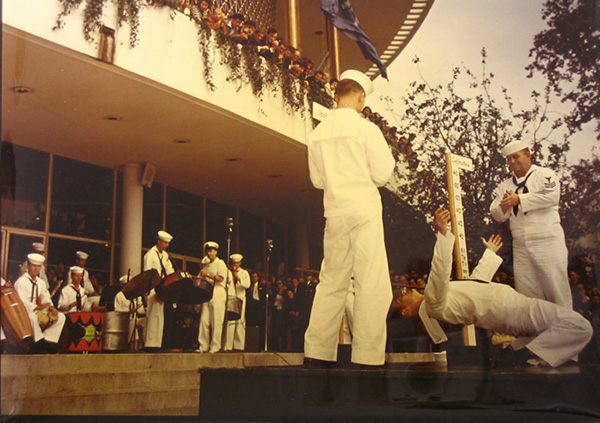
U.S. Navy Steel Band at World's Fair in Brussels, 1957 Source: Andrew Martin, "Words of Steel: Pete Seeger and the U.S. Navy Steel Band," in Voices: The Journal of New York Folklore, Vol. 34, 2008. Used with permission of the Nimitz Library, United States Naval Academy.
STEELPAN MUSICThe steelpan is the only acoustic musical instrument invented in the 20th century. It emerged in the 1930s from communities in Trinidad and Tobago and is today the official national musical instrument of the twin islands.
Evolution of the Steelpan
The first instruments developed in the evolution of steelpan were tamboo bamboos, tunable sticks made of bamboo wood. Tamboo bamboo bands included percussion of a (gin) bottle and spoon. By the mid-1930s, tamboo bamboo bands included improvised metal percussion such as frying pans, dustbin lids, and automobile brake hubs. These musicians sparked a street movement that transformed into the steelpan orchestra (also known as steelpan band).
The first recording of an early steelpan band, "Lion-Oh," featured singer Roaring Lion (Raphael De Leon) and Hell Yard musicians playing a metal drum called a boom to supply low bass notes, two metal cookie tins to play the melody, a two-note pan called a du-dup, and a bottle and spoon to maintain the rhythm. At the time of the steelpan's popularity in Trinidad, it was seen as being associated with a violent or derelict crowd. It was unacceptable for women to be involved in such activities.
The early pan instruments were improved by adding additional notes throughout the 1940s, using 30-gallon drums. The departure of U.S. troops from Trinidad left behind hundreds of empty 55-gallon drums, which led innovators to create the modern steelpan. Ellie Mannette introduced the 55-gallon steelpan by pounding the drum lid inwardly, whereas before, the drums were pounded outwardly. The new technique made possible a full chromatic spectrum. It was this modern steelpan that Trinidadian Rudy King introduced to America when he started a steel band in Brooklyn in 1949. The Trinidad All Steel Pan Percussion Orchestray (TASPO) was the first steelband whose instruments were all made from oil drums. They performed at the Festival of Britain in 1951, introducing the steelpan and a new music genre to the world.
Modern Steelpan Music
Today steelpans are made from high-quality steel by skilled artisans.
How a steel pan is made:
Making a Steel PanSteelpan music can be performed by a soloist on a single pan.
Steelpan soloist Jaden plays an arrangement of "Human Nature" by Michael Jackson
Steel orchestras, also called steelbands, are large ensembles of steelpans of different sizes: the large bass drums and surrounding tenor, cello, and melody pans. The rhythm section of a steel band is driven by drums and metal percussion instruments called the Engine Room. Steelpans were often featured in arrangements by calypsonians, such as Lord Kitchener's "Pan in A Minor," which became internationally famous when Jit Samaroo arranged it for the Amoco Renegades Steel Orchestra, leading the band to a historic Panorama championship in 1987. Steelband arrangements, which are about 10 minutes long and brilliantly intricate, take a long to time to learn, as band members do not read music and each player must memorize their part.
Ebony Juniors - UK Junior Panorama 2017 play Peter Ram's "Good Morning" arranged by David Ijaduola
A panorama is a competition of large steelpan orchestras that can feature up to 120 performers on stage. The premier Panorama competition originated in Trinidad and Tobago in the 1963 Carnival, with bands competing for the title of National Panorama Championship. Panoramas are also held in the U.K., in Miami, and in Brooklyn during the West Indian American Day Carnival. Bands played extended arrangements of calypso songs; today the arrangements usually are of soca songs.
The U.S. Navy Steel Band
In February 1957, the Admiral Daniel Gallery conceived and established the United States Navy Steel Band, the first all-American steel band and the only military steel band. Controversial and unorthodox, Admiral Gallery would not be content with the conventional military brass band assigned to admirals so long as he could substitute something unique and novel in it′s place and be the first to have that novelty. That opportunity came in February 1957, when for the first time he heard the famous steel bands of Trinidad during the annual Carnival. “The music just got inside me and shook me up.” [Skip Poole, "A Not-So-Frief History of the US Navy Steel Band" 2011]
Admiral Gallery also took a dim view of rock and roll, the new form of popular music that was emerging, and believed that calypso and steelpan music could "knock rock 'n' roll and Elvis Presley into the ash can.”
From 1957 until their disbandment in 1999, the US Navy Steel Band performed over 20,000 concerts worldwide. In 1973, the band officially moved headquarters from Puerto Rico to New Orleans and found the city and annual Mardi Gras tradition an apt musical and cultural fit. The band brought a significant piece of Caribbean artistic capital—calypso and steelband music—to the American mainstream. Its impact on the growth and development of steelpan music in America is enormous. [Andrew R. Martin, Steel Pan Ambassadors, Univ. Press of Mississippi, 2017]

U.S. Navy Steel Band at World's Fair in Brussels, 1957
Source: Andrew Martin, "Words of Steel: Pete Seeger and the U.S. Navy Steel Band," in Voices: The Journal of New York Folklore, Vol. 34, 2008. Used with permission of the Nimitz Library, United States Naval Academy.CARNIVAL

News photo via Free Republic
Carnival in Trinidad and Tobago
The Trinidad and Tobago Carnival is an annual event held on the Monday and Tuesday before Ash Wednesday. During the French colonial period, masquerade carnival events derived from European Christian traditions were introduced by the colonial elite. Indentured laborers and slaves, who were prohibited from taking part in Carnival, formed their own, parallel celebration, canboulay, which became the precursor for the Trinidad and Tobago Carnival. The street parade is the main event of Carnival, preceded by several days of parties and cultural events, particularly steelpan band competitions. The parade features elaborate costumes, called "mas," and large trucks with live musicians and DJs blasting soca music.

Source: Wikimedia Commons by Fordmadoxfraud, CC BY-SA 3.0
The Carnival celebrations have spread throughout the Caribbean and South America. Most West Indian countries have their own versions of Carnival. Other carnival events include Toronto's Caribana festival and the Carnival in Notting Hill, London.
Jean-Marc /Jo BeLo/Jhon-John from Caracas, Venezuela, CC BY 2.0 <https://creativecommons.org/licenses/by/2.0>, via Wikimedia Commons
West Indian American Carnival
The West Indian American Carnival is a five day event that culminates in a street parade in Crown Heights, Brooklyn, on Labor Day. About two million people attend. West Indian islands represented in the parade include Trinidad and Tobago, Haiti, Barbados, Dominica, Saint Lucia, Jamaica, Saint Vincent and Grenada. Mainland Caribbean countries such as Guyana, Suriname, and Belize also participate.
Carnival went from a room in Harlem to
now a parade where thousands of people dance down the streets, with large floats and extremely
elaborate costumes with vibrant colors, sparkles, and tons of feathers. Cash prizes are offered to
the most elaborate costume.
Early carnival events ( which were mainly by Trinidadian standards) were described as “ a restricted
parade” not as a carnival celebration. There was American style marching, small floats, and mainly
calypso music.The Carnival began in Harlem during the 1920s when Jessie Wardell, a Trinidadian immigrant, hosted annual extravagant costume parties in the Savoy and Audubon Ballrooms. Unlike the celebrations across the West Indies, New Yorkers had to celebrate indoors, as the city’s cold weather prevented them from comfortably partying outside. By 1947, as the parties grew larger, Wardell organized the first Labor Day street festival along Harlem's Lenox Avenue. It was not until Rudy King brought in the steel pan in the 1950s, that people started to actually dance and sing and move during Carnival. in the mid 1970s, steel pan drums were seen less and less, and DJs were seen more and more. By the 1990s the pan was rarely seen during the street parade.
In 1969 the parade was moved to Eastern Parkway in Brooklyn. Like the Trinidad and Tobago Carnival, the West Indian American Carnival includes a panorama competition, which is held at the Brooklyn Museum grounds on the Saturday before Labor Day. The event is an immersive evening experience featuring live music, traditional Caribbean food, and high-energy celebrations.
West Indian American Day Parade, NYC, 2025
Video excerpts used with permission of YouTube: Live Walking NYC
https://youtube.com/livewalkingnycJ'Ouvert
For more than a century J'Ouvert2 "break of day" processions have marked the opening of Carnival in Trinidad. Held in the predawn hours of Carnival Monday, J'Ouvert evolved from 19th century Canboulay festivals-nighttime celebrations where ex-slaves gathered to masquerade, sing, and dance in commemoration of their emancipation. When the traditionwas incorporated into Trinidad's pre-Lenten Carnival,J'Ouvert became an arena for African-derived percussion, witty satire singing, sardonic costuming, and, more recently, lively steelband music. In contrast to the bright, fancy pageantry ofMonday and Tuesday afternoon Carnival, Jouvert's gruesome devils and
mud-covered revelers personify what folklorist Stephen Stuempfle has called the "underworld dimension of Carnival...grim and sinister characters, dirty and coarse costumes, and aggressive verbal and physicalaction". Historically, J'Ouvert's demonic and satirical masquerading, coupled with dense percussion and steel pan music, manifest Carnival's deepest challenge to order and authority, and for
Trinidadian novelist Earl Lovelace, the essence of the "Emancipation spirit." [Ray Allen, "J'ouvert in Brooklyn Carnival: Revitalizing Steel Pan and Ole Mas Traditions" in Western Folklore 56 (Summer/Fall 1999)]Oil-smeared Jab-Jab is one of the traditional "devils" of J'Ouvert.
READING
Ray Allen and Lois Wilcken, "Introduction" and Don Hill, "'I Am Happy Just to Be in This Sweet Land of Liberty' The New York City Calypso Craze of the 1930s and 1940s" in Island Sounds in the Global City
Ray Allen, "J'ouvert in Brooklyn Carnival: Revitalizing Steel Pan and Ole Mas Traditions" in Western Folklore 56 (Summer/Fall 1999)
REFERENCES
Ray Allen, "Is Brooklyn J'Ouvert Dead?," City Lore, 2017Harvey R. Neptune, Caliban and the Yankees: Trinidad and the United States Occupation, The University of North Carolina Press, 2009
Ray Allen, Jump up! : Caribbean Carnival music in New York City. New York, NY: Oxford University Press, 2019
Donald Hill, Calypso Callaloo: Early Carnival Music in Trinidad, Temple University Press, 2006
Ray Allen and Lois Wilcken (eds.), Island Sounds in the Global City: Caribbean Popular Music and Identity in New York, New York Folklore Society and the Institute for Studies in American Music at Brooklyn College, 2001
Gage Averill, "'Pan Is We Ting': West Indian Steelbands in Brooklyn," in Kip Lornell and Anne K. Rasmussen (eds.), The Music of Multicultural America, University Press of Mississippi, Jackson, 2016
Holger Henke, The West Indian Americans, Westport: Greenwood Publ., 2000
Peter Manuel with Bilby Largey and Kenneth Michael, Caribbean Currents: Caribbean Music from Rumba to Reggae, Temple University Press, 2006
GROUP TOPICS
Rapso
Ragga-Soca
Soca bands
Women in calypso (soca divas)
J'Ouvert