Thanks for your patience during our recent outage at scalar.usc.edu. While Scalar content is loading normally now, saving is still slow, and Scalar's 'additional metadata' features have been disabled, which may interfere with features like timelines and maps that depend on metadata. This also means that saving a page or media item will remove its additional metadata. If this occurs, you can use the 'All versions' link at the bottom of the page to restore the earlier version. We are continuing to troubleshoot, and will provide further updates as needed. Note that this only affects Scalar projects at scalar.usc.edu, and not those hosted elsewhere.
HIGH ART HIPOCRISY: Intersections of Cartoons and Fine Art
Main Menu
Introduction
The Birth of the Newspaper
Comics: Taking Over the Sunday Supplement
Comics in the Early 1900s
The 1913 Armory Show
Showtime! New York City, Chicago, and Boston
The Critiques and The Comics
The Pop Art Movement, Roy Lichtenstein, and Comic Books
Deconstructing Perspectives of Lichtenstein’s Work: Pro-Appropriation or Pro-Cartoonist?
The Rise of 1940s Comic Books in the Late 20th Century
Comics in Museums
The MoMA “High and Low” Show
Art Spiegelman’s Response to MoMA High and Low
Comics in Museums Today
Abstract Comics
Cora's Curation of Abstract Comics
Conclusion
References
Cora Hernandez
ca60d402b432a51ad192c7a6d79f42e30854c48e
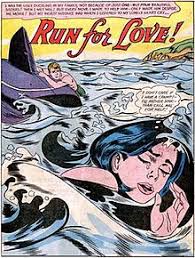
Roy Lichtenstein's "Drowning Girl" (1963)
1 media/Roy_Lichtenstein_Drowning_Girl_thumb.jpg 2024-08-14T11:29:00-07:00 Cora Hernandez ca60d402b432a51ad192c7a6d79f42e30854c48e 45671 1 Roy Lichtenstein's "Drowning Girl" (1963) plain 2024-08-14T11:29:01-07:00 Cora Hernandez ca60d402b432a51ad192c7a6d79f42e30854c48eThis page is referenced by:
-
1
2024-08-13T21:10:23-07:00
The Pop Art Movement, Roy Lichtenstein, and Comic Books
13
plain
1548042
2024-08-14T12:32:37-07:00
The Pop Art movement emerged in America during the late 1950s in response to fine art dominating the art market during the first half of the 20th century. Pop Art employed materials from American life and culture to revolt against the strict confines of fine art’s traditional technique and style.
According to Tate Collective, Pop Art “began as a revolt against the dominant approaches to art and culture and traditional views on what art should be. Young artists felt that what they were taught at art school and what they saw in museums did not have anything to do with their lives or the things they saw around them every day.”
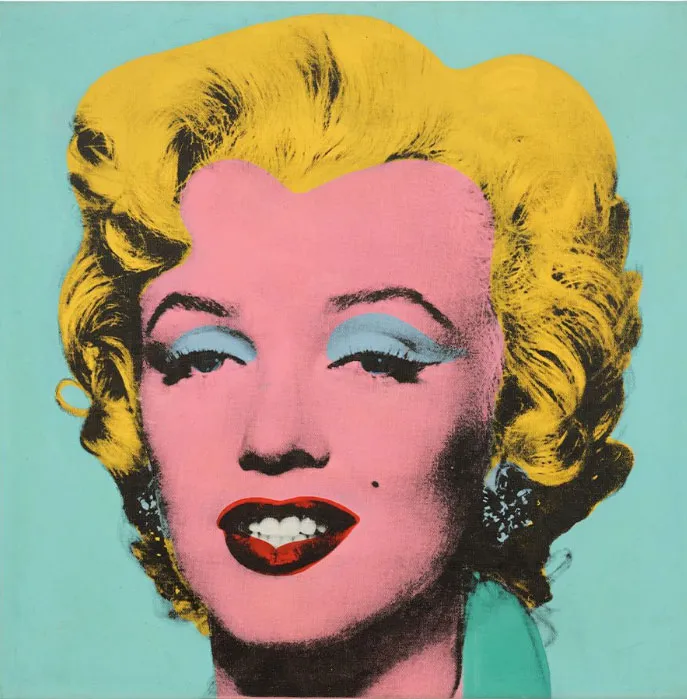
Pop Art was also a reaction to the mass-production of commercial goods post-World War II. Famous artists such as Andy Warhol, Jasper Johns, Robert Rauschenberg, Richard Hamilton, and Keith Haring all produced works in accordance with the Pop Art movement and the mass-production of commercial goods.
One particularly significant Pop Artist by the name of Roy Lichtenstein grew up with an interest in music, specifically jazz, and participated in summer art classes during his free time. Ultimately, when it was time for Lichtenstein to go into college, he chose to study fine arts at The Ohio State University in 1940, instead of pursuing his interest in jazz as a profession. However, his studies were briefly interrupted when Lichtenstien was drafted into the military from 1943 to 1945. During the time of his service, an officer noticed the young soldier had a talent for illustration and assigned him the role of enlarging cartoons from the military paper Stars and Stripes. An officer who was higher up noticed his talent and promoted him to drafting designs for the military. Before joining the military, Lichtenstein had always been interested in the arts. After serving in the military for two years, he spent time in France to experience the art scene, spending time in Paris and visiting the Louvre. Afterwards, he finished his degree at Ohio State and graduated in 1949 with an MFA. He continued to teach at the University for a few years, while also pursuing a career as an artist and participating in art shows in Manhattan, and had his first solo exhibition at Carlebach Gallery in 1951.
In 1957, Lichtenstein moved to upstate New York, wanting to be closer to the new styles of art that were emerging in the city. He began teaching for State University of New York at Oswego. It was at this time he would start incorporating different elements of everyday American culture into his work, including images from comic books and work of cartoonists. Although he was still working in abstract painting at the time, he started trying to find ways to hide elements of American popular culture into his work, including infamous characters such as Mickey Mouse. Lichtenstein began teaching at Rutgers University in 1960, where he met fellow professor and artist Allan Kaprow. Lichtenstein was inspired by Kaprow’s paintings which were full of imagery from popular culture, which caused him to revisit his interest in intersections of painting and commercial imagery. This style of painting would become his claim to fame.
Lichtenstein saw the height of his career in the early-to-mid 1960s when he painted:
- Drowning Girl (1963)
- Whaam! (1963)
- Crying Girl (1963)
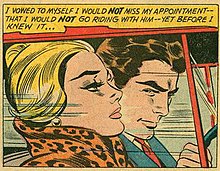
- In the Car (1963)
- Happy Tears (1964)
- Ohhh…Alright… (1964)
- Oh Jeff…I love you, Too…But… (1964)
- We Rose Up Slowly (1964)
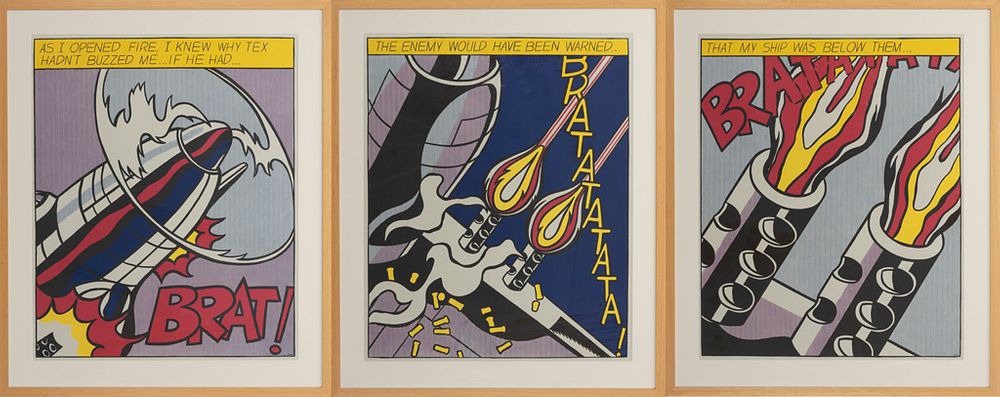
- As I Opened Fire (1964)
- The Melody Haunts My Reverie (1965)
- M-Maybe (1965)
Out of these 11 paintings from the early-to-mid 1960s, 9 of them were derived from comic books. Below is a list of which works include appropriated material, and the specific comic book he appropriated the material from:
- Drowning Girl (1963) was derived from Issue #83 of Secret Hearts by Arleigh Publishing Corp (1962)
- Whaam! (1963) originated from several comic books, but primarily a 1962 War Comic Book by Irv Norwick
- Crying Girl (1963) was adapted from the DC Comics’ Secret Hearts #88 (June 1963)
- The source for In the Car (1963) was DC Comics’ Girls Romances #78 (September 1961)
- Ohhh…Alright… (1964) was derived from Secret Hearts #88 by Arleigh Publishing Corp (June 1963)
- Oh Jeff…I love you, Too…But… (1964) was derived from a comic by the illustrator Tony Abruzzo. Lichtenstein changed the text in the comic from Abruzzo’s original “Oh, Danny, I'm so sorry!” but Lichtenstein changed the text to,“Oh Jeff…I love you, Too…But…”
- We Rose Up Slowly (1964) was adapted from a National Periodical panel titled Girls' Romances #81 (January 1962)
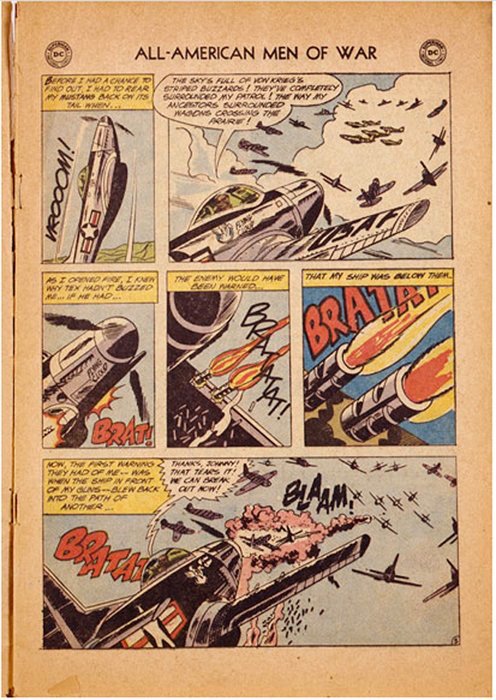
- As I Opened Fire (1964) was derived from Jerry Grandenetti's "Wingmate of Doom" panels in issue #90 of All American Men of War (March–April 1962)
- The Melody Haunts My Reverie (1965) references Mitchell Parish's 1929 lyrics for the 1927 song "Stardust" by Hoagy Carmichael.
After Roy Lichtenstein appropriated comic book material, he failed to attribute and compensate the artists for the use of their original illustration work. Some argue that Roy Lichtenstein’s act of “reimagining” illustrations by comic artists is appropriate in the context of Pop Art, considering that appropriation is a main aspect of the movement. Alternatively, critics of Lichtenstein state that his blatant appropriation of already under-represented cartoonists and illustrators does not serve a convincing enough purpose in the context of Pop Art. This debate continues to this day.

.jpg)