Thanks for your patience during our recent outage at scalar.usc.edu. While Scalar content is loading normally now, saving is still slow, and Scalar's 'additional metadata' features have been disabled, which may interfere with features like timelines and maps that depend on metadata. This also means that saving a page or media item will remove its additional metadata. If this occurs, you can use the 'All versions' link at the bottom of the page to restore the earlier version. We are continuing to troubleshoot, and will provide further updates as needed. Note that this only affects Scalar projects at scalar.usc.edu, and not those hosted elsewhere.
HIGH ART HIPOCRISY: Intersections of Cartoons and Fine Art Main MenuIntroductionThe Birth of the NewspaperComics: Taking Over the Sunday SupplementComics in the Early 1900sThe 1913 Armory ShowShowtime! New York City, Chicago, and BostonThe Critiques and The ComicsThe Pop Art Movement, Roy Lichtenstein, and Comic BooksDeconstructing Perspectives of Lichtenstein’s Work: Pro-Appropriation or Pro-Cartoonist?The Rise of 1940s Comic Books in the Late 20th CenturyComics in MuseumsThe MoMA “High and Low” ShowArt Spiegelman’s Response to MoMA High and LowComics in Museums TodayAbstract ComicsCora's Curation of Abstract ComicsConclusionReferencesCora Hernandezca60d402b432a51ad192c7a6d79f42e30854c48e
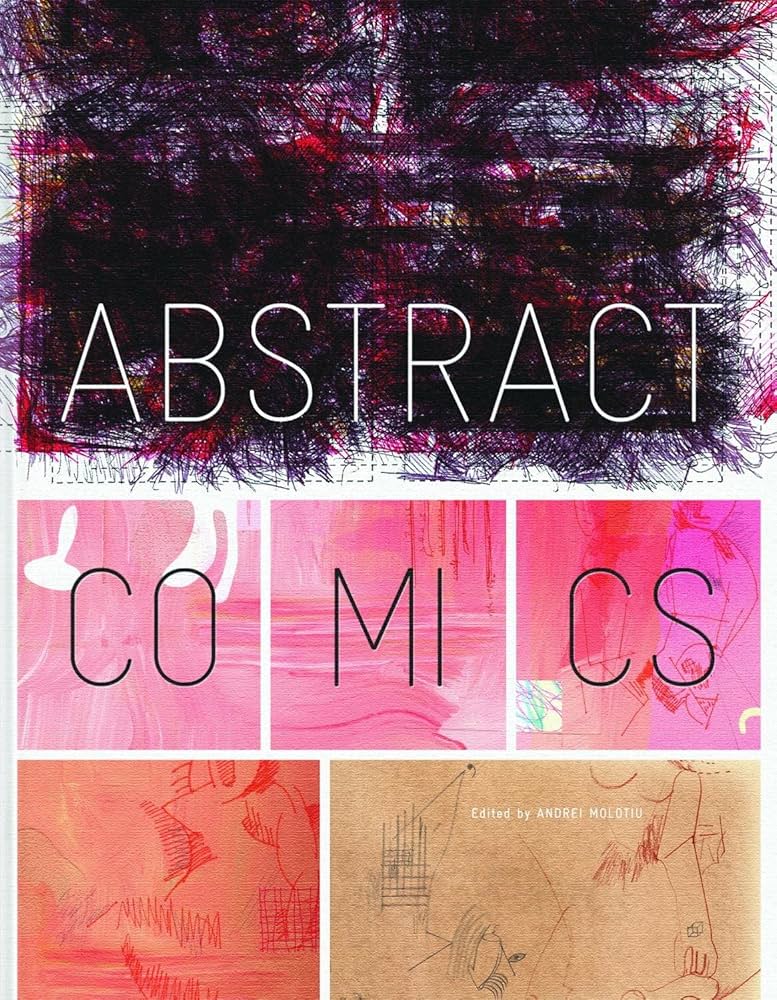
Cover of Andrei Moloitu's "Abstract Comics"
1media/abstract comics_thumb.jpg2024-08-14T06:53:12-07:00Cora Hernandezca60d402b432a51ad192c7a6d79f42e30854c48e456711Cover of Andrei Moloitu's "Abstract Comics"plain2024-08-14T06:53:16-07:00Cora Hernandezca60d402b432a51ad192c7a6d79f42e30854c48e
Abstract comics are a genre of comics art that reject the use of representational images and instead employ reduced visual elements to tell a story. They incorporate and reference elements of both modern art and cartoon art, creating a fusion of distinct form and value. Although abstract comics are a completely different subsection of comics, they grew right alongside comic strips and books in the 1960s to today. Abstract comics began to appear in the 1960s. Modern artists who worked as illustrators for comic strips and cartoons began creating them as a fusion between the two fields of modern abstract painting and comics. Artists such as Robert Crumb created some of the first abstract comics in 1967. Crumb was not alone while creating abstract comic work during this time, as prolific cartoonist Gary Panter was also beginning to create abstract comics. Abstract comics have yielded a fair amount of discourse regarding their functionality and categorization between both the fields of art and comics. Although they had been a part of some academic discussion prior, abstract comics got their big break in 2009 when Andrei Molotiu created an anthology titled Abstract Comics. The anthology features past and present abstract comics, highlighting the development of the medium throughout its lineage. Molotiu spoke about the anthology in an Artforum interview with Nicole Rudick. In the interview, while speaking about the purpose of abstract comics, Molotiu states, “Comics are an art of reduction anyway, so it’s easy to conceive of a story in which squares and triangles function as traditional characters. In abstract comics, however, the “story” being told is primarily one of formal transformations and visual energy, not the depiction of a narrative that can be otherwise conveyed verbally.” The visual energy described by Molotiu can be seen throughout abstract comics panels and the way illustrators choose to portray a certain subject matter. However, if the visual elements and energy in abstract comics are purely meant to portray a subject matter, how are readers and meaning makers meant to understand what the illustrators were getting at when they were drafting the comic? Author Paul Fisher Davies speaks about meaning-making when reading abstract comics in his 2013 academic article titled Animating the Narrative in Abstract Comics. In the article, Davies states, “Once an entity is perceived as in motion in this way, onlookers bring to bear their understanding of the meanings of motions in the world to impute to the object intentionality, motivations and desires, and this ability and willingness to read images in this way is based in quite low-level perceptual systems as explored by Michotte and Heider and Simmel, amongst others.” (Davies 267) The manner in which Davies describes making meaning out of the motion in abstract comics is very insightful to how viewers derive meaning from abstract comics, and Davies academic work should definitely stand as a guide for those who are new to viewing this format.