Thanks for your patience during our recent outage at scalar.usc.edu. While Scalar content is loading normally now, saving is still slow, and Scalar's 'additional metadata' features have been disabled, which may interfere with features like timelines and maps that depend on metadata. This also means that saving a page or media item will remove its additional metadata. If this occurs, you can use the 'All versions' link at the bottom of the page to restore the earlier version. We are continuing to troubleshoot, and will provide further updates as needed. Note that this only affects Scalar projects at scalar.usc.edu, and not those hosted elsewhere.
HIGH ART HIPOCRISY: Intersections of Cartoons and Fine Art Main MenuIntroductionThe Birth of the NewspaperComics: Taking Over the Sunday SupplementComics in the Early 1900sThe 1913 Armory ShowShowtime! New York City, Chicago, and BostonThe Critiques and The ComicsThe Pop Art Movement, Roy Lichtenstein, and Comic BooksDeconstructing Perspectives of Lichtenstein’s Work: Pro-Appropriation or Pro-Cartoonist?The Rise of 1940s Comic Books in the Late 20th CenturyComics in MuseumsThe MoMA “High and Low” ShowArt Spiegelman’s Response to MoMA High and LowComics in Museums TodayAbstract ComicsCora's Curation of Abstract ComicsConclusionReferencesCora Hernandezca60d402b432a51ad192c7a6d79f42e30854c48e
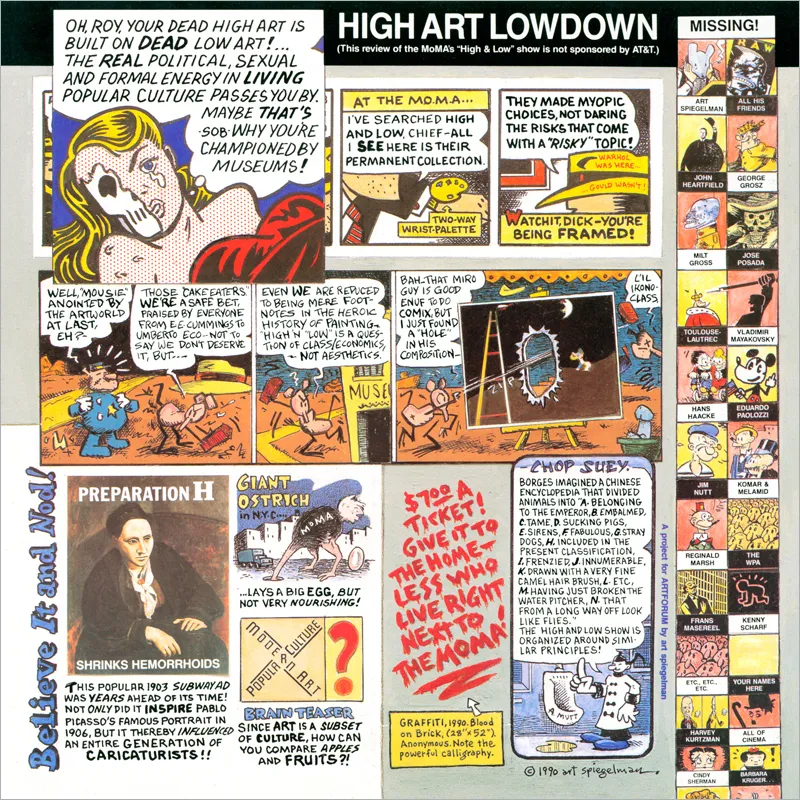
Art Spiegelman's response to the advertising section of the MoMA "High and Low" exhibition
1media/Screenshot 2024-08-14 at 2.11.51 PM_thumb.png2024-08-14T11:16:49-07:00Cora Hernandezca60d402b432a51ad192c7a6d79f42e30854c48e456711Art Spiegelman's response to the advertising section of the MoMA "High and Low" exhibitionplain2024-08-14T11:16:50-07:00Cora Hernandezca60d402b432a51ad192c7a6d79f42e30854c48e
Perhaps no one was more upset by the MoMA’s High and Low: Modern Art and Popular Culture exhibition than American cartoonist Art Spiegelman. Spiegelman is known for his graphic novel, Maus, which originally ran in Raw Magazine from 1980 to 1991. Spiegelman has won extensive awards for his work as a cartoonist, including a Yellow Kid Award, a Guggenheim Fellowship, and a Pulitzer Prize. Considering his career, it was no surprise that Art Spiegelman made a page of comics in response to the MoMA exhibition. Titled High Art Lowdown, Spiegelman’s response to the exhibition is absolutely pulverizing. In one section of the critique, Spiegelman introduces commentary on the Roy Lictenstein art that was included in the exhibition. While mimicking a piece of Lichtenstein’s artwork, Spiegelman states, “Oh, Roy, your dead high art is built on dead low art!... The real political, sexual, and formal energy in living popular culture passes you by. Maybe that’s -sob- why you’re so championed by museums!” This callout to Lichtenstein is intense, as it shames Lichtenstein for appropriating so-called “low” and “dead” art, and Spiegelman blatantly states that Lichtenstein doesn’t pay attention to culture, and that is why he is so successful in museum spaces. In another section of his critique, Spiegelman critiques the MoMA’s attempt at tracing lineages throughout the history of popular culture and modern art. On a copy of Pablo Picasso’s Portrait of Gertrude Stein, Spiegelman pasted the Preparation H logo, and left some choice words about the MoMA’s examples of lineage throughout their exhibition. Spiegelman states, “This popular 1903 Subway Ad was years ahead of its time! Not only did it inspire Pablo Picasso’s famous portrait in 1906, but it thereby influenced an entire generation of caricaturists!!” Spiegelman’s dig at the curators for incorrectly assigning lineages in context of popular culture and modern art is intense and unforgiving. Farthest to the right on the page of comics is a “MISSING!” panel of elements Spiegelman believed were missing from the MoMA exhibition. The list included artists such as: Himself (Art Spiegelman), all of his friends, John Heartfield, George Grosz, Milt Gross, Jose Posada, Jim Nutt, The WPA, Cindy Sherman, the list goes on. Spiegelman ends the list of missing artists with “Etc, etc, ect,” and a “Your names here” section. In the “MISSING!” section, Spiegelman includes “All of cinema” as missing from the MoMA exhibition, which is true, considering that the curators did not include a single element of film/video as art OR as an element of commercial/popular culture. Art Spiegelman’s High Art Lowdown critique of the MoMA High and Low exhibition serves as a constant reminder that the MoMA and curatorial team made some unforgettable mistakes in 1990.