Jacob Lawrence: The Storyteller
Some of them said my art is social commentary. It couldn’t be anything else if I grew up in Harlem and that is the source of my content.
Jacob Lawrence, 1993
Growing up in the rich mosaic of the Harlem Renaissance, Jacob Lawrence sought to create a guiding figure to lead a new revolution in America. In his adaptation of Toussaint L'Ouverture's life, Lawrence brings to light moments of intellectual, political, and military action in a time of unrest and injustice. Recognizing those same characteristics in segregated 1930s America, Lawrence resurrects Toussaint L'Ouverture's image as an inspiration for people struggling under oppression everywhere.
Born in Atlantic City, New Jersey, Jacob Lawrence (1917-2000) was born to parents who were two of thousands of Black Americans and Caribbean peoples who migrated to the North for better jobs in industrial cities (1910-16). After his mother's divorce, he and his siblings moved to Harlem around 1930. In Harlem's earlier years, it was a near capital for Black cultural exploration, producing greats such as Cab Calloway (1907-94) of Cotton Club fame and Fats Waller (1904-43), the former popular for the musical style of Boogie-Woogie. This era would not be coined the "Harlem Renaissance" until 1947 by historian John Hope Franklin. By the 1930s, Harlem was struck by mass evictions and poverty, leaving this once great Black utopia a near shadow of its former self.
As a child, Lawrence attended Utopia House, a settlement house for the children of working mothers, alongside his siblings, where he began working with various materials like crayons and poster paints. Here, he met his art friend and teacher Charles Alston (1907-77), who grew extremely impressed with Lawrence's artistic talent at such a young age. In 1932 and 1934 Jacob Lawrence attended the Harlem Art Workshop where Alston again instructed him. Lawrence rented a space at Alston's studio where he worked alongside artist Henry Bannarn (1910-65). Here he met many prolific Black artists and writers as Alain Locke (1885-1954), Langston Hughes (1901-67), Ralph Ellison (1914-99), and Aaron Douglas (1899-1977), whose flat and bold style and political messaging became a major influence on Lawrence's own art.
While researching Haitian history at the Schomburg Center for Research in Black Culture, Lawrence came across The Life of Toussaint L'Ouverture (1853) by Relly Beard (1800-76). Using this knowledge of Haiti’s history, Jacob Lawrence painted The Life of Toussaint L'Ouverture series (1938). Lawrence was very interested in depicting Black resistance and resilience. This was important to him, as in 1935, the Harlem Race Riot occurred, a result of years of racialized tensions between the white and Black populations which was exacerbated by a history of police brutality. In 1939, a group of Black men entered the Alexandria Library, where they silently sat and read books, a protest against the library' whites-only policy. This became one of the very first protests in the early Civil Rights Movement. Sadly, in Lawrence's early years, there was not much in the way of positive Black representation, a frustration that sparked his many series of works (e.g. Harriet Tubman, 1939). The narrative at the time was extremely white-centric, where many of the figures represented in relation to the history of liberation were white.
In 1938, Lawrence went to the Works Progress Administration (WPA) with artist Augusta Savage (1892-1962), where he was assigned to the Easel Project, which propelled his early career. In 1941, Lawrence's Migration series was shown at the Downtown Gallery, making him the first Black person to be shown at a major New York art gallery, considerably boosting his career. That same year, he married the artist Gwendolyn Knight (1915-2005). After serving in World War II, he created his War series (1946-47) and began teaching at Black Mountain College in 1946 after accepting an invitation by German artist Josef Albers (1888-1976). Josef Albers was an artist, teacher, and color theorist at the Bauhaus, an art school founded by Walter Gropius (1883-1969) in 1919 and acclaimed for its many artists such as Anni Albers (1899-1994) and Paul Klee (1879-1940). The school would be shut down by the Nazi party and though later was approved to reopen under certain restrictions, Walter Gropius refused and the school officially closed in 1933.
I would describe my work as expressionist. The expressionist point of view is stressing your own feelings about something.
Jacob Lawrence
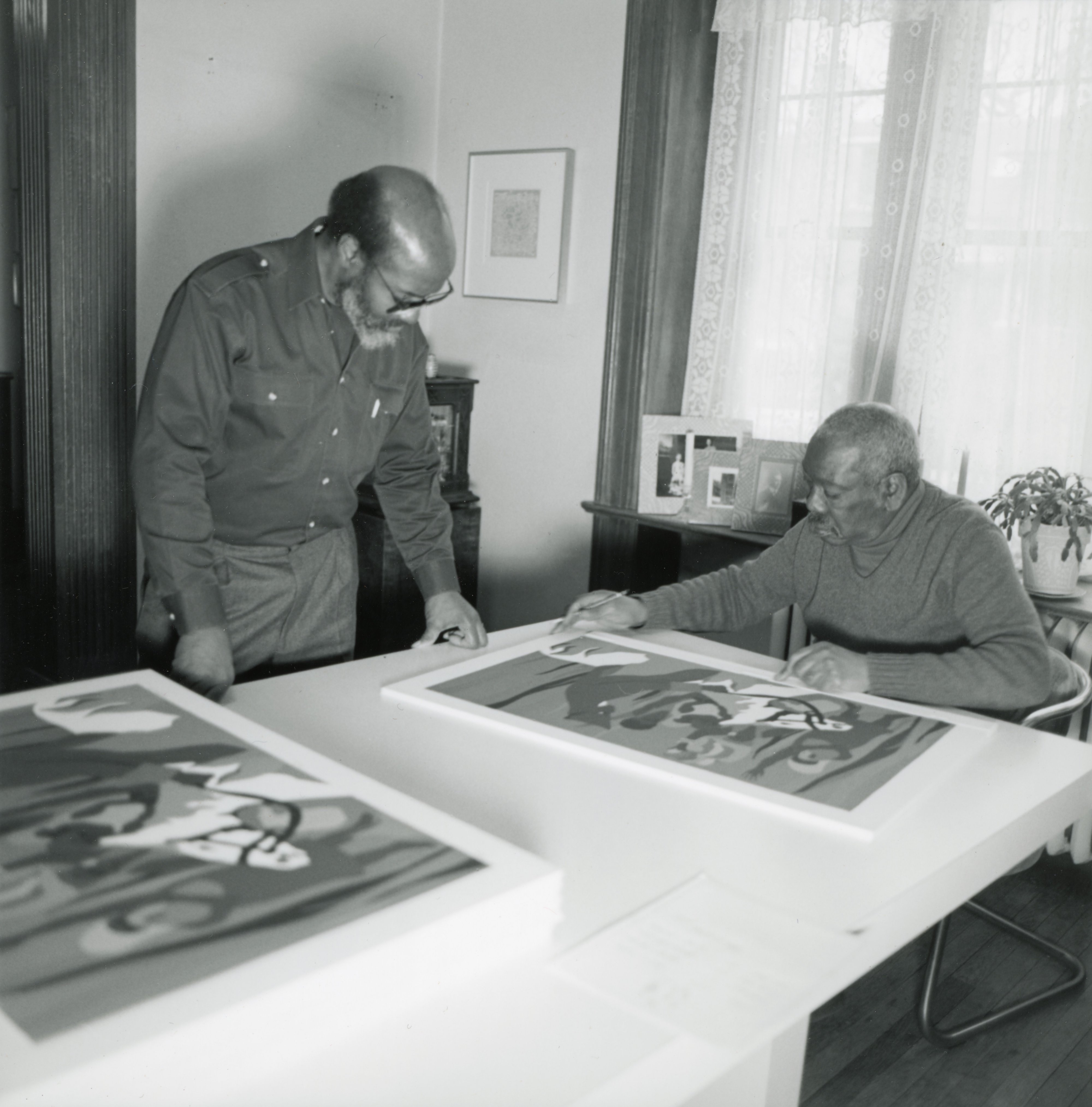
After Black Mountain College, Lawrence taught at Pratt University in 1955, for about fifteen years. In 1970, he was appointed full professor and later the assistant to the dean of the art school. In 1971, Lawrence left Pratt when he accepted an invitation to teach at Washington State University (1971-86). That same year, Lawrence and printmaker Lou Stovall (1937-2023), began the printing The Life of Toussaint L'Ouverture series. Lawrence died on June 9, 2000 at the age of 82, with his wife Gwendolyn Knight later joining him on February 18, 2005.
This page has paths:
- The 2024 Curatorial Project Sibel Zandi-Sayek