Art: Language
Introduction
One of the many facets of the Russian avantgarde movements that we have been investigating in this course has been the visual representations of language in various mediums. On some occasions, we are presented with hand-made books of poetry in which words presented to us are assigned additional layers of meaning by their visual presentation (orientation, size of the letter-forms, etc...). On other occasions, words appear along-side visuals and become a part of the art they accompany. Below are a few examples of such instances of language as art.Examples
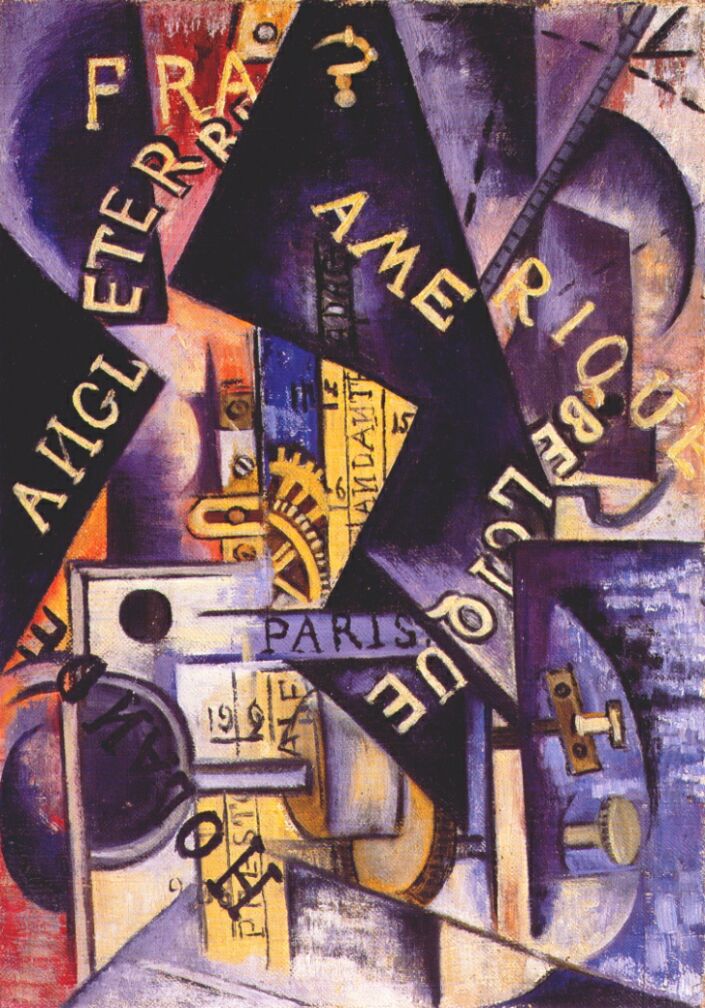
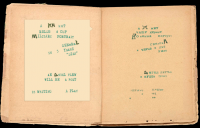
Here on the left, we are presented with an example of a painting in which words take center-stage. Or maybe they're something resembling words? An almost immediate reaction to Rozanova's Suprematist painting Metronome, is to begin trying to read these word. This could be seen as futile, as few of these "words" seem to possess any obvious quality of meaning. Words such as "АИGL", "АМЕ", and "RIQUE" seems to hint at their definitions hiding in the English, French, and Russian linguistic traditions while also suggesting that their meanings lie outside of those systems. Additionally, the meanings of those more decipherable words, "PARIS" and "ENTER" are called into question, for what's to say that the system that failed us before with the other "words" would suddenly apply? It could be the case that it is in this very movement to assign meanings to these "words" from these systems that their true meaning is lost.Next, a futurist poem from the book "Mirskontsa". The poem titled "Akhmet" resembles its fellow works in the book, as well as others in the zaum (trans-sense) tradition in its presentation. The curious mix of handwritten and printed letter-forms, as well as the stanzas' orientation on the page are cause for pause when examining this piece. Additionally, as the rough translation of the poem shows, these stanzas, if we can call them that, seem to be disconnected in meaning; hardly supporting an argument that would call this poem typical. How then do we read this work? How do we interpret the choice of letters as handwritten? Do we even read it as a single poem, or maybe four disjointed "poems"?
Here, another example, this one a piece from the artist El Lissitzky. It is commonly known as "Strike the Whites with the Red Wedge", but it is in this title that a question, similar to those asked of the works above arises. In the Russian language, different suffixes denote a word's place in a sentence, and thus impart a certain meaning onto the word (mostly) regardless of its position in the sentence. In this "sentence", the verb is the command-form of "to strike" (БЕЙ) while the indirect object is the word for "by means of wedge" (КЛИНОМ) as well as the adjective form of the word "red" (КРАСНЫМ) and the plural direct object form of the word "white" (БЕЛЫХ). But, in a way, the audience can understand this, even without knowing the Russian. The words that describe the scene are inseparable from it. The question then becomes why include them, or rather, what to they add to this piece?
Discussion
So, we have seen three examples of language in, or rather language as art within this movement, but what makes this move significant, and what is going on in each of these works?In Metronome, we are presented with a puzzle: some words seem to lack meaning while others are clearly recognizable. However, this problem seeks to highlight something important about our experience of the art, namely, a need to read it. To call these words "nonsense", to say they lack meaning is only possible when comparing it to the systems mentioned above. Sure, they seems useless when marked against an English, French, or Russian dictionary, but what about when observed solely as a phenomenon in relation to their frame instead? After all, to attempt to read them at all, you are already contorting yourself physically, tilting your head as to observe them in some sort of "right-side-up" fashion, is it from there too much of a stretch to say then that their meaning should be observed in a similar way? Their color, their location and orientation on the page, and their varying fonts seem to imply a mood rather than convey a definition. In fact, as a result of lacking a semantic definition, these "words" are able to embody this modal quality even more so; the mood shines through, undistracted by such definitions.
In Strike the Whites, we are presented with the opposite effect, our scene is in a very real sense narrated by words given both vocabulary and grammatical definitions. The vocabulary comes from the fact that these words resemble so closely words in the Russian language with commonly accepted meanings. The grammatical comes from the fact that Russian is a language in sentences can be written in nearly any order without losing too much meaning (though usually, this means any order in a sentence that is in-line like this one and contains proper punctuation). In this case, the words add something unexpected to the piece: temporality. By creating a "sentence" of sorts, the artist posits a world of verbs, a world where actions have starting and ending points, and thus where time as the metric of how those actions are satisfied. This addition of time makes this a dynamic piece, as now movement is implied as movement through time, and thus through space as the wedge "strikes" from left to right.
Finally, in Ahkmet
This page has paths:
- Language in Art, Language as Art Ian Lehine