Scalar's 'additional metadata' features have been disabled on this install. Learn more.
Exploding Tongues: Language, Art, and the Russian Avant-gardeMain MenuBack to Futurism: Russian Artist BooksIntroductory Page by Chris GilmanBookENDS: A Working Theory of Textuality as Cultural Dominant, 1912-An Introduction and Conclusion to a Semester's Investigation into the Book Arts as an Avant-garde PracticeBook Case StudiesCollaborative Research by Case StudiesBig Bang: Timeline of Russian Avant-Garde Book Arts and Their Cultural ImpactsA Timeline of Russian Avant-Garde Book Arts and Their Cultural ImpactsCoaRse CaLIBrationARTS 227 "Introduction to Letterpress Printing" (Pedersen) and CSLC134/RUSN334 "Exploding Tongues" (Gilman)NthOlogyA limited edition collaborative book arts project by students of ARTS 227 (Pedersen) and CSLC 134/RUSN 334 (Gilman), Spring, '17MANIFESTERS (AB & Kelly): A portfolio of process and productsAppendix: A Path Through Russian Avant-Garde BooksChristopher Gilman1985b99a2acd541caa12a10c3ebf6896565283abDexter Blackwell92e005ca94195f836c6089cf147faff4c74fa79eZoe Foster-La Duc1c8954189fb3ee4ab6e36bfb90fae86777eab97Stephen Heim7069d17c035042745c96bc6c7619096cd7b33da4Kelly Kirklande1805e502570d093d70f00df18f145c99290d0a3Ian Lehineb028c384a69e4b92166e7791b002fa3f2cee5818Timothy Lewis13880d3d99b4b71ce85be63e69a6d44e38853d68Jmedina29ac3fc10003fb639ac412984b59b01a5b826e161Taylor Robinsonaa08dd3939f1f1c6162c5518ae531385e51659afEvan Sarafian042e10782d9a6d3f0001a4b35abb02f58ad84684Craig Dietrich2d66800a3e5a1eaee3a9ca2f91f391c8a6893490ILiADS (Institute for Liberal Arts Digital Scholarship)
12017-04-26T18:54:12-07:00Stephen Heim7069d17c035042745c96bc6c7619096cd7b33da4Emanating from 3DStephen Heim2Lines Emanate from Three Dimensional Shapesplain2017-04-26T18:57:33-07:00Stephen Heim7069d17c035042745c96bc6c7619096cd7b33da4
This page is referenced by:
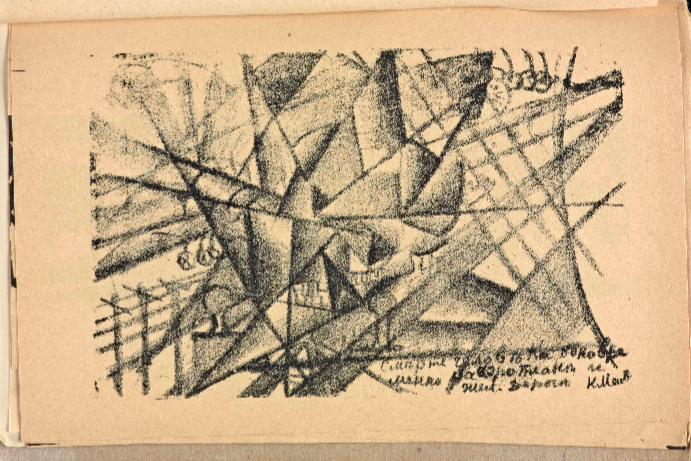
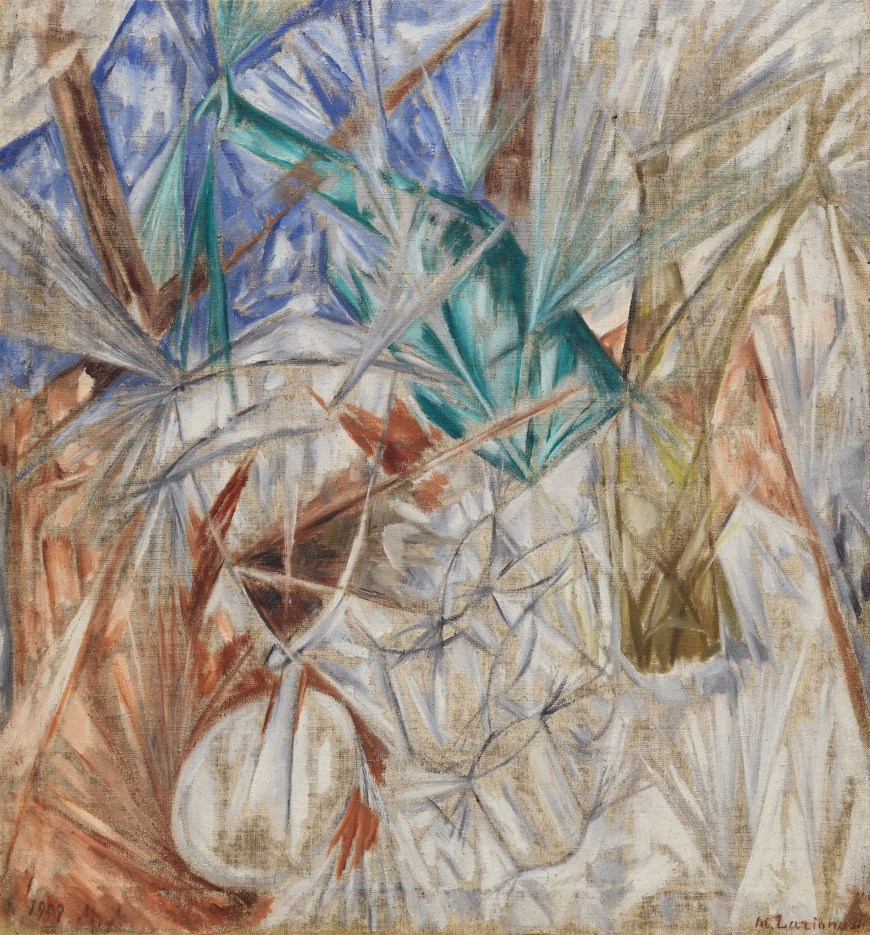
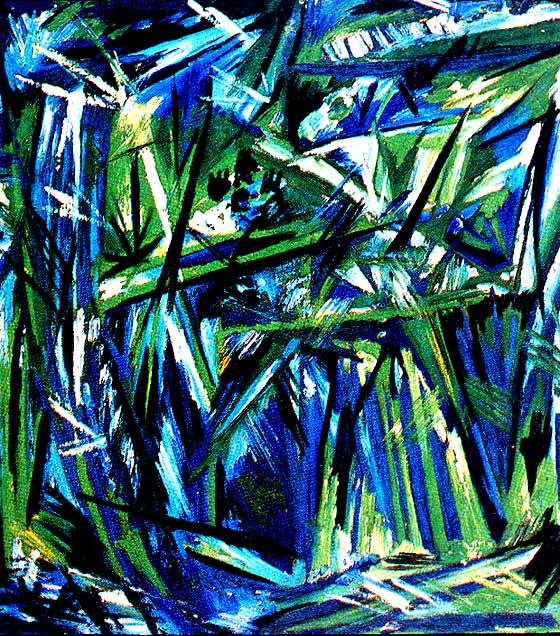
12017-04-13T10:58:39-07:00(Hyper)cubism13Tracking Higher Dimensionality in the Art Forms of the Russian Avant-gardeplain2017-04-28T18:17:26-07:00The ideas of the fourth dimension and non-Euclidean geometry were a popular scientific, literary, and artistic cultural phenomenon throughout Europe at the dawn of the 20th century. As such certain aspects of these ideas were incorporated into the then-developing Cubist theories. The "freedom" of geometries not constrained by convention or Euclid's three dimensions was particularly appealing to Cubist artists. Farther East, Russian mathematicians and scholars wrote prolifically on the subject of non-Euclidean geometry. It was the idea of a fourth dimension, however, that caught on and spread throughout popular culture and appeared in many art forms of the Russian Avant-garde. The philosophical and mystical - in addition to mathematical - elements of a spatial fourth dimension as described by the writings of Peter Ouspensky were extremely influential to several artists and styles of this movement. We can track the influence and appearance of the cultural phenomenon that is the fourth dimension as it spreads through the Russian Avant-garde; in one of Kazimir Malevich's earliest contributions to a Futurist book as well as Mikhail Larionov and Natalya Goncharova's Rayist paintings, then in El Lissitzky's Prouns, sketches, and diagrams, and finally in various works of (unrealized) Russian fantasy architecture.
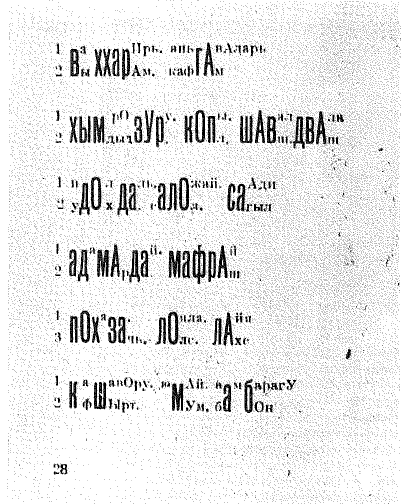
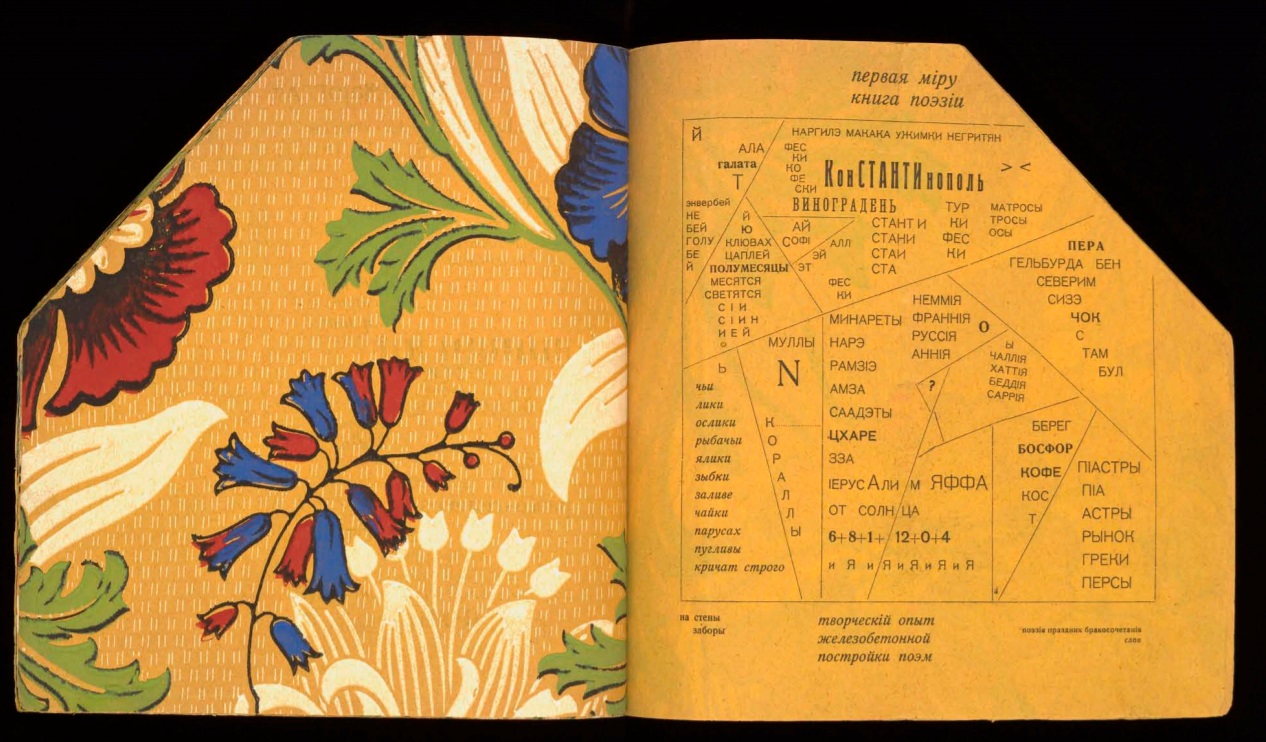
The aforementioned Futurist piece by Kazimir Malevich, "Death of a man simultaneously on an airplane and the railway", and Rayist works by Mikhail Larionov and Natalya Goncharova, "Glass" and "Green and Blue Forest" respectively, exhibit particularly notable parallels to the fourth dimension and Ouspensky's ideas and writings. Highly geometrical, jagged, and acute lines as well as abstract color masses are used to suggest a reconciliation of human perception and the unknowable fourth dimension - an intuition of new meaning and understanding from recognizable fragments. Upon examining these qualities within these early pieces of the Russian Avant-garde and similar ones in later works such as Vasily Kamensky's "Tango With Cows" and Ilia Zdanevich's "As Though Zga", it is clear that certain elements of fourth dimensionality persisted in bookmaking throughout the artistic movement. Tango With Cows exhibits qualities seen in Malevich's Futurist piece as well as qualities seen in Larionov and Goncharova's Rayist pieces. "As Though Zga" exhibits elements of simultaneity and fragmented realities seen in the fourth dimension through its countless possible readings.