Thanks for your patience during our recent outage at scalar.usc.edu. While Scalar content is loading normally now, saving is still slow, and Scalar's 'additional metadata' features have been disabled, which may interfere with features like timelines and maps that depend on metadata. This also means that saving a page or media item will remove its additional metadata. If this occurs, you can use the 'All versions' link at the bottom of the page to restore the earlier version. We are continuing to troubleshoot, and will provide further updates as needed. Note that this only affects Scalar projects at scalar.usc.edu, and not those hosted elsewhere.
At the Crossroads of the SensesMain MenuAt the Crossroads of the Senses – Digital CompanionVisualizing the Table of ContentsVisualizing Synaeshesia as ConstellationSynaesthesia TimelineVision: Chapter 3 - SalomeMusic: Chapter 4 - ScriabinColor-Sounds & Visual Music: Chapter 5 - KandinskyColor-Forms, Sounds & Motion: Chapters 6–7 - Kupka and BelyTouch: Chapters 8–9 - RilkeThe Lower Senses: Scent, Taste & TouchEpilogue: The Afterlife of Synaesthesia – Neurodiversity, Visualizations, ConstellationsPolina Dimovae3cc21567714201b2dd4d0a2c7acf46b8dd6ea1c
Synaesthesia Science and Art: Introduction and Chapters 1–2
1media/Flournoy, Number Forms Diagram, Synopsie, 1893, p. 165.png2018-10-04T05:07:50-07:00Polina Dimovae3cc21567714201b2dd4d0a2c7acf46b8dd6ea1c3146936image_header15687542025-02-18T12:11:09-08:00Polina Dimovae3cc21567714201b2dd4d0a2c7acf46b8dd6ea1cKey Image: Théodore Flournoy, Number-Form Diagrams Source: Des Phénomènes de synopsie(Audition Colorée), Paris & Genève, 1893, p. 165.
Do sounds have shapes? Are the imaginary words Kiki and Bouba round or jagged? Which colors correspond to which pitches and why? What are the colors of numbers and how are numbers localized in space? What forms and shapes do sounds and music evoke in the mind of synaesthetes? How has synaesthesia as both a neurophysiological trait and an artistic metaphor been discussed since the 1800s? What types of synaesthesia, or pairings of the senses and modalities, exist? How do we test for synaesthesia? The Introduction and Chapters 1 and 2 of At the Crossroads of the Senses explore these questions, and this path of the digital companion provides further illustrations.
This page has paths:
12024-11-30T15:06:56-08:00Polina Dimovae3cc21567714201b2dd4d0a2c7acf46b8dd6ea1cAt the Crossroads of the Senses – Digital Companion (old)Polina Dimova83plain8578392025-03-08T23:16:17-08:00Polina Dimovae3cc21567714201b2dd4d0a2c7acf46b8dd6ea1c
12025-03-08T22:49:37-08:00Polina Dimovae3cc21567714201b2dd4d0a2c7acf46b8dd6ea1cAt the Crossroads of the Senses – Digital CompanionPolina Dimova17plain2025-06-29T06:19:42-07:00Polina Dimovae3cc21567714201b2dd4d0a2c7acf46b8dd6ea1c
Contents of this path:
1media/The-takete-maluma-effect-first-introduced-by-Koehler-1929-The-majority-of-participants_thumb.png2023-06-11T09:11:31-07:00Polina Dimovae3cc21567714201b2dd4d0a2c7acf46b8dd6ea1cDH 1.1a. Takete and Baluma4DH 1.1a. Wolfgang Köhler, “Takete and Baluma.” Source: Reproduced from Wolfgang Köhler, Gestalt Psychology, p. 243. New York: H. Liveright, 1929. Which of the two shapes corresponds to Köhler’s imaginary words Takete and Baluma? The answer should be satisfyingly intuitive.media/The-takete-maluma-effect-first-introduced-by-Koehler-1929-The-majority-of-participants.pngplain2024-12-10T21:16:06-08:00Polina Dimovae3cc21567714201b2dd4d0a2c7acf46b8dd6ea1c
1media/2560px-Booba-Kiki.svg1_thumb.png2023-06-11T09:08:34-07:00Polina Dimovae3cc21567714201b2dd4d0a2c7acf46b8dd6ea1cDH 1.1b. Kiki and Bouba5DH 1.1b. "Kiki and Bouba." Ramachandran and Hubbard, “Synaesthesia—A Window into Perception, Thought and Language,” Journal of Consciousness Studies (8.12, 2001): 3-34. Which of the two shapes corresponds to the imaginary words Kiki and Bouba?media/2560px-Booba-Kiki.svg1.pngplain2024-12-18T12:34:11-08:00Polina Dimovae3cc21567714201b2dd4d0a2c7acf46b8dd6ea1c
1media/IMG_0209_thumb.JPG2023-06-11T09:26:26-07:00Polina Dimovae3cc21567714201b2dd4d0a2c7acf46b8dd6ea1cDH 1.2. Pop-Out Effect. Visual Search Task4DH 1.2. Pop-Out Effect. In Ramachandran and Hubbard visual search task, grapheme-color synaesthetes, who may see 2 as red and 5 as green, find the embedded triangle more easily and much faster compared to controls because of their color-number associations.media/IMG_0209.JPGplain2024-12-18T12:36:38-08:00Polina Dimovae3cc21567714201b2dd4d0a2c7acf46b8dd6ea1c
1media/humanfacultydeve00galt_0422-edit_thumb.jpeg2023-06-11T09:28:47-07:00Polina Dimovae3cc21567714201b2dd4d0a2c7acf46b8dd6ea1cDH 2.1. Francis Galton, "Colour Associations," 1883.2DH 2.1. Colour Associations. Francis Galton, Inquiries into Human Faculty and Its Development, 1883.media/humanfacultydeve00galt_0422-edit.jpegplain2024-12-18T12:37:22-08:00Polina Dimovae3cc21567714201b2dd4d0a2c7acf46b8dd6ea1c
1media/DH 2.2. Purkinje_file-20221021-19-ovckhv_thumb.jpg2024-12-03T17:46:09-08:00Polina Dimovae3cc21567714201b2dd4d0a2c7acf46b8dd6ea1cDH 2.2. Jan Evangelista Purkyně, Afterimages and Subjective Physiological Visual Phenomena, 18196Jan Evangelista Purkyně, "Beiträge zur Kenntniss des Sehens im subjectiver Hinsicht," Prague, 1819media/DH 2.2. Purkinje_file-20221021-19-ovckhv.jpgplain2024-12-12T21:44:52-08:00Polina Dimovae3cc21567714201b2dd4d0a2c7acf46b8dd6ea1c
1media/Screen Shot 2023-06-12 at 12.02.10 AM_thumb.png2023-06-11T14:09:06-07:00Polina Dimovae3cc21567714201b2dd4d0a2c7acf46b8dd6ea1cDH 2.3a. A. Wallace Rimington, Chromatic Scale in Music and Colour1Rimington, A. Wallace. Colour-Music: The Art of Mobile Colour. London: Hutchinson & co., 1912, 18-19.media/Screen Shot 2023-06-12 at 12.02.10 AM.pngplain2023-06-11T14:09:08-07:00Polina Dimovae3cc21567714201b2dd4d0a2c7acf46b8dd6ea1c
1media/Screen Shot 2023-06-12 at 12.03.09 AM_thumb.png2023-06-11T14:12:38-07:00Polina Dimovae3cc21567714201b2dd4d0a2c7acf46b8dd6ea1cDH 2.3b. A. Wallace Rimington, Extended Colour Keyboard1Rimington, A. Wallace. Colour-Music: The Art of Mobile Colour. London: Hutchinson & co., 1912, 56-57.media/Screen Shot 2023-06-12 at 12.03.09 AM.pngplain2023-06-11T14:12:39-07:00Polina Dimovae3cc21567714201b2dd4d0a2c7acf46b8dd6ea1c
12019-06-07T03:11:28-07:00Polina Dimovae3cc21567714201b2dd4d0a2c7acf46b8dd6ea1cThéodore Flournoy, “Des Phénomènes de synopsie (Audition Colorée),” 18934Number-Form Diagrames, Fig. 48-53, p. 165. For the full text, click on Source below.media/Flournoy, Number Forms Diagram, Synopsie, 1893, p. 165.pngplain2024-12-17T10:47:12-08:00Polina Dimovae3cc21567714201b2dd4d0a2c7acf46b8dd6ea1c
12024-08-24T16:20:14-07:00Polina Dimovae3cc21567714201b2dd4d0a2c7acf46b8dd6ea1cCharles S. Myers, "Two Cases of Synaesthesia," 19144British Journal of Psychology vol. 7 (1914): 112 - 117. An article devoted to the synaesthesia of Scriabin (Subject A) and an accomplished female painter (Subject B)media/Myers_1914.pdfplain2024-12-17T17:10:29-08:00Polina Dimovae3cc21567714201b2dd4d0a2c7acf46b8dd6ea1c
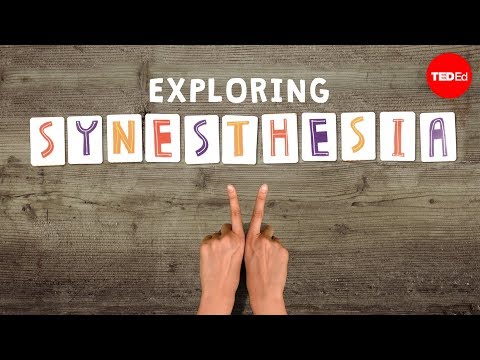
12024-12-17T17:13:30-08:00Polina Dimovae3cc21567714201b2dd4d0a2c7acf46b8dd6ea1cRichard E. Cytowic, “What color is Tuesday? Exploring synesthesia,” 20133Full TED-Ed lesson by leading synaesthesia neurologist Richard Cytowic. How does one experience synesthesia -- the neurological trait that combines two or more senses? Synesthetes may taste the number 9 or attach a color to each day of the week. Richard E. Cytowic explains the fascinating world of entangled senses and why we may all have just a touch of synesthesia.plain2024-12-17T17:17:32-08:00Polina Dimovae3cc21567714201b2dd4d0a2c7acf46b8dd6ea1c
12025-02-18T12:09:01-08:00Polina Dimovae3cc21567714201b2dd4d0a2c7acf46b8dd6ea1cDavid Howes, “Sensorium,” 20242How many senses are there, really? Do the senses have a history? What makes smell ‘the affective sense’ par excellence? Are the senses so many independent channels, or do they interact with and modulate each other? And, if so, how might we cultivate the capacity to see feelingly or smell colours? These are among the questions to be addressed in the Sensorium Element discussed by David Howes.full2025-02-18T12:09:22-08:00Polina Dimovae3cc21567714201b2dd4d0a2c7acf46b8dd6ea1c