Union Station’s Importance in Ottawa History
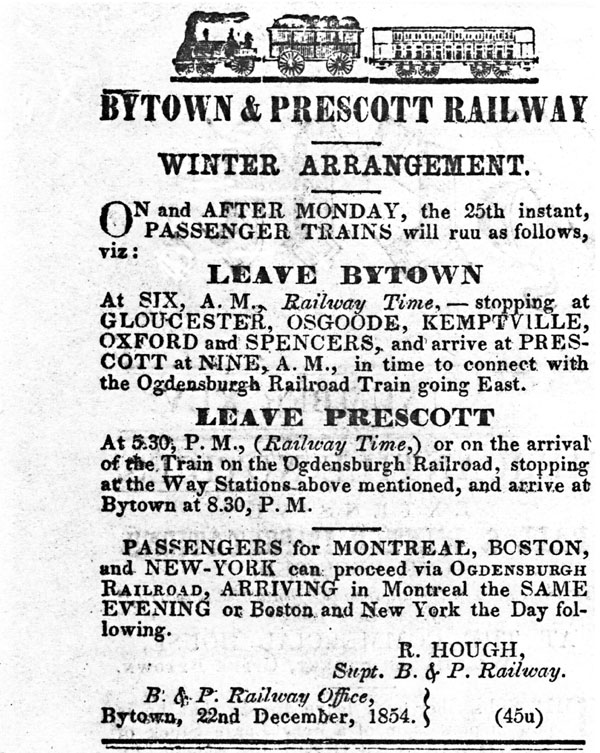
However, some thirty-five years later in the summer of 1883, Ottawa was still lacking in the finer amenities of a capital city, according to Mr. and Mrs. Howard Vincent of London, England, who had travelled from Montréal to Ottawa by steam train on a North American tour. Mrs. Vincent noted in her diary that “Ottawa, other than the Parliament Buildings...is the dullest and most primitive of towns” (Vincent 1886, 22-23).
Consequently, when it was completed as Ottawa’s central station for the Grand Trunk Railway, Union Station was indeed a powerful symbol. It was awe-inspiring. It was much like the new experience of travelling by steam train “for people who had never known travel at speeds above that of a galloping horse” (Coulls 1999). It was designed to be a smaller version of the mammoth Pennsylvania Station that occupied eight acres in central New York City. The architectural elements and materials were intended to mimic the opulence of the ancient Baths of Caracalla in Imperial Rome: giant Corinthian columns, wide stairways, arched thermal windows, high coffered and barrel-vaulted ceilings, elaborate ornamentation – all characteristics of the Beaux-Arts classical revival style and typical of early 20th-century landmark public buildings (Parks Canada) across North America.
Hence the station represented Ottawa’s transformation from a primitive “timber-lugging” town (Vincent), to a national capital that could now welcome, in style, the comings and goings of politicians, dignitaries, and well-heeled visitors from around the world. Furthermore, it connected Ottawa with technological modernity and with modern urban centres like New York, Chicago and Washington. The rapidly evolving railway system was part of the country’s “narrative of progress, both national and technological” (Currie 1957, 57). It was “a highway of civility, linking the hubs of civilization, through the sprawling wilderness” (Currie, 58).
Sited in Confederation Square within view of the Parliamentary East Block, the station was an impressive entry point to Ottawa. It was also connected by tunnel to the newly built Château Laurier Hotel directly across the street. This was part of the grand plan of Charles Melville Hays, a visionary railroad executive deeply involved in railway development on both sides of the border. To attract wealthy tourists, Melville planned to establish luxury hotels alongside the new railway systems, and marketed the resort “package” as a first-rate operation (Liscombe 1993, 134,138). Both Union Station and the Château Laurier were officially opened on June 12, 1912.
This page has paths:
- Making the Past Present: Union Station Restoration – A Political Facelift? Maegen Sargent
- Bibliography Maegen Sargent
- Conclusion Maegen Sargent