Amanda - Organic Architecture/F.L. Wright
Frank Lloyd Wright was a key figure in the modernist movement and was one of the first architects to coin the term organic architecture. Frank Lloyd Wright started incorporating the term ‘organic’ into his theory of design in 1908. Organic architecture focuses on the harmonious relationship between materials, design/form, and function; "parts were related to the whole as the whole was related to the parts".1 This also includes the relationship between the building and the site (nature, topography, climate). F.L. Wright believed this harmonious relationship would create an organic building that is suited for human’s spiritual and physical needs. F.L. Wright viewed nature, function, ornament, depth and, space as inherent qualities of human spirituality. His beliefs helped devise six design principles of organic architecture.1
- Simplicity and repose should be the measures of art.
- Multiplicity of styles.
- Correlating nature, topography and architecture.
- Using colors from nature and adapting them to fit congruously with other natural materials used in building.
- Expressing “the nature of materials”.
- Spiritual integrity in architecture.
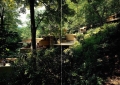
This is an exterior side view of Fallingwater.4
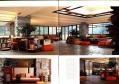
This is an interior view of the main floor of Fallingwater.4
F.L. Wright thought people "misused and misunderstood" commonly used terms in organic architecture. His interpretation of each term goes hand-in-hand with and further explains his beliefs and his design principles of organic architecture.
F.L. Wright's interpretation of the nine "misused and misunderstood" organic architecture terms:3
- Nature is not just living matter but the interior essence of materials, plans, or feelings.
- Organic refers to the relationship of parts to wholes, connoting integral and intrinsic qualities.
- Form follows function "form and function are one".
- Romance stands for the creative force expressed by the inspired individual.
- Tradition does not require imitation or precedent, but a sense of belonging.
- Ornament is the making of poetry, an emotional expression that is integrated into architecture and reveals and enhances the structure of the building.
- Spirit is the essential life force within an object, not the imposition of a divine presence on high.
- the third dimension is the depth that is intrinsic to a building
- Space is the "continual becoming: invisible foundation from which all rhythms flow to which they must pass. Beyond time or infinity. The new reality which organic architecture serves to employ in building. The breath of artwork."
References
- Wright, Frank Lloyd. Frank Lloyd Wright Collected Writings. Ed. Bruce Brooks. Pfeiffer. Vol. 5. New York: Rizzoli in Association with the Frank Lloyd Wright Foundation, 1994. Print.
- "Fallingwater Home." Fallingwater | Home. Web. 10 Mar. 2016.
- Riley, Terence, and Peter Reed. "Frank Lloyd Wright and Modernism."Frank Loyd Wright, Architect: , the Museum of Modern Art, New York,. New York: Museum of Modern Art, 1994. 32-53.
- Kaufmann, Edgar, and Mark Girouard. Fallingwater. Ed. Walton Rawls. London: Architectural, 1986.