Thanks for your patience during our recent outage at scalar.usc.edu. While Scalar content is loading normally now, saving is still slow, and Scalar's 'additional metadata' features have been disabled, which may interfere with features like timelines and maps that depend on metadata. This also means that saving a page or media item will remove its additional metadata. If this occurs, you can use the 'All versions' link at the bottom of the page to restore the earlier version. We are continuing to troubleshoot, and will provide further updates as needed. Note that this only affects Scalar projects at scalar.usc.edu, and not those hosted elsewhere.
Modern Architectures of North AmericaMain MenuHelp! Help! Help!SuburbiaArchitecture Relating to the Natural EnvironmentPatients, Prisoners, PoliticsIdentity: What Lies Beneath Style and FormChange and AdaptationErica Morawski - The Hotel Nacional de Cuba: Making Meanings and Negotiating NationalismsSteph - Moorish Revival ArchitectureBrittney - Sustainable Urban DesignsThe Shift: Art Deco & Modernismby Bayleigh BoganTransition to Streamline ModerneSydney - The Coppelia Ice Cream Shop in Havana, Cuba: A Cultural Moment ManifestedKatie - LevittownGenevieve - The Multifaceted Development of Creole ArchitectureThe Former Church of the Holy Communion: A Specific Example of Change and Adaptation of a Single Building Over TimeRe-Purposing a Religious BuildingZarah Ferrari: Tule Lake Segregation Center: Rising Above an Unjust SystemZarah FerrariLaura - The Suburban Kitchen in Levittown, PABy Laura Krok-HortonMarianna Mapes, Disease and the Body Politic: The National Leprosarium at Carville, LouisianaLiz - Eichler, Neutra, and the mid-century Californian SuburbV. Nash- Berkeley City Women's Club (1929), Berkeley, CA, Julia MorganJulia Morgan was a West Coast architect.Metropolitan Museum of Art: A Transition to ModernismBrendan - Academy of Music
Amanda - Organic Architecture/F.L. Wright
12016-02-15T11:47:41-08:00Brendan O'Connellebfc3d10f3e31650b3aa34b91ad42e84b7c1f7ba818023plain2352022016-03-28T17:00:12-07:00amanda barriscale5001ecd2ba98bf98931b2fc217caa37ba69fea9fFrank Lloyd Wright was a key figure in the modernist movement and was one of the first architects to coin the term organic architecture. F.L. Wright thought it was important to integrate nature and architecture, "parts were related to the whole as the whole was related to the parts".1F.L. Wright believed everything from the materials to the design had to come together as a whole to create organic building suited for humans spiritual and physical needs. F.L. Wright viewed nature, function, ornament, depth and, space as inherent qualities of human spirituality. His beliefs helped devise six design principles of organic architecture.1
Simplicity and repose should be the measures of art.
Multiplicity of styles.
Correlating nature, topography and architecture.
Using colors from nature and adapting them to fit congruously with other natural materials used in building.
Expressing “the nature of materials”.
Spiritual integrity in architecture.
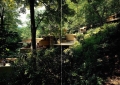
I have chosen Fallingwater, a house designed by F.L Wright, to elucidate and illustrate F.L. Wright's style of organic architecture.
This is an exterior side view of Fallingwater.4
This is an interior view of the main floor of Fallingwater.4 References
Wright, Frank Lloyd. Frank Lloyd Wright Collected Writings. Ed. Bruce Brooks. Pfeiffer. Vol. 5. New York: Rizzoli in Association with the Frank Lloyd Wright Foundation, 1994. Print.
"Fallingwater Home." Fallingwater | Home. Web. 10 Mar. 2016.
Riley, Terence, and Peter Reed. "Frank Lloyd Wright and Modernism."Frank Loyd Wright, Architect: , the Museum of Modern Art, New York,. New York: Museum of Modern Art, 1994. 32-53.
Kaufmann, Edgar, and Mark Girouard. Fallingwater. Ed. Walton Rawls. London: Architectural, 1986.