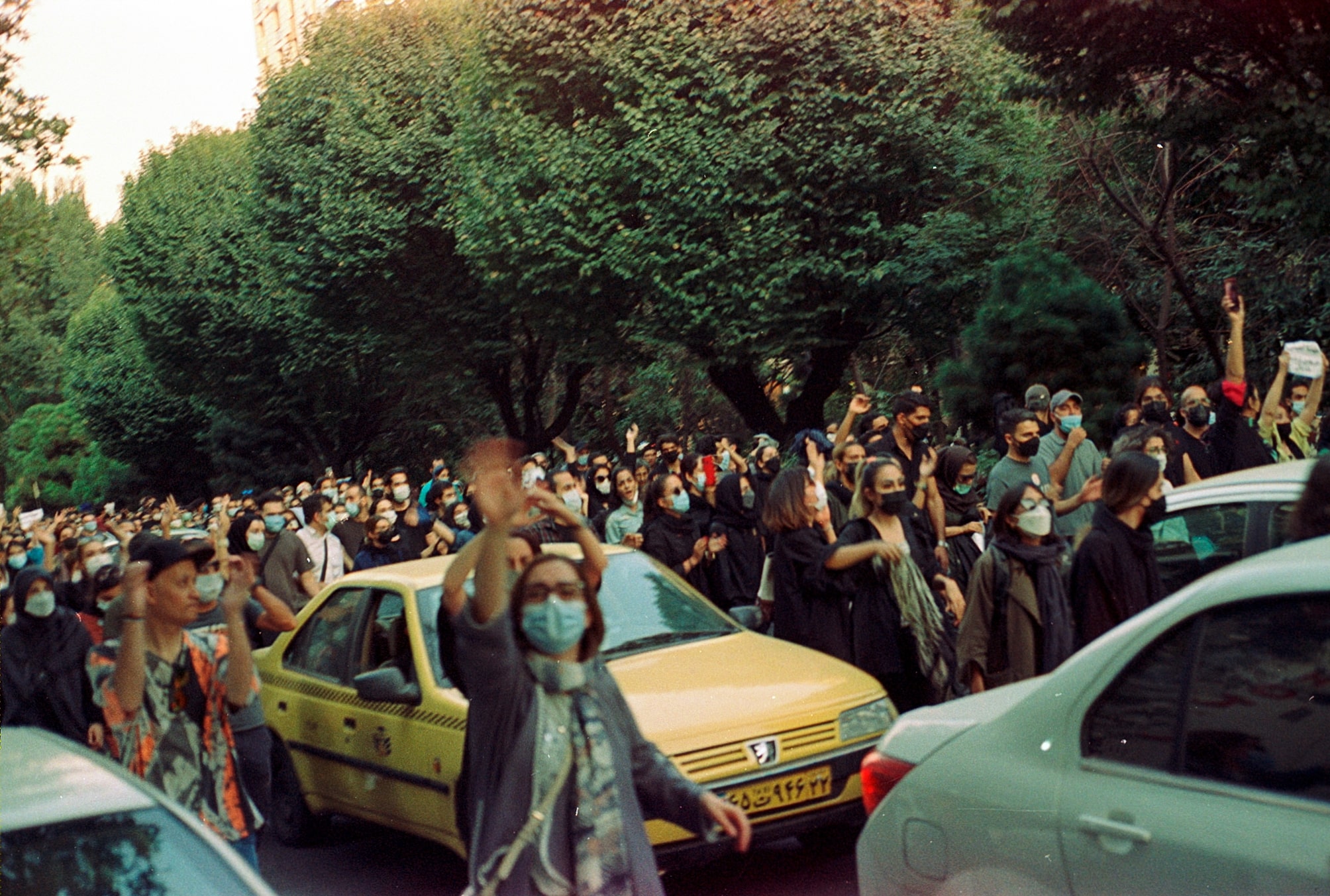
WLF protest in Iran
1 media/SE WLF protest_thumb.jpg 2024-11-25T18:03:11-08:00 Hatcher Stanford f03c763a99bfcb6c17d2215a2cf35f70ee661993 45871 1 Women Life Freedom protest in Iran by anonymous photographer via iranhumanrights.org plain 2024-11-25T18:03:12-08:00 Hatcher Stanford f03c763a99bfcb6c17d2215a2cf35f70ee661993This page is referenced by:
-
1
media/Sarina Graffiti.jpg
2024-10-09T10:12:29-07:00
Sarina Esmailzadeh
22
Teenage Normacly and Protest
image_header
2024-12-06T09:42:10-08:00
In September of 2022, Sarina Esmailzadeh was murdered at the hands of the Iranian authorities, while protesting in the name of Women, Life, Freedom. Just 16 at the time, Sarina, like many others across Iran, had been moved by the death of Mahsa Amini and taken to the streets to protest the authoritarian rule of the regime.
Maryam Alemzadeh, in her work Revolutionary Politics of the Normal (2023), explains the significance of Mahsa Amini’s death with regard to “normalcy” of Iranian life, in which many Iranians were no longer able to turn a blind eye to the regime’s brutal policing, and subordination of women and thus, began participating in the Women, Life, Freedom movement.Indeed, before becoming a martyr of the Women, Life, Freedom uprising Esmailzadeh, like any other teen, had the innocent dream of being a content creator and began posting video blogs to YouTube. These videos included normal and mundane events such as going on a family trip, or making pizza, yet, they also contained Sarina’s keen thoughts on the situation of not only Iranian women, but also Iranian’s as a whole under the violent tools of authoritarian rule (Amnesty International, 2023). Furthermore, Sarina appears in her videos unveiled, and often portrays herself with a colorful personality that defies the repressive religious and cultural laws of Iran that dictate the lives of women. The way in which she carries herself in her self-produced videos when viewed against her untimely death retroactively represents the, “perished youth, [and] repressed joy,” as described by Asef Bayat (New Lines Magazine, 2023).
In one of her video blogs, Sarina expresses, “the pain of seeing the lives of her peers in L.A. or New York, enjoying life and freedom,” (Amnesty International). This lamentation encapsulates the break from normalcy felt by many Iranians with special regard to internet access, which has shaped this uprising to be different from Iran’s prior movements. In a New Lines Magazine interview (now banned by Iranian authorities) with Dr. Asef Bayat, he describes how the internet has been a space for those, “disillusioned and resentful of politicians and ‘politics,’” and that through use of these internet spaces the Iranian youth can, “understand how much they are deprived,” (New Lines Mag, 2022). This accurately details the significance of Sarina’s lamentation for normalcy, in which her internet use showed her the normalcy she was being deprived of at the hands of the regime.
Furthermore, Alemzadeh explains in her work that this loss of normalcy influences the way in which an uprising is fostered and progresses. She makes the distinction between traditional forms of grievance, in which an injustice must be ideologically tied to its source, and grievance of normalcy. The latter needs no ideology, and according to Alemzadeh, the Women, Life, Freedom movement has no central ideology surrounded by socio-economic theory, organized by a central body. Yet, Women, Life, Freedom (like many other uprisings and social movements) enjoys a collective consciousness that harbors the grievances of those marginalized by the regime, thus, this movement is widely accessible through its grievances of lost normalcy (2023).
Sarina Esmailzadeh might serve as an example of the path taken by Iranian youth, from disillusioned and deprived of normalcy to disobedient. With respect to her death at the hands of the regime, Sarina in turn became just like Mahsa Amini, whose death marked a point-of-no-return for many Iranians, and inspired many, including Sarina herself, to protest (Alemzadeh, 2023).
- Hatcher Stanford
ReferencesAlemzadeh, Maryam. “Revolutionary Politics of the Normal.” International Journal of Middle East Studies 55, no. 4 (2023): 724–28. https://doi.org/10.1017/S0020743823001381.
Bayat, Asef. 2022. “A New Iran Has Been Born — a Global Iran.” New Lines Magazine. October 26, 2022. https://newlinesmag.com/argument/a-new-iran-has-been-born-a-global-iran/.
GuestBloggers. “Honoring Sarina Esmailzadeh, Iranian Protester and YouTube Creator, on Her 17th Birthday.” Amnesty International UK, 2 July 2023, www.amnesty.org.uk/blogs/campaigns-blog/sarina-esmailzadeh-17-birthday.