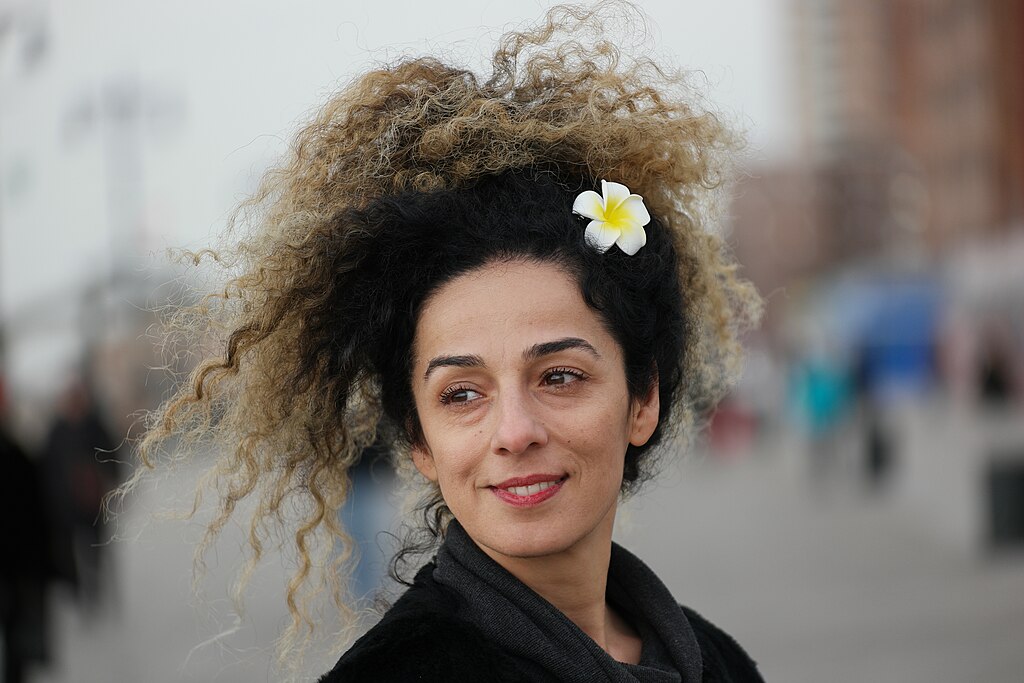
Masih Alinejad
Masih Alinejad was the ideal Woman Life Freedom supporter for the West. A journalist and activist exiled from Iran, Alinejad stripped the Woman Life Freedom movement of its intersectionality and made it a revolution purely against the hijab. Although a loud voice in the early days of the movement, Alinejad is now recognized as playing into flawed ideas of Western feminism.
In her memoir, The Wind in My Hair, Alinejad describes growing up in a small village during the first decades after the Islamic Revolution of 1979. Her father, a staunch regime supporter, enlisted in the basij and got upset when any of the women in his family were without headscarves, even in the home. Alinejad recalls having to sleep with her headscarf on, which she says "hijacked" her identity. From stricter clothing requirements to gender segregated schools, the regime's impositions on women permeated Alinejad's entire childhood. Purity culture was drilled into her head early on, so she grew up with a sense of shame around her own body.
Fast forward a few decades, and Alinejad innocently posts a picture of herself in London, running freely without the hijab in 2014. She said she immediately received an outpouring of support, borderline envy, from women inside Iran still bound by compulsory hijab laws. From that, the "My Stealthy Freedom" movement was born, a form of protest in which women "stealthily" disobeyed mandatory veiling laws by posting pictures with their hair uncovered. The My Stealthy Freedom movement quickly gained traction on Facebook, getting 130,000 likes in only nine days, according to BBC.
In 2017, #MyStealthyFreedom expanded to include “White Wednesdays” campaign, which called on Iranian women to wear white hijabs on Wednesdays to protest the compulsory hijab laws. Dozens of women posted their pictures and videos without hijabs under #WhiteWednesdays and #GirlsofRevolutionStreet hashtags.
After the state killed Mahsa Amini for not wearing her hijab properly in 2022 and the Woman Life Freedom Movement took its full form, the movement became about so much more than the hijab. Amini became the symbol of struggle for not just women, but for religious minorities, ethnic minorities, and the working class. The movement’s intersectionality was apparent from its inception.
Yet, Alinejad remained fixated on the hijab, and Western media praised her for doing so, dubbing her as the woman "whose hair scares Iran." As the Woman Life Freedom movement developed, Alinejad rallied women to defy hijab laws through her 10 million+ following, but she never addressed any other aspect of the movement– she never addressed the “collective” part of “collective liberation.” But the New Yorker hailed her as the “leader” of the movement, and Time Magazine named her as one of their 2023 “Women of the Year.” Alinejad’s selective rhetoric perfectly played into the Western savior complex that rescues women of color from their own cultures, making her the ideal activist for Western media to put on a pedestal.

Meanwhile, activists in Iran criticized Alinejad. For example, Alinejad met with President Donald Trump’s Secretary of State Mike Pompeo, who was an outspoken advocate for severe sanctions on Iran that would cripple its economy and drastically reduce the standard of living for the average Iranian. (It was an additional slap in the face that Pompeo didn't support women's reproductive rights in the United States either). Alinejad said she wanted sanctions against Iran’s government, but not its people– when in fact nearly two decades of sanctions have caused unemployment and inflation to skyrocket. Over 1,000 Iranian academics and activists condemned Alinejad’s “opportunistic activism,” saying her alignment with Western leaders like Pompeo meant she did not have the best interests of the Iranian people in mind.
Alinejad's activism was very much rooted in her own childhood and the way Islamic dress code was enforced on her. In The Wind in My Hair, she clarifies that she would have opposed Reza Shah's 1936 mandatory unveiling because she is not anti-hijab, but pro-autonomy. However, Western media often conflates the two, painting a dichotomy between the oppressed, veiled woman and the uncovered, liberated woman. Iranian feminism has consistently broken that binary for decades, but Alinejad's lack of nuance in her activism (that Western media subsequently amplifies) only reinforces the binary.
Alinejad, through her calculated support of the Woman Life Freedom Movement, has partially facilitated the Western view that the movement is only about the hijab and womens’ rights. Such perceptions of Iran perpetuate neo-colonial, Orientalist ideas that Iranian and Middle Eastern cultures and Islam are inherently backwards and oppressive.
This page has paths:
- Personas/Icons of Woman, Life, Freedom Asal Khers
- M.A. Maryam Ahmed
- Icons & Personas of Woman Life Freedom Hatcher Stanford