Chilean women protest death of Iranian Mahsa Amini
1 2024-11-06T10:16:14-08:00 Maryam Ahmed 0a0bac97b4f545b0078f67cd1ce8dbe449b63efd 45871 1 (24 Sep 2022) RESTRICTION SUMMARY ASSOCIATED PRESS Santiago - 23 September 2022 1. Various of women dancing ... plain 2024-11-06T10:16:14-08:00 Maryam Ahmed 0a0bac97b4f545b0078f67cd1ce8dbe449b63efdThis page is referenced by:
-
1
media/Lorde+Glasses.png
media/Lorde+Glasses.png
2024-10-09T10:26:07-07:00
A River Runs Through Revolution Street
19
New Intersectionality of WLF
image_header
2024-12-06T22:19:15-08:00
In Manijeh Moradian’s “Embodying Revolution” (2024), Moradian explains the unique intersectionality that characterizes the Women Life Freedom uprising as a response to authoritarian patriarchal rule and the internal colonialism of marginalized peoples in Iran. This intersectionality not only permeates various social, ethnic, economic, and age groups of Iran but also spans transnational boundaries, in which solidarity between feminist movements across different continents builds resilience in these movements. However, it's important to understand that this intersectional approach to feminist organization is largely a result of past experiences of women in Iran during prior movements and revolutions. During the 1979 revolution, women in Iran had become a growing political force that Khomeini identified as crucial to securing power in Iran and thus, were promised social dignity and economic advancement in return for their support of Khomeini. Women began to oblige, adopting Islamic practices without “true” belief, and casting their support for Khomeini’s ascent to power, expecting prosperity under this new rule. However, these promises quickly turned to dust and Khomeini’s regime began its harsh and authoritarian rule that women in Iran continue to suffer from today. The ideological effects of this failure, as well as several others, to secure dignity and prosperity through a change in government became manifest in not only the intersectionality of the Women Life Freedom uprising, but also its decentralized and non-ideological framework, that prioritizes the reclamation of a stolen, “normal life,” (Bayat, 2022).
Asef Bayat, an Iranian professor and author, explains that Women Life Freedom, “has brought together the urban middle class, the middle-class poor, slum dwellers and people with different ethnic identities — Kurds, Fars, Azeri Turks and Baluchis,” (2022), while Maryam Alemzadeh illustrates the unique lack of cohesive ideology of WLF in “Revolutionary Politics of the Normal,” (2024). This combination of the broad solidarity of a, “super-collective,” and the refusal of WLF participants to use the regime’s defunct channels of reform, as well as grievances based around, “ruined lives, perished youth, suppressed joy and a simple dignified existence they have been denied,” have created a movement that can more effectively bring dignity and prosperity to women in Iran.
My restraint to mention the other sectionalities that support WLF in hopes of also achieving dignity and prosperity in the sentence prior to this one, is completely intentional. That is not to say that other peoples of Iran do not reap the benefits of this movement, or that the women central to WLF plan to exclude others from the movement like Khomeini’s regime did with their female supporters after 1979. Rather, it stems from the fact that dignity and prosperity for women in Iran predicates implies dignity and prosperity for all peoples. In The Combahee River Collective Statement, the Combahee River collective explain that Black women, “do not have racial, sexual, heterosexual, or class privilege to rely upon, nor do [they] have even the minimal access to resources and power that groups who possess anyone of these types of privilege have,” thus, Black American women occupy the lowest possible position in American hierarchy (CRCS, 1977). Therefore, a system of government and society in America that would provide Black women with dignity and prosperity and that does not deprive them of the, “normalcy,” they idealize for themselves, would have to also do so for all other marginalized peoples (Alemzadeh 2024). In short, when the welfare of a sectionality, or grouping of sectionalities, that occupies the lowest position of hierarchy is prioritized in a movement, the welfare of all other sectionalities are “baked into” that movement. CRCS explains this strategy of movement centered around women’s welfare, when stating that they, “are not convinced… that a socialist revolution that is not also a feminist and anti-racist revolution will guarantee our liberation,” echoing the despair felt by the women that supported Khomeini who learned that negotiations for the welfare of women on the margins of a political revolution cannot guarantee their liberation (1977).
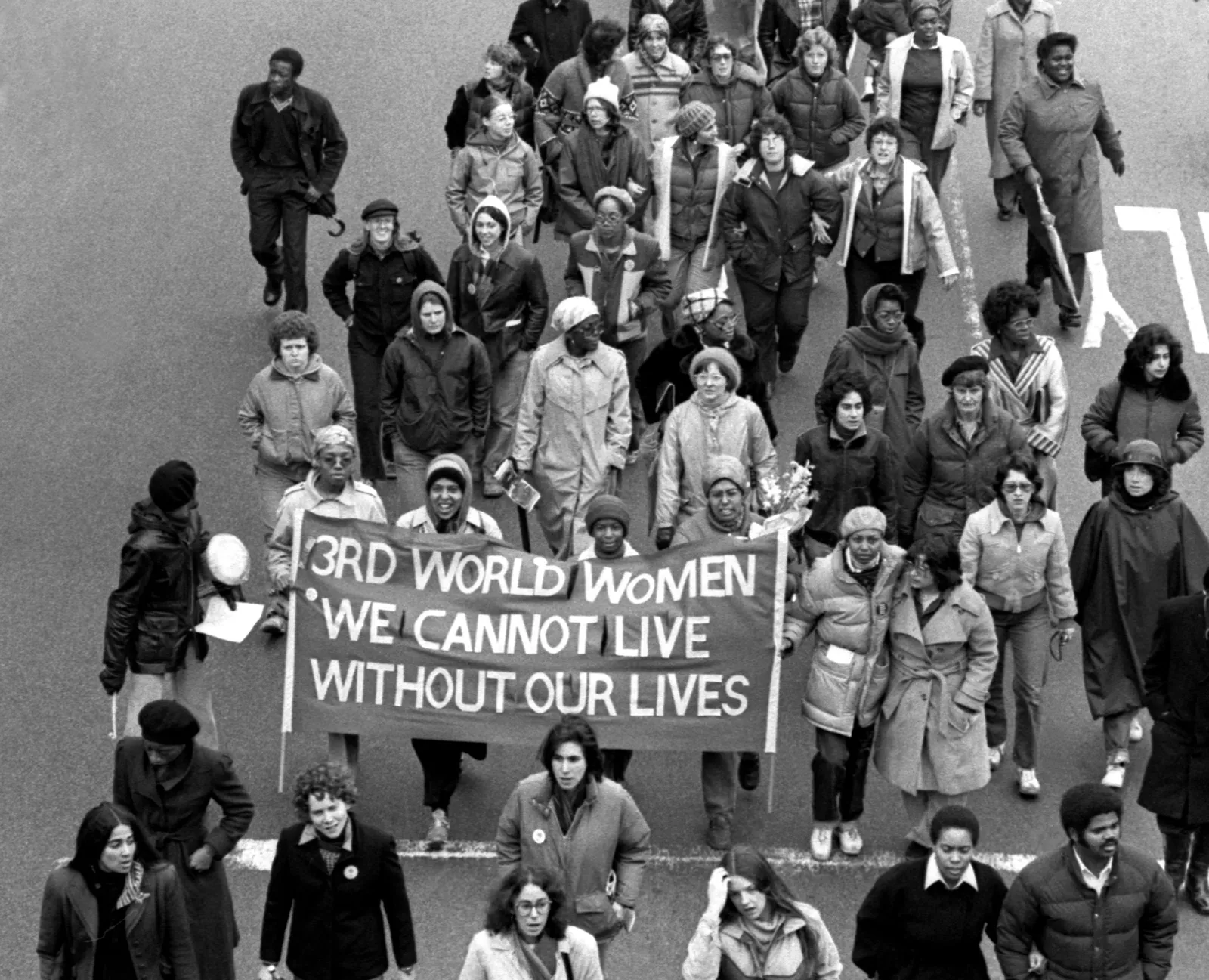
This strategy of movement organization explains the solidarity towards and participation in WLF, which should now be apparent as a symptom of women’s centrality to WLF. Indeed, women’s dignity and prosperity as the foundation of WLF, rather than a more specific and therefore more exclusive ideology has acted as a beacon for all other marginalized peoples of Iran, having realized that WLF was, “instigated and led by women, but is not exclusively about women’s rights” (Alemzadeh, 2024). Outside of Iran, the intersectionality of WLF has already, “resonated with other feminist movements and created new forms of transnational and diasporic activism,” (Moradian, 2024).
- Hatcher Stanford
References
Alemzadeh, Maryam. “Revolutionary Politics of the Normal.” International Journal of Middle East Studies 55, no. 4 (2023): 724–28. https://doi.org/10.1017/S0020743823001381.
Bayat, Asef. 2022. “A New Iran Has Been Born — a Global Iran.” New Lines Magazine. October 26, 2022. https://newlinesmag.com/argument/a-new-iran-has-been-born-a-global-iran/.
BlackPast, B. (2012, November 16). (1977) The Combahee River Collective Statement. BlackPast.org. https://www.blackpast.org/african-american-history/combahee-river-collective-statement-1977/
Eskandari, Sarah. “Internal Colonialism in Iran: Gender and Resistance against the Islamic Regime.” International Journal of Middle East Studies 55, no. 4 (2023): 739–43. https://doi.org/10.1017/S002074382300140X.
Manijeh Moradian. “Embodying Revolution: Situating Iran within Transnational Feminist Solidarities.” Radical History Review 1 January 2024; 2024 (148): 164–170. doi: https://doi.org/10.1215/01636545-10846893
-
1
media/Screenshot 2024-12-04 at 12.57.31 PM.png
2024-10-23T10:16:56-07:00
The Young Person's Revolution
18
What role did Gen Z play in Iran's Woman Life Freedom movement?
image_header
2024-12-08T20:04:57-08:00
When protests broke out across Iran following the killing of Mahsa Jina Amini, young people were at the forefront– the average age of arrested protesters in Iran was 15. Worldwide, young people are often the first to take a stand for justice, mostly because they have less to lose than older people with secure careers and families. While this is true for young Iranians, their prevalence in the Woman Life Freedom movement is largely due to the fact that they see the Islamic regime in a very different light than their parents. Younger Iranians weren’t alive for the 1979 Revolution or the Iran-Iraq War; all they really know of the Islamic regime is the oppression it’s inflicted on women and minorities.
While protesters flooded the streets, young Iranian schoolgirls led their own protests, contrary to claims from the Iranian Revolutionary Corps Guard that these demonstrators were merely outside agitators. For example, schoolgirls in Karaj publicly removed their hijabs and chanted “death to the dictator” in October, 2022, according to a video from a BBC journalist.
In a march in Gohardasht, Karaj, schoolgirls remove their head coverings today chanting "death to the dictator" while cars sounds horns in support.
— Shayan Sardarizadeh (@Shayan86) October 3, 2022
It's hard to put into context just how unprecedented these scenes are in Iran.#مهسا_امینی #MahsaAminipic.twitter.com/xxMatcVA7u
There were similar instances of schoolgirls removing their hijabs throughout the Woman Life Freedom protests, showing the prominent role of Gen Z in the movement. The fact that schoolgirls specifically removed their hijabs is significant, because they have far less autonomy due to their age, gender, and reliance on the education system— removing their hijabs in that context is arguably a greater act of defiance than independent adults doing the same.
Additionally, Gen Z’s use of social media allowed the protesters’ message to spread beyond borders. Iconic images of protesters— such as those of Vida Movahed standing on a utility box unveiled and a group of uncovered women dancing around a bonfire— worked their way across the internet to create an international name for the movement. On apps like TikTok and Instagram, young people in Iran paved the way for the Iranian diaspora to amplify the movement.
Gen Z’s online expertise also allowed for access to diverse forms of protest, often borrowing from other transnational feminist movements. Via the internet, for example, Iranian women took the Chilean song and dance “A Rapist in Your Path” and performed it in Persian, changing the lyrics slightly to fit their circumstances. This shows how the internet gave access to different kinds of protest and allowed transnational solidarity to build among feminist movements across the world.
Young Iranians have been at the front of the Woman Life Freedom movement due to their largely oppressive experiences under the Islamic Regime, and the internet has been one of their primary tools in amplifying the movement and developing international solidarity with other
feminist movements.
-M.A. -
1
media/Chile WLF.jpg
2024-10-23T16:22:39-07:00
Beyond Borders: Transnationality and Intersectionality
13
image_header
2024-12-02T18:27:28-08:00
While the Woman, Life, Freedom movement is situated in Iran, its ideas of collective liberation transcend time and space. Particularly with the issue of womens’ rights, other forms of feminist protest from around the world made their way to Iran due the growing role of the internet in freedom struggles globally. This transnational movement further highlights the intersectionality of Woman Life Freedom.
Feminist movements in Latin America influenced the Woman Life Freedom movement. For example, Iranian women took the Chilean song and dance “A Rapist in Your Path,” and performed it in Persian, slightly changing the lyrics to fit their circumstances. The accompanying choreography– combined with other revolutionary acts like taking off the hijab– represented Iranian women reclaiming their bodily autonomy. To do such a powerful dance uncovered, in public---and most importantly, in numbers---represented unity among Iranian women and outright defiance of restrictive hijab laws.
The dance also represented a broader shift in how women are perceived by society, eliminating distinctions between public and private spaces. As Negar Hatami explains in her piece "Heads Without Headscarves" that women had both formal and informal projections, depending on whether they were at home or in public. This dance is one of the many ways the Woman Life Freedom erased the line between public and private, formal and informal, and allowed women to simply exist as they are. To read more about how Woman Life Freedom upended what was "normal" for Iranian society, click here. (insert page about afterlives)"It is at the level of the body that a historical impasse has been broken."
-Manijeh Moradian, "Embodying Revolution"In the same work, Moradian also points out how the West (and particularly Western media) see Iran, and the Middle East at large, as having only two options: Islamic fascism or pure secularism. She explains how Western feminists develop Islamophobic viewpoints as a result of the Islamic State’s repression, generalizing the entire religion as “backwards.” Lost in their savior complex, many Western feminists end up perpetuating a different form of injustice, only it’s more palatable to Western sensibilities. Rather than enforce this binary between fundamentalism and secularism, Moradian argues we should stand in solidarity with womens’ right to choose their lifestyle, especially with regard to the hijab.
Part of transnational solidarity is understanding, rather than demonizing, other cultures. In this case, long-standing, Orientalist tropes make it easy for the outside world to vilify Islam, the hijab, and Persian culture— with figures like only perpetuating the idea. No one culture is the beacon of women’s liberation, and the transnational nature of the Woman Life Freedom movement exemplifies this.