Thanks for your patience during our recent outage at scalar.usc.edu. While Scalar content is loading normally now, saving is still slow, and Scalar's 'additional metadata' features have been disabled, which may interfere with features like timelines and maps that depend on metadata. This also means that saving a page or media item will remove its additional metadata. If this occurs, you can use the 'All versions' link at the bottom of the page to restore the earlier version. We are continuing to troubleshoot, and will provide further updates as needed. Note that this only affects Scalar projects at scalar.usc.edu, and not those hosted elsewhere.
Sailing the British Empire : The Voyages of The Clarence, 1858-73Main MenuSailing the British Empire: The Voyages of the Clarence, 1858-73IntroductionThe Crew / AcknowledgmentsThe Provenance of Watson's LogAdditional Sources: Logs, Crew Lists, DiariesInside Lloyd's Register"Green's Celebrated Service"Details on owner of the ship at the time of our voyage, Richard Green.The Master Builder: William PileThe Master: Joseph Watson's BiographyA Mate's ProgressThe Career of Henry Berridge, First Mate of the ClarenceThe Crew of the Clarence in 1864An annotated crew listThe 18th HussarsThe Clarence and the Cyclone of 1864Origins of Indian Emigrants Aboard The ClarenceThe Surgeon-SuperintendantWages of indentured labourers in Demerara (1870-1900)The Clarence Sails to AustraliaMutiny! Violence and Resistance Aboard "Coolie Ships"Cholera: The Killer from CalcuttaSTSC 077, Fall 2015 First Year Seminar, University of Pennsylvaniab33a025deaa7595ed0079bfc9b77ea3cb14b8d08STSC 077, The University of Pennsylvania, fall 2015
Mutinies Varied by Port of Departure
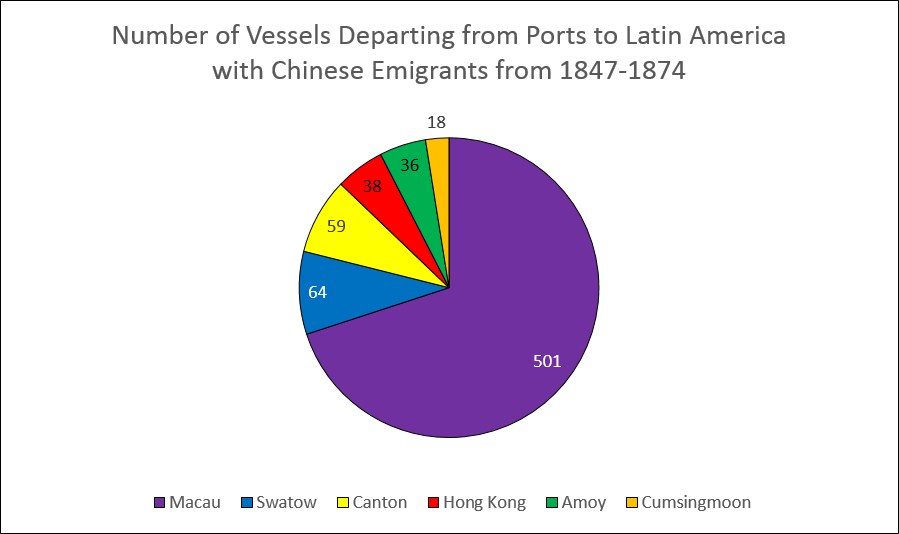
12015-12-14T17:32:01-08:00STSC 077, Fall 2015 First Year Seminar, University of Pennsylvaniab33a025deaa7595ed0079bfc9b77ea3cb14b8d0862651plain2015-12-14T17:32:01-08:00STSC 077, Fall 2015 First Year Seminar, University of Pennsylvaniab33a025deaa7595ed0079bfc9b77ea3cb14b8d08The Portuguese port of Macau was the oldest port on China's coast, dating back to the 1550s, and as a result, experienced the most trade. Later, the British restricted other nations' access to their ports in 1855. One possible explanation is that they recognized the injustice of the coolie trade, and did not want that trade occurring on their land. However, it is more likely that the British wanted to limit their competition so they could receive higher profits. As a result, other nations such as Peru, one of the largest contributors to the coolie trade, based their operations in Macau, creating significantly more traffic.
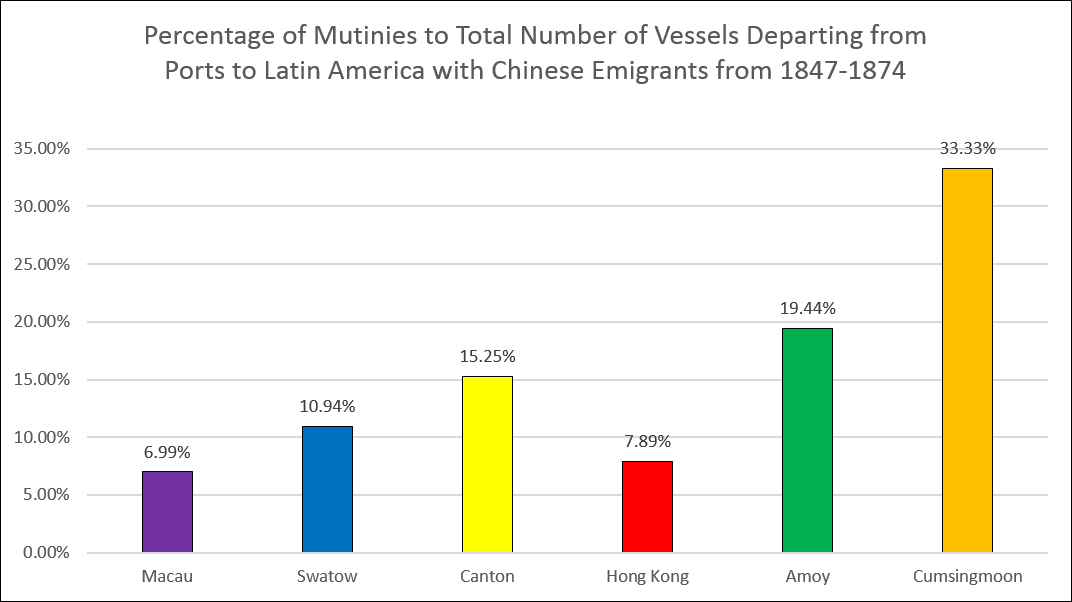
It is important to keep in mind that Cumsingmoon represented only a little over 2.5% of the total number of vessels departing from China with indentured laborers. In both graphs, Latin America encompasses Cuba, Peru, Chile, the British Caribbean colonies, French Guiana, Martinique, Guadeloupe, and various other colonies.
Mutiny varied by port of departure. Stricter regulation of emigration from British (Hong Kong) and Portuguese (Macau) colonies’ ports resulted in lower incidence rates of mutinies aboard those ships. However, the other ports experienced more mutinies as kidnapping and bribes went undeterred. Specifically, at the time, Cumsingmoon was an opium depot, further promoting its extremely high mutiny rate, as corruption was pervasive.
Sources Cited: 1. Meagher, Arnold Joseph. The Introduction of Chinese Laborers to Latin America: The" Coolie Trade", 1847-1874. University of California, Davis., 1975. 185-202. 2. Northrup, David. Indentured Labor In the Age of Imperialism, 1834-1922. Cambridge: Cambridge University Press, 1995. 55. 3. Christopher, Emma, Cassandra Pybus, and Marcus Rediker. “La Trata Amarilla.” Many Middle Passages: Forced Migration and the Making of the Modern World. Berkeley: U of California, 2007. 168.
This page has paths:
12015-12-14T17:32:01-08:00STSC 077, Fall 2015 First Year Seminar, University of Pennsylvaniab33a025deaa7595ed0079bfc9b77ea3cb14b8d08Mutiny! Violence and Resistance Aboard "Coolie Ships"STSC 077, Fall 2015 First Year Seminar, University of Pennsylvania3splash2180232016-02-24T15:41:36-08:00STSC 077, Fall 2015 First Year Seminar, University of Pennsylvaniab33a025deaa7595ed0079bfc9b77ea3cb14b8d08
This page references:
12015-12-14T17:32:01-08:00Number of Vessels1(Meagher, Arnold Joseph. The Introduction of Chinese Laborers to Latin America: The" coolie Trade", 1847-1874. University of California, Davis., 1975, 201.)plain2015-12-14T17:32:01-08:00