Thanks for your patience during our recent outage at scalar.usc.edu. While Scalar content is loading normally now, saving is still slow, and Scalar's 'additional metadata' features have been disabled, which may interfere with features like timelines and maps that depend on metadata. This also means that saving a page or media item will remove its additional metadata. If this occurs, you can use the 'All versions' link at the bottom of the page to restore the earlier version. We are continuing to troubleshoot, and will provide further updates as needed. Note that this only affects Scalar projects at scalar.usc.edu, and not those hosted elsewhere.
The Third Alternative: The Oral History of Duquesne University's Third AlternativeMain MenuThe NarratorsMeet the interviewees behind the Third Alternative Oral History Project.The ProblemA brief history of Duquesne's financial crisis.The ContextThe national events taking place during the Third Alternative's campaign and how they affected the movement.The PublicHow the public of Pittsburgh interacted with and helped the Third Alternative.The EffectThe impact the Third Alternative left on Duquesne.Neighborhood CanvassingA timeline of the Third Alternative canvassing campaign.MapsMaps relating to the Thank You March and events at Duquesne University during the Third Alternative.The InterviewersMeet the students behind the Third Alternative Oral History Project.MediaCheck out our photograph collection and our documentary!Alexandra Zaremba2ce33ac8d647e2cc48718f436f303eaaa6355ceeRonald Owensaaa9113bde590a7c6854e4725baae71951e3aa5fGrant Stoner3ba49a95660aa18855c7cc5b6f8323bd1559c039Katherine Millardcc2b6742e9253dd1ad65ec8397845ff983008eb3Anna Samuels3cffb72092034ddc575aeb5ac3c9bf5d3f493c74Celia Phillips64f1bafd9e2ec54881e7e3a41417ecf15c8f4e1cLauren Eisenhart-Purvisce45d8431788bb04d876eaa4210e612cb18c860aEvan Daverio15eb18d2fdf506be557957b6adfa91b111c1b87d
The Plan
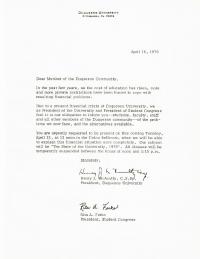
1media/Students working phone-o-thon-from Rita.jpgmedia/Students working phone-o-thon-from Rita.jpg2017-12-05T17:21:16-08:00Lauren Eisenhart-Purvisce45d8431788bb04d876eaa4210e612cb18c860a258549How the Third Alternative planned to save Duquesne.image_header2017-12-10T13:56:31-08:00Lauren Eisenhart-Purvisce45d8431788bb04d876eaa4210e612cb18c860aThis group of students that called themselves the Third Alternative were initially composed of members of Student Government and other campus organizations. They were led by Rita Ferko and Patrick Joyce, who were inspired by the atmosphere of student involvement and responsibility in the early 1970s. Their goal was to raise a million dollars in order to keep Duquesne open and affordable. The group approached Fr. Henry J. McAnulty, the university president, with their plan, and he agreed to let them start this movement. Their first step was to inform Duquesne students and staff about the financial situation. The Third Alternative was concerned about transparency from the start, and so had Fr. McAnulty call for a campus-wide meeting in April 1970 to address students, faculty, and staff. He outlined the financial crisis in detail, and then Rita spoke about the students’ idea to save the school. Hundreds of students signed up to volunteer and help with the Third Alternative that day; kicking off the beginning of the movement.
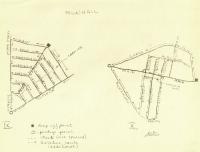
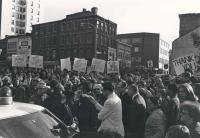
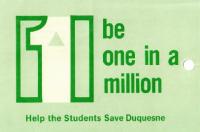
Over the summer, the leaders of the movement worked on their plan to raise a million dollars. They started the campaign with a phonathon in June, and helped the administration trim the budget to create a small surplus. When students returned to campus in the fall, the Third Alternative began a massive canvassing campaign that covered the entire Pittsburgh area. The focus of this campaign was encouraging people to “be one in a million,” with a goal of collecting at least one dollar from each person they interacted with. Students from all over the city mapped out neighborhoods, were loaded onto busses, and walked the streets collecting donations. The students were warmly received by local neighborhoods and their citizens, and tens of thousands of dollars was raised through this canvassing campaign. The Third Alternative concluded its canvassing campaign in November with a 94.6 mile march from Altoona to Pittsburgh; the distance that one million dollar bills would cover if they were laid end to end. The march was a symbol of the movement’s gratitude to all the Pittsburgh area residents who donated. As those students marched from Altoona, many other students marched through the neighborhoods they canvassed. The movement supplemented their canvassing efforts by writing to local alumni, corporations, and foundations to solicit donations. The Third Alternative also raised money through special events during the 1970-1971 school year, including raffles, speaking tours, and fundraisers during Homecoming and other sporting events. This movement incorporated many organizations and groups on campus, making the student body feel involved in the movement and its accomplishments. The Third Alternative also collaborated closely with community leaders, local media, and organizations of Pittsburgh. This cooperation with local leaders and spreading of goodwill helped lead to the success of their fundraising campaign.
This page has paths:
1media/The State of the University Address.jpgmedia/The State of the University Address.jpg2017-11-07T08:27:24-08:00Ronald Owensaaa9113bde590a7c6854e4725baae71951e3aa5fWelcomeAlexandra Zaremba34We are the Third Alternative Oral History Project.image_header2017-12-10T14:21:33-08:00Alexandra Zaremba2ce33ac8d647e2cc48718f436f303eaaa6355cee
This page references:
12017-12-08T10:50:45-08:00Canvassing Map - Munhall1A street map of Munhall, a neighborhood of Pittsburgh, drawn by students to help canvassing efforts.media/Munhall map.jpgplain2017-12-08T10:50:45-08:00
12017-12-08T10:52:25-08:00Thank You March - Market Square1Students from the Third Alternative meet up with marchers in Market Square in downtown Pittsburgh.media/oct march.jpgplain2017-12-08T10:52:25-08:00
12017-12-08T11:08:19-08:00Be One in a Million Tag1The Third Alternative left calling cards at homes with their slogan printed on them during their canvassing efforts.media/one in a million.jpgplain2017-12-08T11:08:19-08:00
12017-12-08T11:12:51-08:00State of the University Announcement1The letter that Father MacAnulty and Rita Ferko sent to the campus community, inviting them to the State of the University address in April of 1970.media/state of university announcement.jpgplain2017-12-08T11:12:51-08:00