Thanks for your patience during our recent outage at scalar.usc.edu. While Scalar content is loading normally now, saving is still slow, and Scalar's 'additional metadata' features have been disabled, which may interfere with features like timelines and maps that depend on metadata. This also means that saving a page or media item will remove its additional metadata. If this occurs, you can use the 'All versions' link at the bottom of the page to restore the earlier version. We are continuing to troubleshoot, and will provide further updates as needed. Note that this only affects Scalar projects at scalar.usc.edu, and not those hosted elsewhere.
Spectacles of Agency and Desire: Dance Histories and the Burlesque Stage
Main Menu
Katherine Greer
fc295a655478c83ef28fbc5d88f44e832ee8ba0b
Lilianna Kane
c453f3fcecc1717732f04f989f34f22e5a4d4903
Maddie Leonard-Rose
7795fc6919b777a978ec7bda4587e47146d4272e
Margaret Morrison
70f833738ab191151c82af514f5ee008e3ec05e1
Claire Staveski
fd4448269ba1d9180643996c497c3b954e2e9635
Rachel Sigrid Freeburg
19a18a24de8629654b230af3d38b9d4e018fd92a
Nena Couch
011ed4d85d026b7c015f3ceb81e22a57b29b69c6
Harmony Bench
0272c6dce71da71c341d0dca5e4d21947d1ad231
Donna Mae Brown
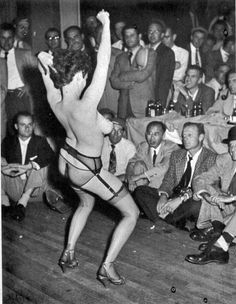
1 2015-10-19T13:56:21-07:00 Margaret Morrison 70f833738ab191151c82af514f5ee008e3ec05e1 5977 2 Donna Mae “Busty” Brown aka. “Miss Anatomy”.. Ms. Brown prepares to toss another salvo of monstrous BUMPS towards a captivated “He-Man Press Club” audience; a weekly get-together where members of the L.A. Press Club would gather to socialize (ie. booze it up & ogle strippers!).. plain 2015-10-19T14:00:48-07:00 Margaret Morrison 70f833738ab191151c82af514f5ee008e3ec05e1This page is referenced by:
-
1
2015-11-18T13:49:48-08:00
Women in the Audience
14
gallery
2015-12-12T08:09:44-08:00
Women were not seen in burlesque theaters primarily until the 1960s. At this time many theaters, performers, and show managers were reaching out to female in the community and creating promotional activities to attract a female audience. Prior to the 1960s, men had been the target audience of advertising and women were not encouraged to attend shows. In a December 1967 Los Angeles Times article, 3 female critics of Burlesque stated "they'd not been encouraged to go to burlesque theaters in their youth and that now they were surprised to find what they'd been missing" (Coe). Ann Corio started the movement towards women attendance in the theatre by changing the performance venues, tweaking the content in the shows, and distancing the Burlesque strip-teaser from prostitution (Vogt 124). According to a New York Times article in December 1963, Ann Corio's show This Was Burlesque, "has been doing well, even bringing in suburban woman by the bus for Wednesday matinee" (2D Burlesque).
Many of the pictures I found throughout magazines and Internet sources depict women in a primarily male heavy audience. The women are often showed snickering, uncomfortable, and curious. From my personal observations of the pictures, the women seemed to show enjoyment from the performance. I have not seen a photo of a women looking mad or upset about the performers. The performers themselves are often shown more focused on the male audience members than the female. They view the men in the audience as their main audience and tend to construct their performances to cause a male response. However with the increase in women in the audience, some performers have began to change their acts. Ann Corio states in an interview with the Los Angeles Times in 1967, "so now we find that women are 60% of our audiences and sometimes it takes me a while to locate a baldheaded man to pat" (Coe).
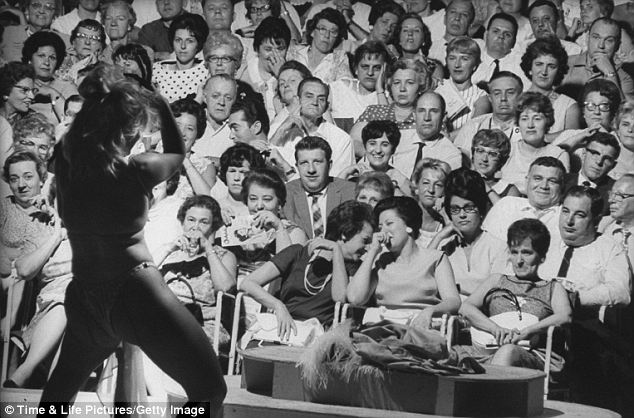
In the picture of Dee Light, you can see women snickering together and women looking intently at the performer. You also see a well-balanced mix of women and men in the audience. You can see what looks like couples in the theatre together, as well as, see big groups of women. Once women began to feel more comfortable attending the theaters. Women began to attend in big groups and without any male escorts. The women all seem to be enjoying themselves and no one seems upset, mad, etc.
The Donna Mae Brown photo is an example of an all male audience. This would be an example of a theater that mostly males attend. You can see that Dee Lite and Donna Mae Brown are seemingly doing similar movements even though their audiences are made up of different people. This shows that the performers are mostly focused on their male audiences and tend to perform to this male type of audience no matter the actual make up of the audience itself.
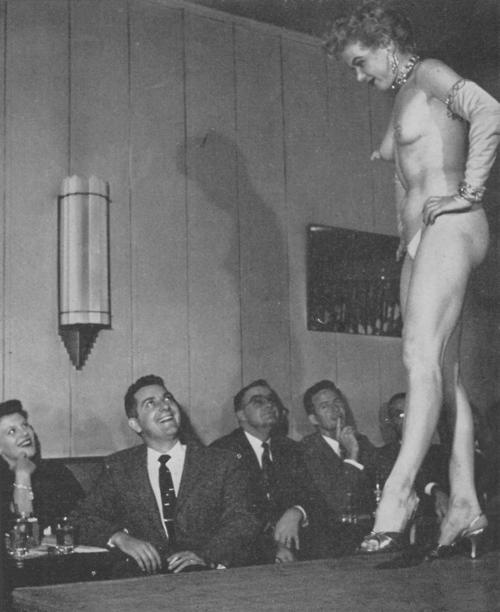
Helena Gardner is shown in the next photo. You can see her looking down on a smiling couple. Both members of the couple look to be enjoying themselves and seem to be connecting to the performer. Couples often attended shows together. Women were often curious about what their husbands found so interesting about burlesque and the theater. It was a form of entertainment that couples were able to enjoy together.
Works Cited:Vogt, Julie N. Woman to Woman: Ann Corio and The Rehabilitation of American Burlesque. Diss. University of Wisconsin, Madison. 2010. ProQuest. Web. 2 Dec. 2015.
Coe, R. L. “Ann, burlesque---stripped for action.” Los Angeles Times (1923-Current File) 19 Dec. 1967. ProQuest. Web. 2 Dec. 2015.
“2D BURLESQUE SHOW IN DOWNTOWN BOW.” New York Times (1923-Current File) 12 Dec. 1963. ProQuest. Web. 2 Dec. 2015.