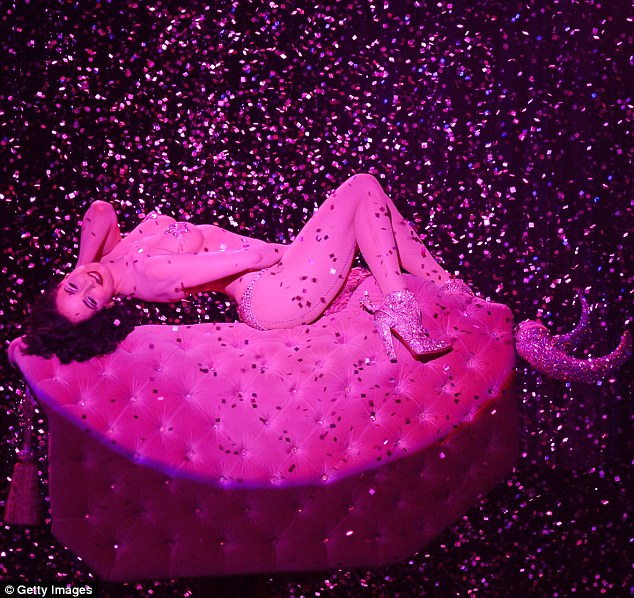
Dita Von Teese Riding a Pink Plush Mechanical Bull
1 2015-12-07T06:55:18-08:00 Maddie Leonard-Rose 7795fc6919b777a978ec7bda4587e47146d4272e 5977 2 plain 2015-12-07T06:55:53-08:00 © Getty Images Maddie Leonard-Rose 7795fc6919b777a978ec7bda4587e47146d4272eThis page is referenced by:
-
1
media/theater2-570.jpg
2015-11-23T01:55:03-08:00
Unruly Women
18
Maddie 3
plain
2015-12-08T20:32:19-08:00
For someone to become a burlesque dancer as a career choice or even a hobby, might lead their family and friends to question that decision because of the stereotypes that Burlesque connotes. Someone uneducated about the subject may equate burlesque with prostitution—and thus regard it as dangerously low. The way that we think about burlesque is closely associated with unruliness: that is, excessive sexual display. This has something to do with the category of “unruly women.” Kathleen Rowe points out that this label dates back to medieval mystery plays (23). In her book “Unruly Women: Gender and the Genres of Laughter,” Rowe complies a list of the eight characteristics she identifies as markers of unruly women.
1) she dominates or tries to dominate men,
2) her body is excessive or fat suggesting a lack of control of her appetite,
3) her speech is excessive,
4) she makes jokes or laughs herself,
5) she may present androgynously and call attention to the social construction of gender,
6) she may be old,
7) her behavior is associated with looseness and whorishness,
8) she is associated with dirt, liminality and taboo.
Almost all of these criteria have some representation in burlesque performance and burlesque culture, and so I think it is important to allow these categories to help us understand how burlesque is performed and the reception of that performance.
Burlesque performers use their unruliness in their performance. Lydia Thompson and her Blondes used their voices in excess as they sang and told jokes. Thompson and her troupe also used masculine costuming which called attention to the social construction of gender. Rose La Rose was famous for engaging with her audience using her voice as well as her dancing body. Gypsy Rose Lee used puns as a part of her stripping act in the 1943 film Stage Door Canteen. Performers transfixed audiences by using their bodies as well as their voices in excess. These displays of unruliness lead to the categorization of burlesque as a liminal form, something that can not be pinned down. It was neither strictly dancing, strictly comedy or strictly stripping--burlesque was a hybrid of the most transgressive nature.
The nature of burlesque as a sexualized performance art caters to the voyeuristic gaze of a male audience, but the performer is not necessarily at the mercy of that gaze. Women performers can be seen as objects on the stage, placed just so, so as to make the consumption of their image most pleasing. Or they can be seen as having agency and subjectivity, depending on how ‘unruly’ they are being. Linda Mizejewski explains, “Because the unruly woman is impervious to patriarchal claims on her, she is ultimately the ‘prototype of woman as subject—above all when she lays claim to her own desire’ (31)” (23). Before the advent of burlesque in America, the desirous performer did not exist on mainstream stages. With the arrival of Lydia Thompson, in all her unruliness, burlesque performers gained a distinct advantage of subjectivity by using unruly behavior to maintain a degree of power over the men who watched their shows. Neo-burlesque stars, such as Dita Von Teese, have carried the desirous performer and her unruly connotations into their contemporary acts. Von Teese showcases the performer as subject by embracing the agency of pleasuring her own body, even if that pleasure is performed.
Works Cited:Rowe, Kathleen. The Unruly Woman: Gender and the Genres of Laughter. Austin, Tex: University of Texas Press, 1995. Print.
Mizejewski, Linda. Pretty/funny: Women Comedians and Body Politics. Austin: University of Texas Press, 2014. Print.