Thanks for your patience during our recent outage at scalar.usc.edu. While Scalar content is loading normally now, saving is still slow, and Scalar's 'additional metadata' features have been disabled, which may interfere with features like timelines and maps that depend on metadata. This also means that saving a page or media item will remove its additional metadata. If this occurs, you can use the 'All versions' link at the bottom of the page to restore the earlier version. We are continuing to troubleshoot, and will provide further updates as needed. Note that this only affects Scalar projects at scalar.usc.edu, and not those hosted elsewhere.
Female Leaders: Elizabeth I and Boudicca Versus Victoria
12019-02-25T22:07:11-08:00Josie Cotton85e536e9436ca7acf1cc79640b3de84b2753ceeb3147417plain2019-03-22T19:30:04-07:00Josie Cotton85e536e9436ca7acf1cc79640b3de84b2753ceebResources and AcknowledgmentsWhy were British women allowed to act like Victorian gentlemen, but Australian women couldn’t act like bushmen? One possible answer has nothing to do with the Second World War, but with a much longer history. While British history has a long tradition of celebrating strong female leaders, Australian history does not. Actually, the only prominent female leader in Australian history, Queen Victoria, upheld traditional gender roles, emphasizing her role as a wife and mother rather than a queen.
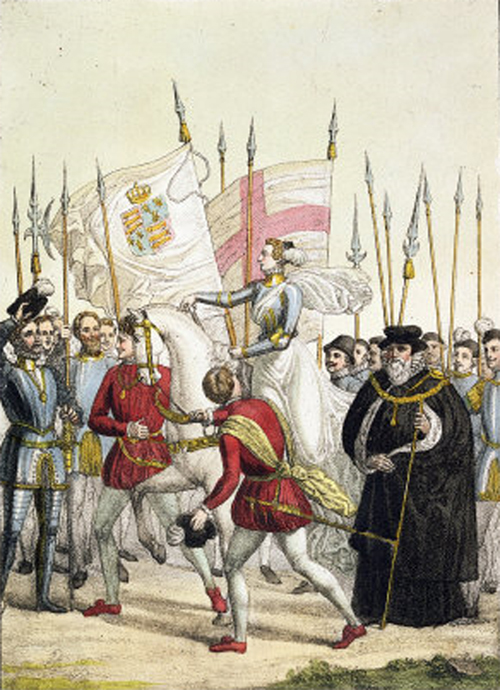
Though Victoria also ruled Britain, Britain had additional female leaders in its history, like Boudicca and Queen Elizabeth I. Boudicca, queen of the Iceni tribe, led an uprising against Roman rule in Britain in the first century AD. Though ultimately her rebellion was unsuccessful, she remains a heroine in British popular imagination. Elizabeth I ruled Britain during its “golden age” of art and culture and defeated the Spanish Armada in 1588. Unlike Victoria, Boudicca and Elizabeth were wartime leaders, and both downplayed their femininity and acted more masculine—Boudicca by wearing armor and leading an army and Elizabeth by proclaiming to her troops that she had “the heart and stomach of a king.” How could a comparison of Boudicca and Elizabeth I with Victoria help to explain both the presence of strong women in British propaganda films and the absence of them in Australian?
Though Australian women war workers had no comparable figure to inspire them, British women were marching alongside Boudicca and Elizabeth, while their American counterparts were riveting with Rosie.
This page has paths:
12019-02-13T21:17:24-08:00Josie Cotton85e536e9436ca7acf1cc79640b3de84b2753ceebNational Identity in Britain and AustraliaJosie Cotton6splash8416402019-02-25T22:07:50-08:00Josie Cotton85e536e9436ca7acf1cc79640b3de84b2753ceeb