This tag was created by Zoë Wilkinson Saldaña. The last update was by Isabella Buzynski.
Café Fanconi
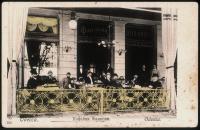
The Swiss-owned Café Fanconi was opened in 1872. Oleg Gubar and Alexander Rozenboim wrote in their survey called “Daily Life in Odessa” that Café Fanconi “existed from 1872 . . . until the last owner immigrated. At first, the café was a hangout for card sharks and shady businessmen, but gradually it became a kind of club for local and visiting writers, artists, actors, and athletes.”
In 1891, the great Yiddish writer, Sholem Aleichem—then just beginning his literary career—moved from Kiev to Odessa. He conveyed his experience in the city and its cafés in The Letters of Menakhem-Mendl and Sheyne-Sheyndl. Menakhem-Mendl is a provincial Jew from a tiny fictional shtetl called Kasrilevke, Like Sholem Aleichem, Menakhem was not only attracted to the elusive economic opportunity in Odessa but also to its cafés — particularly Café Fanconi. He is enticed by Café Fanconi a space of business where “business is done on a man’s word alone” and “a nod is as good as a signature.”
Sholem Aleichem captures the contradiction of urban Jewish modernity as exemplified by the Odessa café. The café is an accessible thirdspace open to anyone, even Menakhem, to participate in conversations about politics, culture, and business all while being served ice cream and coffee by waiters in frock coats. But this is a precarious privilege, and if you lack the money to buy a few servings you are kicked out onto the street, in danger of being picked up by a police officer looking to arrest any Jew who might interfere with the life and business of the café.“By now they know me in every brokerage. I take my seat in Fanconi with all the dealers, pull up a chair at a marble table, and ask for a dish of iced cream. That’s our Odessa custom: you sit yourself down and a waiter in a frock coat asks you to ask for iced cream. Well, you can’t be a piker—and when you’re finished, you’re asked to ask for more. If you don’t, you’re out a table and in the street. That’s no place for dealing, especially when there’s an officer on the corner looking for loiterers. Not that our Jews don’t hang out there anyway. They tease him with their wisecracks and scatter to see what he’ll do. Just let him nab one! He latches on to him like a gemstone and it’s off to the cooler with one more Jew.”
Women gradually became a presence in Odessa cafés, testing the apparent elasticity of the social hierarchy in the male-dominated sphere of the café, and eliciting much male anxiety. In Eliezer Steinman's novel Esther Ḥayot (1922), a poor Jewish migrant from a small town in the Pale of Settlement named Esther is brought to Café Fanconi where “all the smiles, politeness and gentility were, of course, a matter of transaction, and yet the sham was not too jarring to her heart,” for “in the café the deceit was elevated here to the level of truth.” Later in the novel, Esther and her sister, Hanna, imagine how the fluidity of social order in Fanconi might allow them to momentarily suspend their usual gender identities. They imagine going to the café together as a couple of female flâneuses:
Though the café is essentially“Let’s walk around Deribasovskaya Blvd. without any men; leave them alone. Later we’ll walk to Café Fanconi and catch a table. I will smoke a cigarette . . . and invite ‘the dame of my heart,’ feed her with pastry and chocolate . . . just like a man.”
This page has paths:
- Odessa Cafés Isabella Buzynski