Thanks for your patience during our recent outage at scalar.usc.edu. While Scalar content is loading normally now, saving is still slow, and Scalar's 'additional metadata' features have been disabled, which may interfere with features like timelines and maps that depend on metadata. This also means that saving a page or media item will remove its additional metadata. If this occurs, you can use the 'All versions' link at the bottom of the page to restore the earlier version. We are continuing to troubleshoot, and will provide further updates as needed. Note that this only affects Scalar projects at scalar.usc.edu, and not those hosted elsewhere.
Multispectral Thermal Imager ProjectMain MenuMultispectral Thermal ImagerLA-UR-17-26585Data Processing and AnalysisApplicationsDifferent uses for the data collected by the MTISignificant EventsUnexpected events effecting the functioning of the MTI SatelliteGround Truth MeasurementsMTI Cloud ImagesAtmospheric interference and cloud mask algorithmsCreditsMadeline Whitacreff6e9d0020839762e90346899bb13cc3647ebcbd
Project Overview
1media/Flow Chart EEM.PNG2017-06-26T14:59:02-07:00Madeline Whitacreff6e9d0020839762e90346899bb13cc3647ebcbd1970236MTI Overviewplain2017-07-31T06:38:03-07:00Madeline Whitacreff6e9d0020839762e90346899bb13cc3647ebcbdThe Multispectral Thermal Imager (MTI) is a joint project with Los Alamos National Laboratory, Sandia National Laboratories, and Savannah River Technology Center, and was sponsored by the United States Department of Energy Office of Nonproliferation Technology Development. The MTI satellite was launched on March 12, 2000.
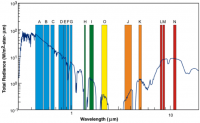
The purpose of this project was to support the nonproliferation of nuclear weapons and other weapons of mass destruction, to enable environmental characterization, and to examine the use of advanced multispectral and thermal imaging technologies from space. In order to achieve this, the satellite uses multiple spectral bands in the visible range, near infrared, shortwave infrared, midwave infrared, and longwave infrared ranges. The imager has a total of 15 spectral bands spanning these ranges.
The MTI was created as part of the legacy of the Landsat program, following the EO-1, Terra, SPOT, IKONOS, QuickBird, and EarlyBird satellites, among others. Proof of principle was a large part of the reason that the MTI program was initiated. This was new and developing technology which could be used to monitor for proliferant activities from space.
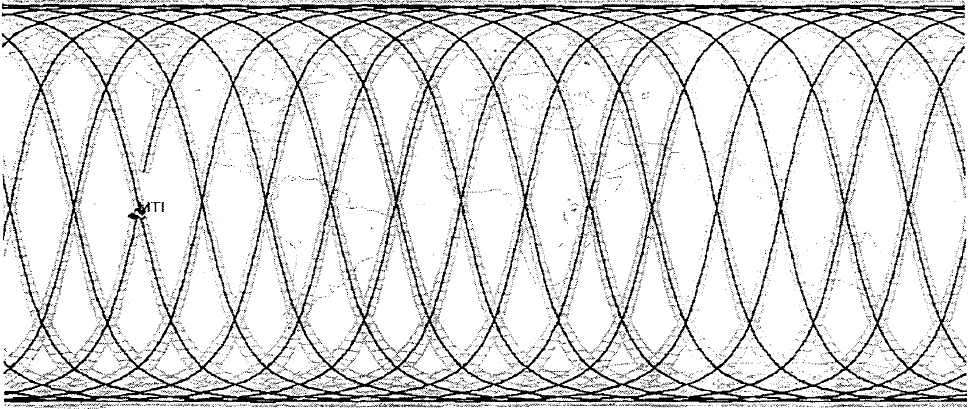
The MTI satellite will be in a circular, sun synchronous orbit, initially injected at 575 kilometers. Ascending equatorial crossings will occur at 1:00 PM spacecraft local time, descending crossings at 1:00 AM. This provides for the collection of both daytime and nighttime imagery. Figure 1 shows a typical ground track for one day. A site is considered to be available for imaging if it is up to +/- 20 degrees off nadir in the cross-track direction (approximately +/- 200 kilometers on the ground). The satellite ground track precesses each day, allowing a given sight to be available for imaging every seven days, on average. The satellite has no propulsion system so the orbit will decay as the mission progresses, and the orbit plane will drift about one hour over three years.
1media/Illustration.PNG2017-07-11T07:30:37-07:00Madeline Whitacreff6e9d0020839762e90346899bb13cc3647ebcbdData Processing and Analysis9plain2017-07-24T07:04:27-07:00Madeline Whitacreff6e9d0020839762e90346899bb13cc3647ebcbd
1media/LA Ski Hill.PNG2017-06-27T10:38:56-07:00Madeline Whitacreff6e9d0020839762e90346899bb13cc3647ebcbdApplications8Different uses for the data collected by the MTIplain2017-07-24T07:05:07-07:00Madeline Whitacreff6e9d0020839762e90346899bb13cc3647ebcbd
1media/Focal Plane Assembly.PNG2017-06-26T15:50:28-07:00Madeline Whitacreff6e9d0020839762e90346899bb13cc3647ebcbdSignificant Events18Unexpected events effecting the functioning of the MTI Satelliteplain2017-07-24T07:16:20-07:00Madeline Whitacreff6e9d0020839762e90346899bb13cc3647ebcbd
1media/Thermal Images Squaw Creek Reservoir.PNG2017-06-26T15:14:41-07:00Madeline Whitacreff6e9d0020839762e90346899bb13cc3647ebcbdGround Truth Measurements14plain2017-07-25T06:34:24-07:00Madeline Whitacreff6e9d0020839762e90346899bb13cc3647ebcbd
12020-02-11T04:54:25-08:00Sam Harveyd4c88ee35b1c49f1c9a8610709e97b4711dab3feSam HarveySam Harvey1plain2020-02-11T04:54:25-08:00Great Work I'm Also Looking forward to start my new architecture projectSam Harveyd4c88ee35b1c49f1c9a8610709e97b4711dab3fe
This page references:
12017-07-11T07:06:39-07:00Spectral Bands Graph2The figure depicts the spectral bands of the MTI. A solar spectrum and thermal emission spectrum are superimposed on the graph as well.media/Spectral Bands Graph.PNGplain2017-07-11T08:25:15-07:00
12017-07-11T06:33:58-07:00Figure 11Typical one day ground track, +/- 200 kilometers, for MTI’s orbit.media/Orbit SAN99.PNGplain2017-07-11T06:33:58-07:00